


"one of the most thorough, extensive and profound photograph works of all time”
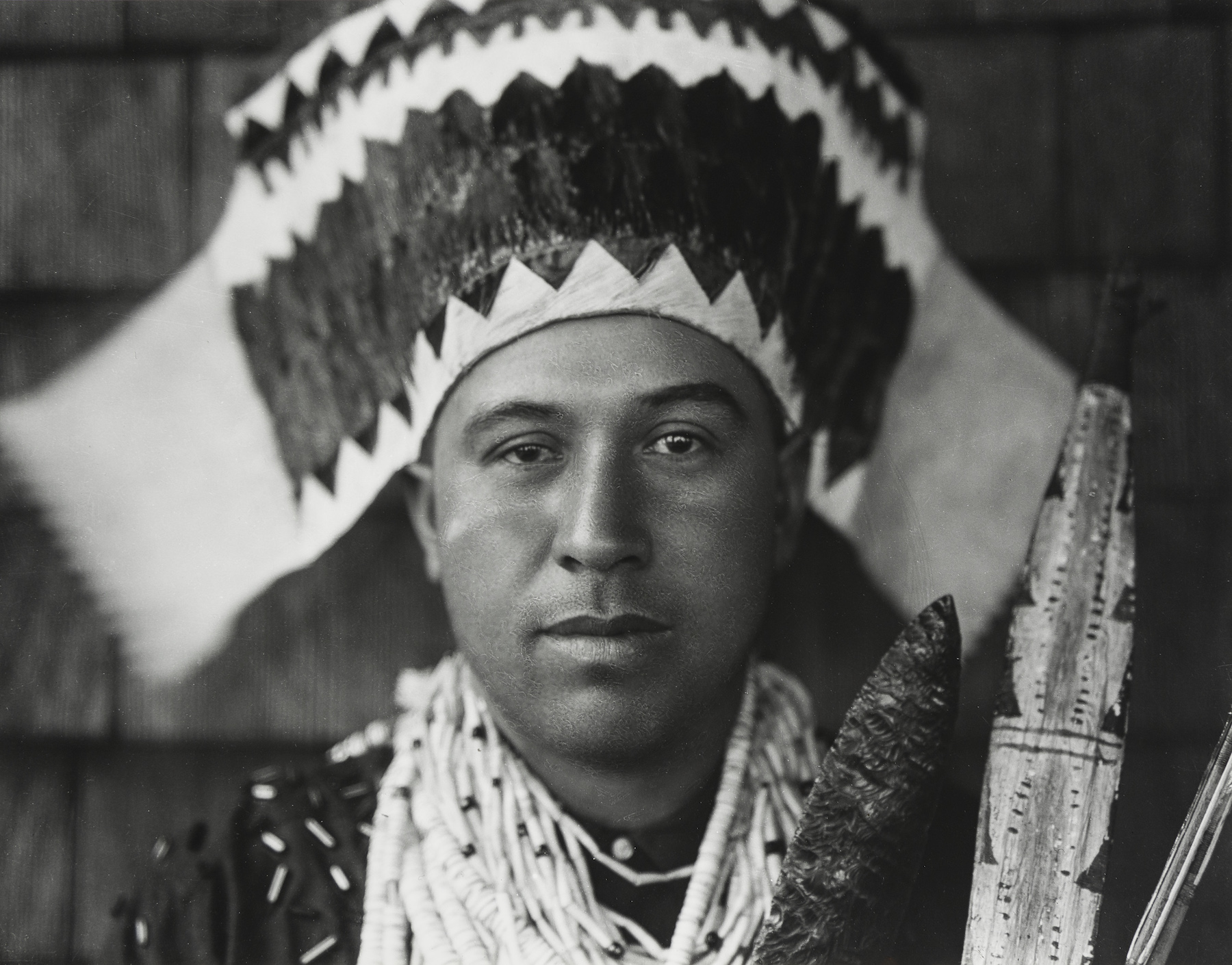
CURTIS, EDWARD S.. Original glass plate interpositive prepared by Curtis for the printing of The North American Indian [portrait of Sam Lopez]
Curtis, 1924
This striking image, titled Tolowa Dancing Headdress (plate 455), was published as a photogravure in The North American Indian, vol. 13, 1924. Approx. 14 x 17 inches. Accompanied by a custom archival wall-mount back lit light box. Excellent condition. A stunning display piece.
This portrait of Tolowa leader Sam Lopez is a splendid original glass plate made for Edward Curtis’s The North American Indian, the greatest photographic work on Native Americans. Curtis was the most celebrated photographer of North American Indians. Over the course of thirty-five years, he took tens of thousands of photographs of Indians from more than eighty tribes. “Never before have we seen the Indians of North America so close to the origins of their humanity, their sense of themselves in the world, their innate dignity and self-possession” (N. Scott Momaday). Curtis’s photographs are “an absolutely unmatched masterpiece of visual anthropology, and one of the most thorough, extensive and profound photograph works of all time” (A. D. Coleman).
This is the original glass interpositive for plate 455, published in 1924 as Tolowa Dancing Headdress in the thirteenth volume of The North American Indian. The title names the regalia and, as Curtis often did across the work, passes over the sitter, whom the record nonetheless preserves: the Library of Congress, holder of Curtis’s copyright deposits, identifies him as Sam Lopez (1886-1977). His Tolowa name was hi-lash, meaning “willow,” which had been his grandfather’s before him, a wealthy headman of Howonquet at the mouth of the Smith River. The name marked him as heir to a line of chiefs, one the Tolowa Nation’s later petition for federal acknowledgment would trace, unbroken, from Guylish in the nineteenth century down to Lopez himself.
Lopez sat for Curtis when he was about age thirty-seven, already a head of one of the prominent Tolowa families and near the start of a public life that would run for half a century. In time it took institutional form: he founded the Del Norte Indian Welfare Association and served as its first president, and he was among the founders of the Federated Indians of California, a statewide advocacy body. He was, in the anthropologist James Collins’s phrase, “a major figure in twentieth-century Tolowa affairs,” a man who came to carry the law and the protocols of the ceremonies and, serving as their moderator, to speak on the community’s behalf. When he died, that office passed to Loren Bommelyn, the linguist and ceremonial leader who remains the foremost authority on the Tolowa language.
The regalia he wears records rank, as Curtis’s own description of the plate makes clear: “The head-dress is of the type common to the Klamath River tribes – a broad band of deerskin partially covered with a row of red scalps of woodpecker. The massive necklace of clam-shell beads indicates the wealth of the wearer, or of the friend from whom he borrowed it. He carries a ceremonial celt of black obsidian and a decorated bow.” Each of these objects held value within the prestige economy that the Tolowa shared with their Yurok, Karok and Hupa neighbors, in which strings of dentalium and clamshell served both as money and as a visible record of a family’s standing. The red woodpecker crests were a currency in their own right, a single scalp valued at roughly two dollars or more in the early accounts, and were sewn onto the regalia worn for the world-renewal dances; blades of worked obsidian, too big and too finely made for any practical use, were kept by wealthy men as treasures and displayed in ceremony. Curtis’s caption allows that the wealth on show might have been the wearer’s or a friend’s; in Lopez’s case the likelier answer is his own. His father and grandfather had run the obsidian trade inland to Bend, Oregon. When Richard Gould wrote the standard study of the Tolowa “wealth quest” in the 1960s, Lopez, by then seventy-nine, was among his informants, and the dentalia and carved elkhorn purse that illustrate the study were Lopez’s own.
The portrait’s significance is bound up with the history of the people it depicts, brought close to destruction in the decades before Curtis reached the coast. From 1851, under California’s first governor, roughly four in five Tolowa were killed within a few years; at Yontocket, the people’s place of origin at the mouth of the Smith River, a militia fell on a Nee-dash, the Tolowa world-renewal ceremony, and burned the plank dancehouse with the celebrants inside, in what the historian Benjamin Madley ranks among the deadliest massacres in American history. The survivors were removed to distant reservations, and by 1921 a federal circular had barred the dance from public performance.
Curtis, making this portrait some two years later, thus recorded the regalia of a rite the government had lately outlawed. The ban drove the ceremony out of public view without ending it, and through the years of suppression Lopez was among those who kept it alive, singing and leading the dances, among them a ten-day dance at Smith River in 1932.
Curtis’s lifelong project was inspired by his reflection that “The passing of every old man or woman means the passage of some tradition, some knowledge of sacred rite possessed by no other; consequently, the information that is to be gathered, for the benefit of future generations, respecting the modes of life of one of the greatest races of mankind, must be collected at once or the opportunity will be lost for all time.” The later history of the Tolowa disproved that premise, for the people persisted, and continue today as two federally recognized nations in their homeland, the Nee-dash danced openly again since the 1960s and the language carried by Bommelyn’s generation from speech into writing.
Sam Lopez lived to help bring about that return. A Christian who had long kept his own church near Howonquet, he concluded late in life that the old Tolowa had known God too, and set about reviving the dances and teaching the younger men to sing, his life spanning the ceremony’s suppression and its return. Because the people did not disappear, the image now means something Curtis never intended. For a living community it is the likeness of an identified ancestor, the kind of image that museums and Native nations have lately worked to return to the descendants who claim them.
The work in which this portrait appeared is itself among the monuments of photography. Curtis selected 723 of his photographs to be printed as large format photogravures in his magisterial The North American Indian, “the most gigantic undertaking in the making of books since the King James Bible” (New York Herald). Another 1505 small format images illustrated the text. The prints were created through an exacting process to transfer the images from unique glass negatives to interpositive glass plates and then to metal printing plates for the photogravures. As in all printing processes, each step in reproduction results in a loss of detail and clarity. Thus the original Curtis interpositive glass plate produced for each of the photogravures retains a uniquely sharp image far exceeding the photogravure in detail. Its clarity is magnified by the dramatic impact of backlighting which creates a virtual third dimension in the plate.
This is an exceptional opportunity to acquire an example of one of the greatest monuments of photography in one of its rarest and most important forms.
References
Richard A. Gould, “The Wealth Quest among the Tolowa Indians of Northwestern California,” Proceedings of the American Philosophical Society 110, no. 1 (Feb. 18, 1966): 67-89; Richard E. Hughes, “Aspects of Prehistoric Wiyot Exchange and Social Ranking” The Journal of California Anthropology 5, no. 1 (1978): 53-66; James Collins, Understanding Tolowa Histories: Western Hegemonies and Native American Responses (Routledge, 1998); Benjamin Madley, An American Genocide: The United States and the California Indian Catastrophe, 1846-1873 (Yale University Press, 2016); Allogan Slagle, “Tolowa Indian Shakers: The Role of Prophecy at Smith River, California” in American Indian Medicine Ways: Spiritual Power, Prophets, and Healing, ed. Clifford E. Trafzer (University of Arizona Press, 2017).
$35,000