


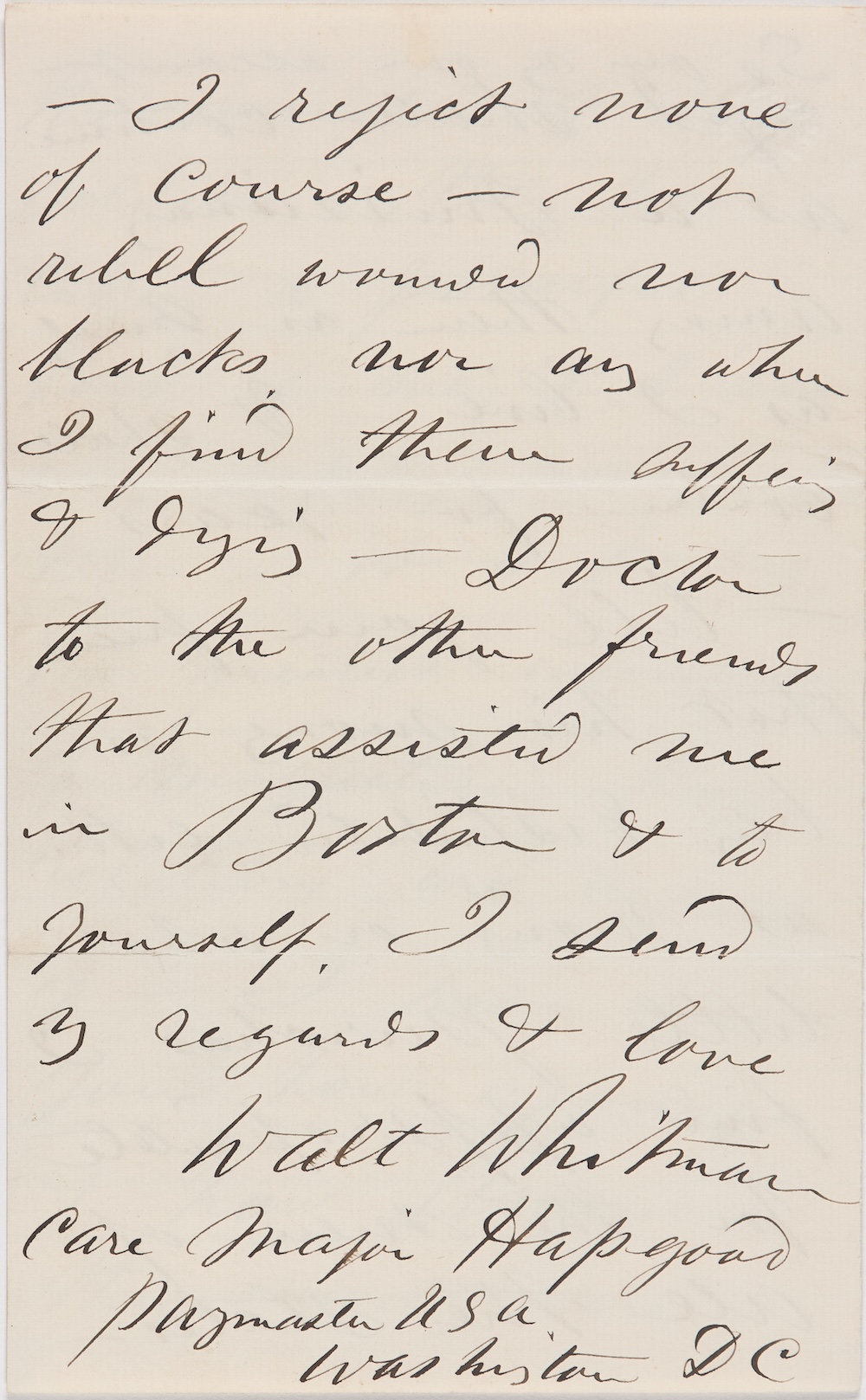
Whitman cares for the soldiers “I reject none of course—not rebel wounded nor blacks nor any when I find them suffering & dying”
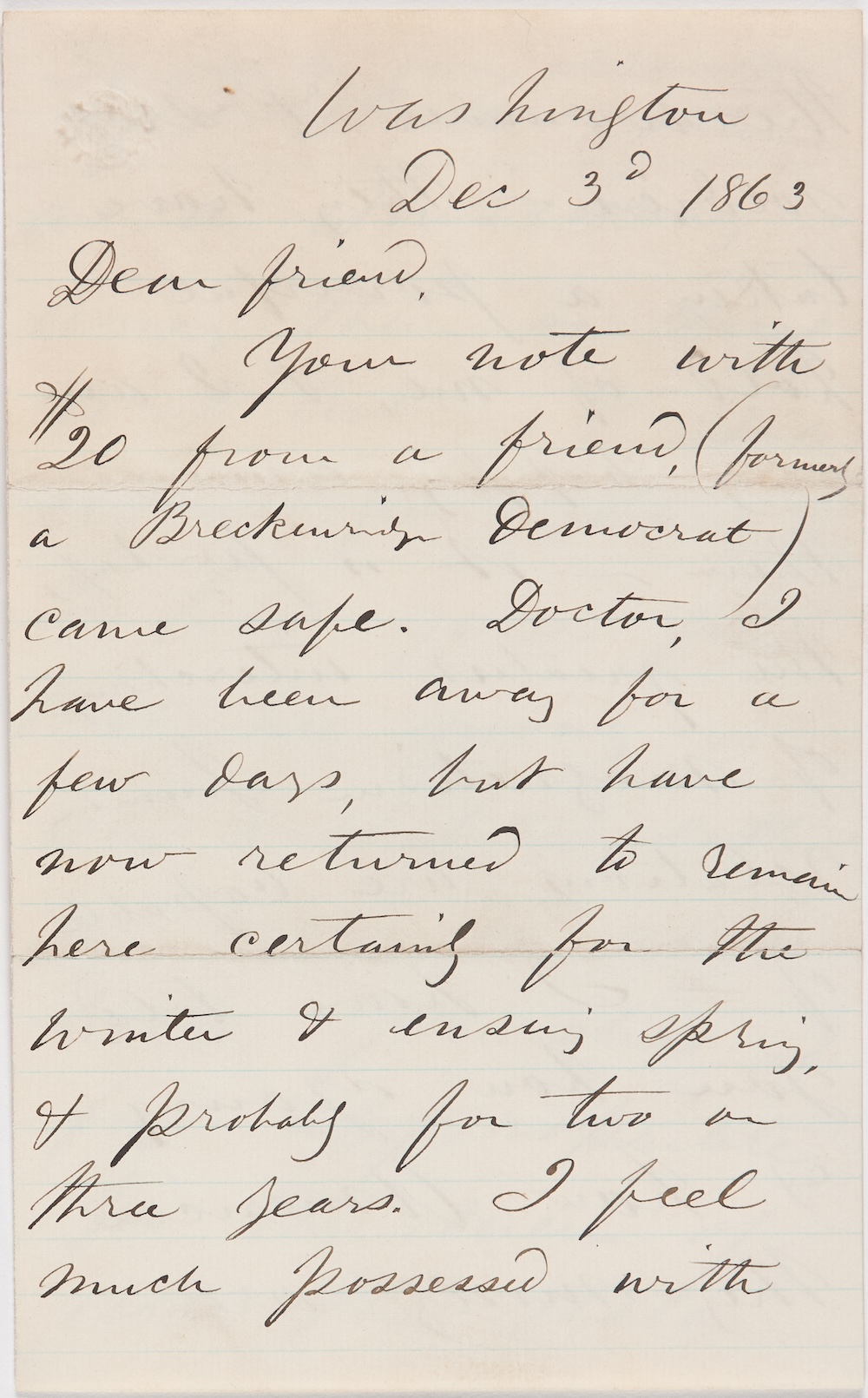
WHITMAN, WALT. Autograph letter signed to Dr. Le Baron Russell
Washington, December 3, 1863
4 pages. With the original postal cover addressed in Whitman’s hand. Original folds. Fine condition.
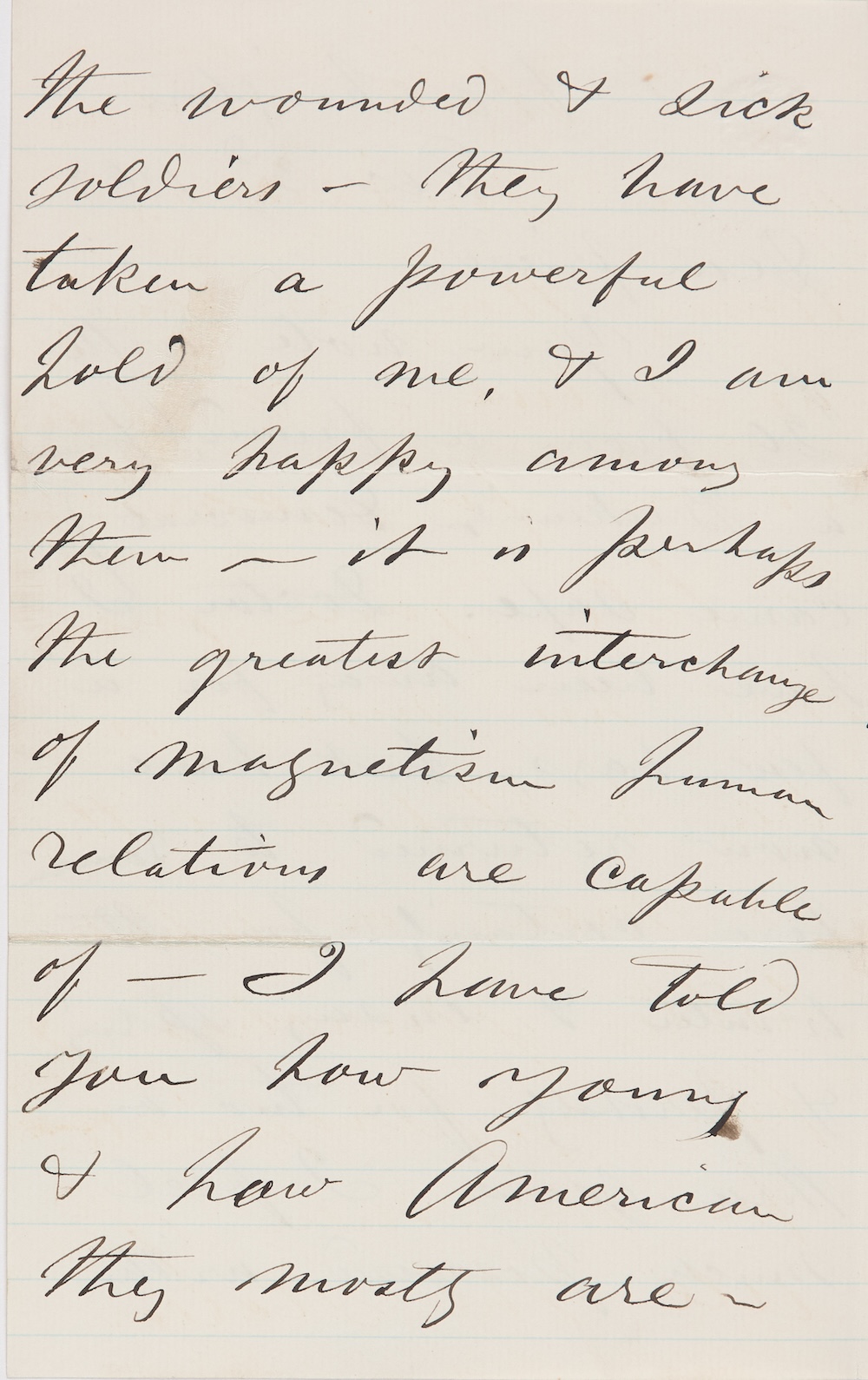
In this deeply moving letter Walt Whitman discusses his experiences caring for wounded soldiers at the height of the Civil War. The letter reflects Whitman’s generosity of spirit, his veneration of democracy and Americanism, and the profound impact of the war on him. Whitman begins:
“I feel much possessed with the wounded & sick soldiers – they have taken a powerful hold of me, & I am very happy among them – it is perhaps the greatest interchange of magnetism human relations are capable of”
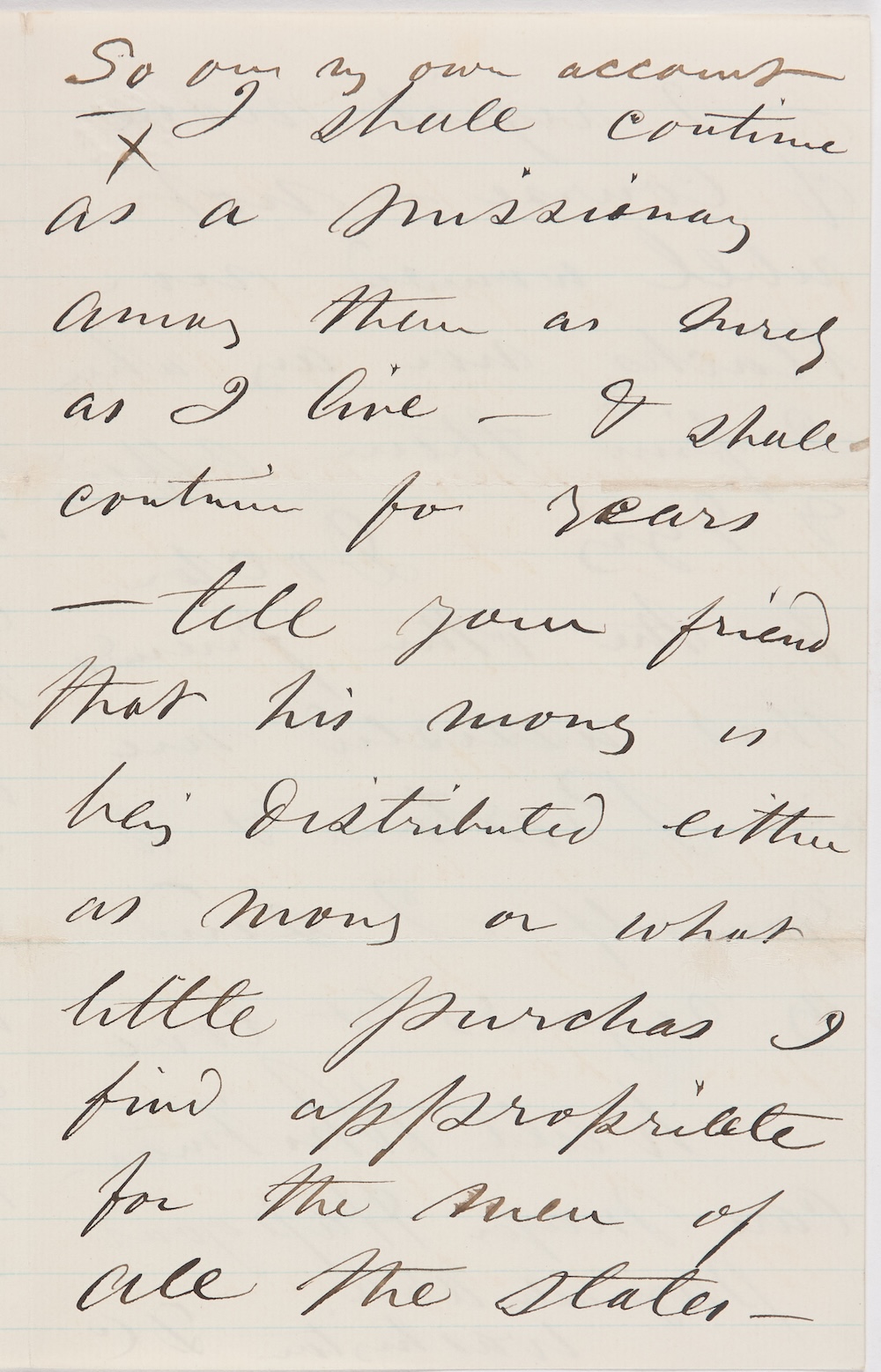
He goes on: “I have told you how young & how American they mostly are—so on my own account I shall continue as a missionary among them as surely as I live—and shall continue for years.”
He thanks Russell for his donation of $20 which he shall distribute for “what little purchases I find appropriate for the men of all the states—I reject none of course—not rebel wounded nor blacks nor any when I find them suffering & dying.” For Whitman they are all Americans, Union man and rebel, white and black.
After coming to Washington in January 1863, Whitman made hundreds of visits to the military hospitals, seeing nearly 100,000 wounded, comforting them, talking with and reading to them, and writing their letters. “His hospital visits accomplished key things he had hoped his poetry would do. They validated his vision of the common man; they answered his need for an ideal family and for loving comrades; and they permitted full indulgence to his humanistic, magnetic medical ideas” (Reynolds, Walt Whitman’s America).
Russell (1814-1889) was a Boston abolitionist and friend of Thomas Carlyle and Ralph Waldo Emerson. Russell made a number of contributions to aid Whitman’s effort to give comfort to the wounded soldiers he cared for in Washington. The poet noted soldiers’ requests in his pocket notebooks and spent countless hours fulfilling them, relying on donors like Russell for funds. In his essay on the military hospitals of Washington, Whitman referred to these gifts, recalling for example the case of a young man who wanted money to buy fresh milk as it came through the ward. The soldier later told Whitman that his compassionate words and small gifts had saved his life.
This is the finest Whitman letter we have ever handled in four decades as the leading dealer of Whitman manuscripts.
$80,000