


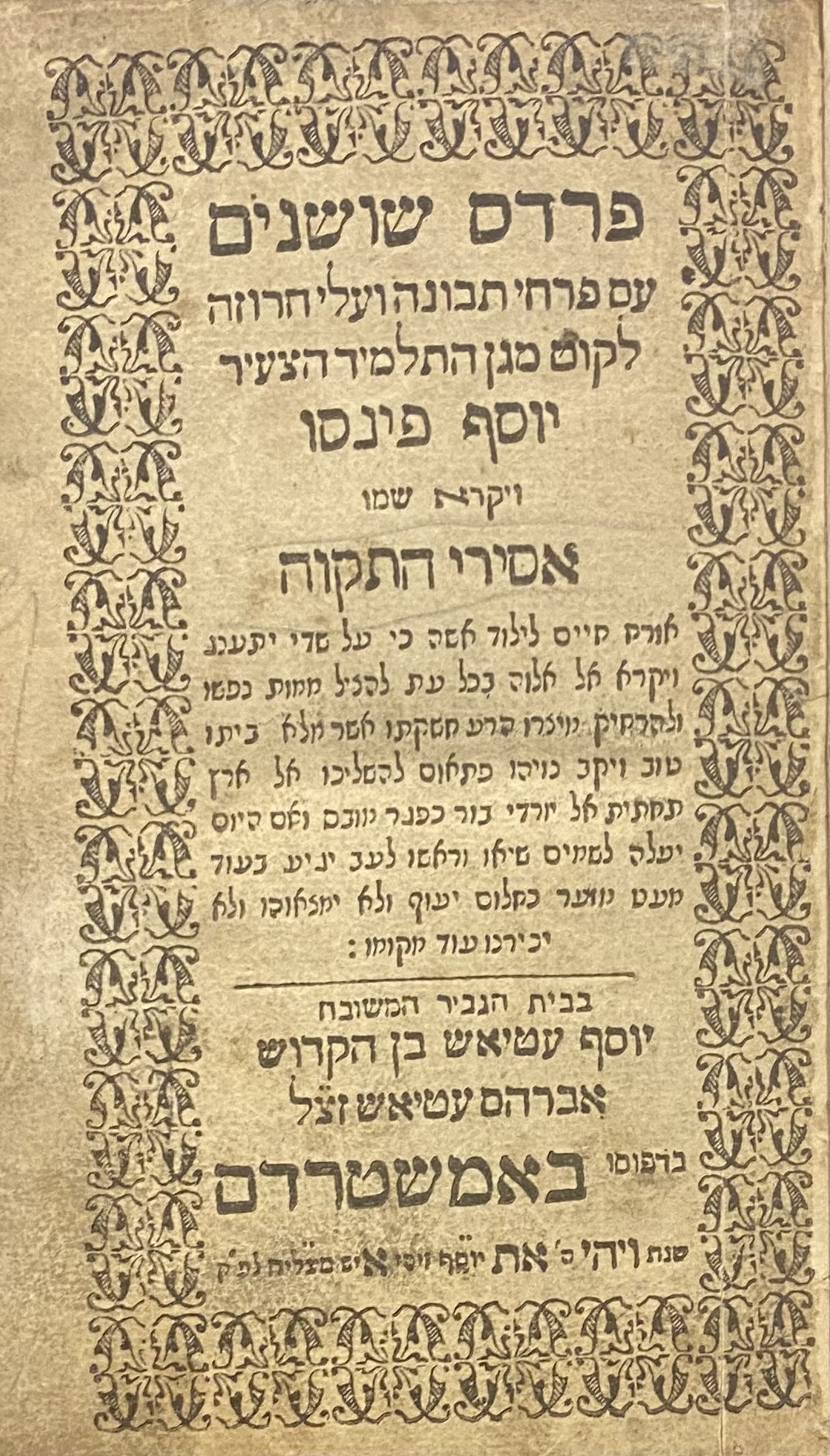
first printed Jewish play
Penso de la Vega, Joseph. Pardes Shoshanim … Asirei ha-Tikvah (Garden of Roses … Prisoners of Hope)
Amsterdam: Joseph Athias, 1673
ff. [20], 54. Half calf and marbled boards. Tiny owner’s stamp of Avraham Meir Habermann, leading scholar of medieval Hebrew literature and longtime director of the Schocken Library. Several leaves slightly short; some restoration. Soiling and occasional stains.
First edition of Asirei ha-Tikvah which, apart from Purim Spiels, was “the first Hebrew-language drama to be printed” (Davidi).
Joseph Penso de la Vega (1650–1692) was a distinguished writer and merchant in Amsterdam. He is often known as Joseph de la Vega. His father Isaac had fled the Spanish Inquisition and settled in Amsterdam where was became an openly practicing pious Jew. A poet of considerable talent, Joseph was a member of the Academia de los Floridos, where Jewish Sephardic poets from Amsterdam would meet to recite both Spanish and Hebrew verses and stage Spanish plays.
Penso de la Vega’s Hebrew drama in three acts, Asirei ha-Tikvah (Prisoners of Hope), is an allegorical depiction of Jewish ethics and the victory of the will over the passions. It was “more reminiscent of a medieval Christian mystery play than of a fashionable French drama, but nonetheless, it was the first Hebrew play to portray true drama” (Gans, Memorbook). “In Prisoners of Hope, the representative of evil is indeed Satan and he is accompanied and assisted by Desire, Pleasure, and Woman, while the representative of good is Reason (Sekhel), assisted by Providence, Truth, and an Angel. The prologue of the play connects Reason with a man of the community’s older generation, while Satan is associated with a young man. But in this introduction Satan is also associated with Christianity, so implicitly Reason is also associated with Judaism” (Davidi).
This first edition appeared in 1673; a second edition was printed in Livorno of 1770. “This is the first dramatic Hebrew play ever printed: the dramatic genre hardly existed in the Jewish world prior to the seventeenth century. This dramatic work was praised and glorified by the community’s prominent leaders and rabbis, and its poets. The rich and extended paratext [published in this volume] is a testimony to this admiration. In this oeuvre, the young writer demonstrates his phenomenal knowledge of the Hebrew language and Hebrew sources. Moreover, this work is also a didactic book with moral lessons aimed at the young generation. Thus, it appears that the eloquent Penso de la Vega paved his way to a career as a preacher and perhaps to a rabbinical career. But life took a different course” as he turned to business (Davidi). Penso de la Vega is today best known for his Spanish treatise on the workings of the stock exchange, Confusion de Confusiones (1688) the first work on stock markets.
Rare: WorldCat locates only four copies in America: Penn, Yale, Hebrew Union College, and Newberry.
This rare volume is a landmark in the history of Jewish culture and its flowering in Amsterdam in the wake of the Inquisition.
$6,500