


The Financial District: Wall Street and Lower Broadway
Various artists. Collection of 8 photographs of the New York City Financial District
New York, 1880s-1890s
8 albumen and gelatin silver prints, various sizes (3 ½ x 3 in. – 14 x 11 in.). Very good condition over all.
This collection of 8 photographs show New York City’s Financial District, including Wall Street and Lower Broadway.
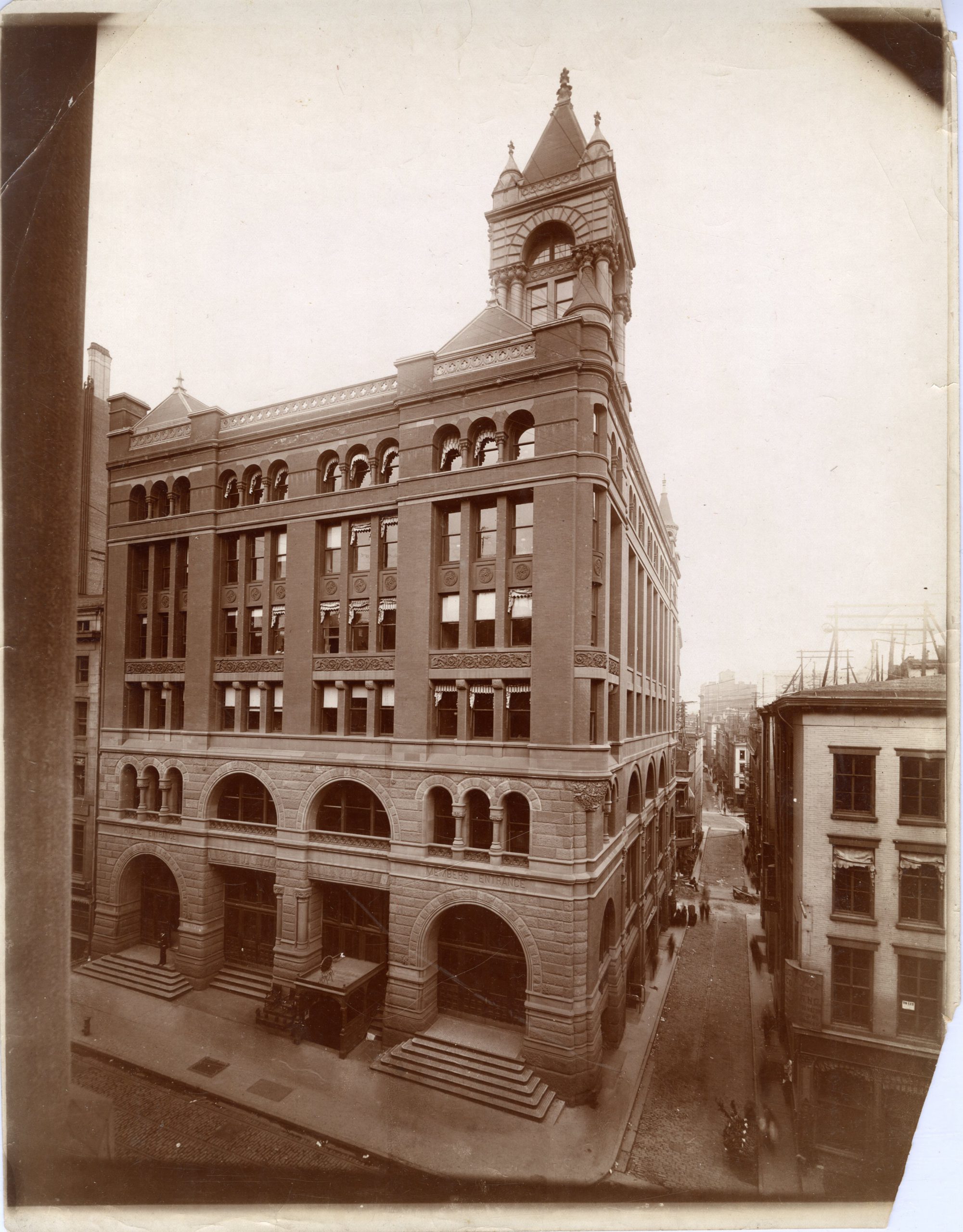
Unidentified photographer. Consolidated Stock and Petroleum Exchange, 60 Broadway, c. 1890s.
The Consolidated Stock and Petroleum Exchange occupied 60 Broadway at the northeast corner of Exchange Place. Designed by Edward D. Lindsey in a Romanesque Revival mode and completed in 1888, it operated as a rival to the New York Stock Exchange, specializing in mining and petroleum securities. Contemporary accounts emphasized its modern planning, particularly the provision of large windows to admit ample light into the trading floors and offices. The building was demolished in 1907, when the site was redeveloped for the Knickerbocker Trust Company.
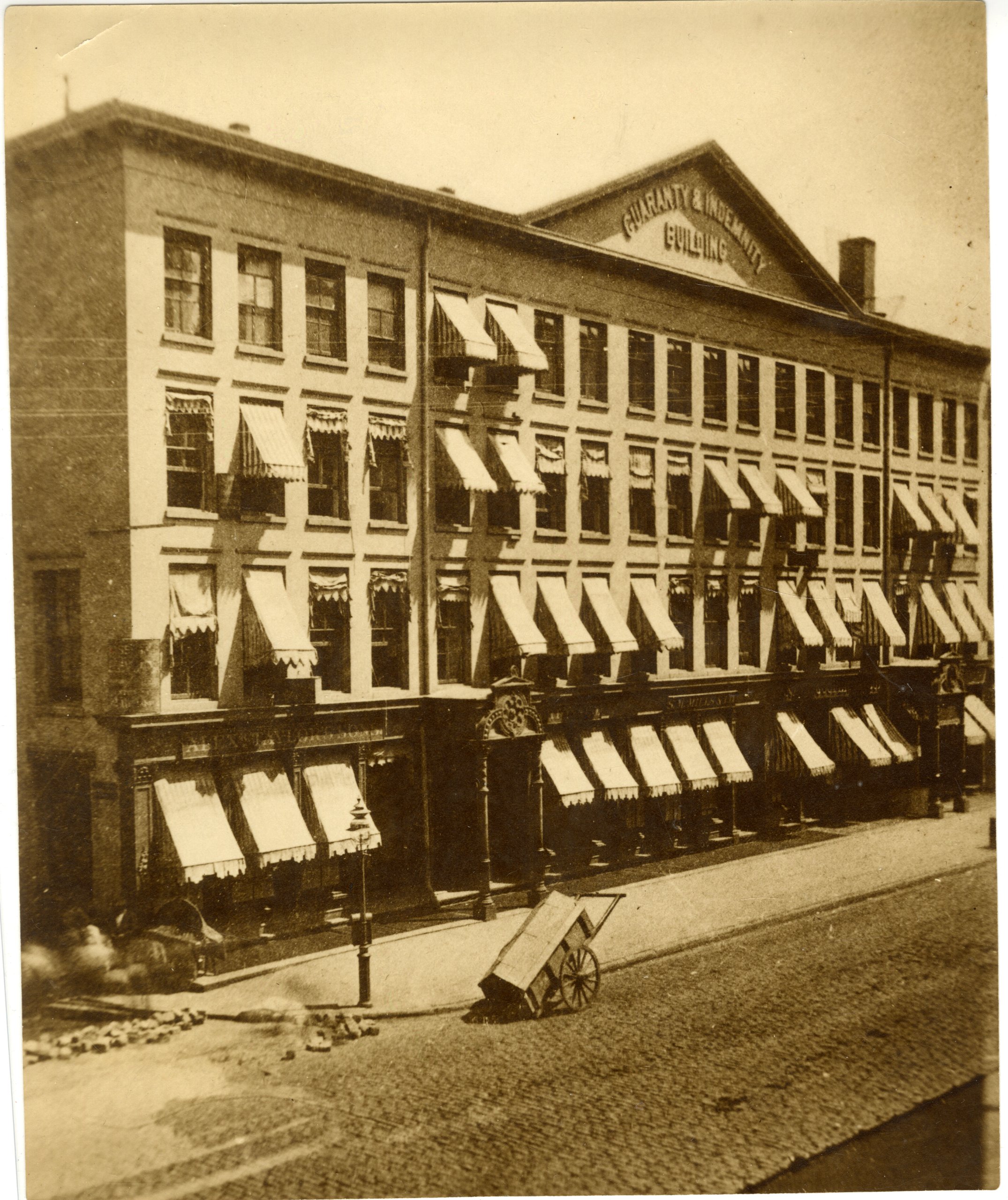
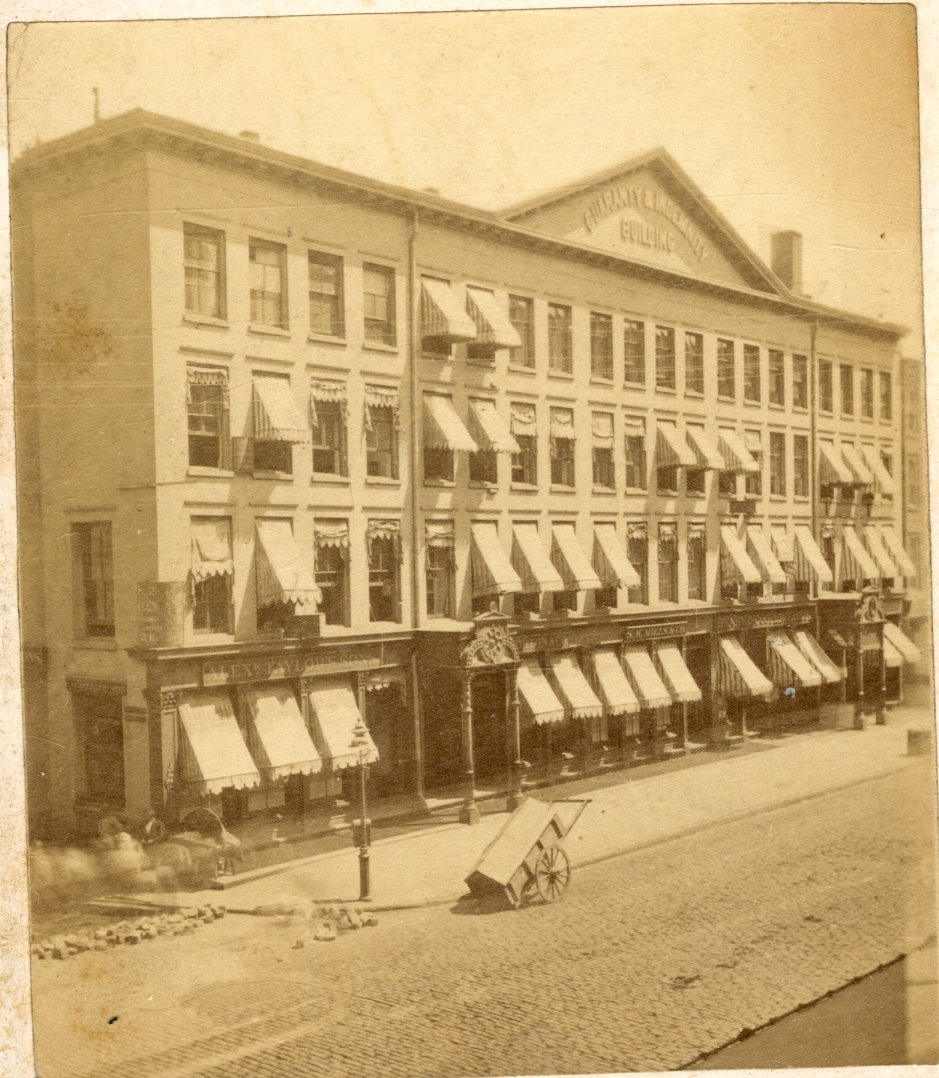
Unidentified photographer. Guaranty and Indemnity Building, 52-54 Broadway at Exchange Place, c. 1876.
Unidentified photographer. Guaranty and Indemnity Building, 52-54 Broadway at Exchange Place, c. 1876.
Two prints from the same negative, one notably small, of a modest three-story commercial block with a pedimented gable reading “Guaranty & Indemnity Building.” Striped awnings articulate each window bay, producing a repetitive surface that borders on pattern. Shops line the ground floor, among them what appears to be Alex Taylor & Co. The cobblestone street in the foreground is actively under construction: loose paving stones lie heaped on newly leveled ground, and a workman’s barrow rests at an angle, its presence partially blurred by motion. The inscription dating the scene to 1876 places these among the earliest images in the group, before the district’s vertical transformation gathered force.
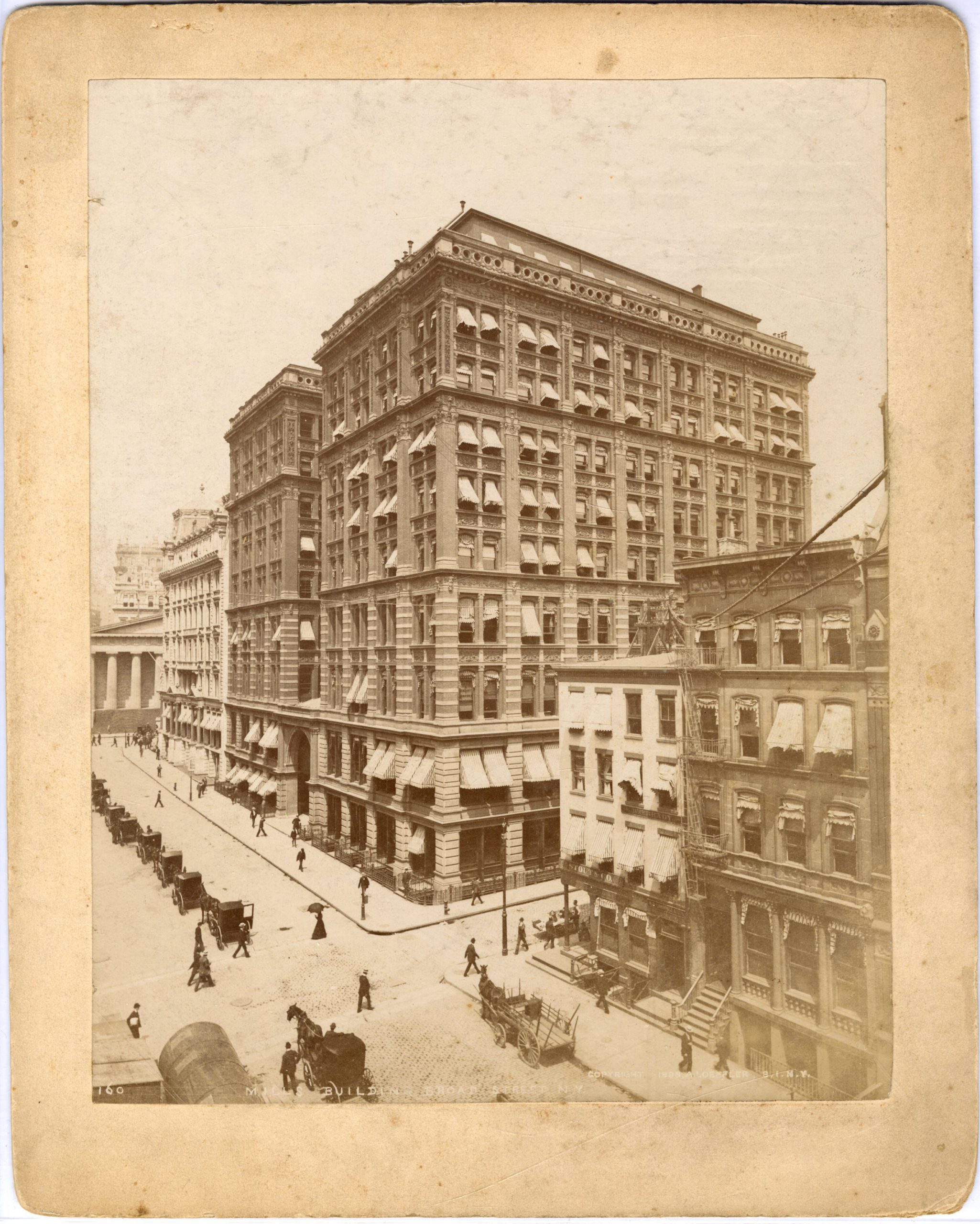
August Loeffler. Mills Building, Broad Street, N.Y., c. 1888.
The Mills Building at 15 Broad Street, designed by George B. Post and completed in 1882 for Darius Ogden Mills, stood among the most prestigious office buildings in lower Manhattan. Rising ten stories in brick and brownstone over a granite base, it occupied the corner of Broad Street and Exchange Place with a mass that reads as both compact and emphatic. A row of hansom cabs lines the street at left, while the columned portico of the Sub-Treasury appears in the distance. The building was demolished in 1926 and replaced by the Equitable Trust Building (completed 1928), whose scale recalibrated the block.
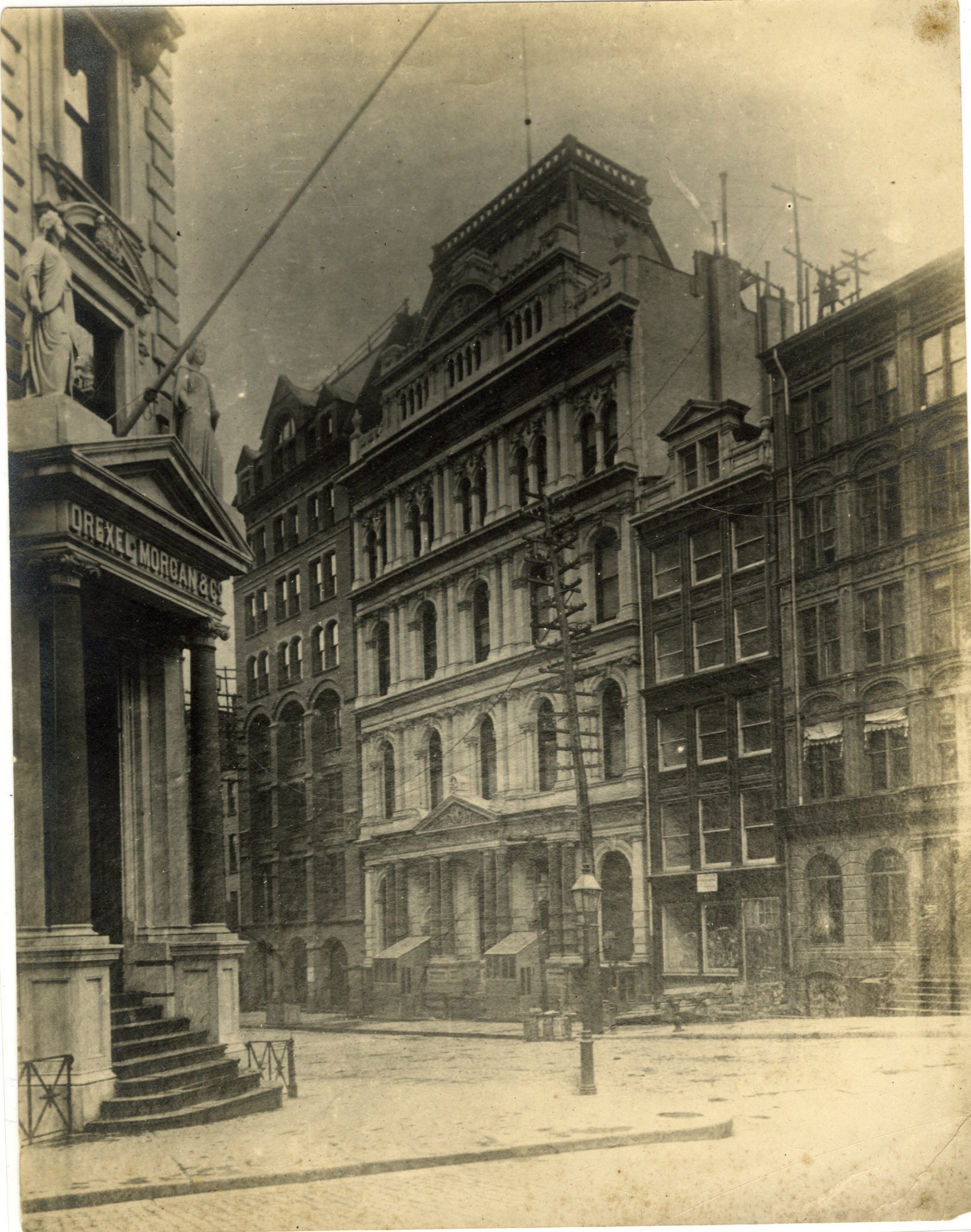
Unidentified photographer. Broad Street, looking south toward Wall Street, c. 1893-1895.
At left, the entrance to the Drexel Building (Arthur Gilman, 1873) carries the name “Drexel, Morgan & Co.,” used until the firm’s reorganization as J.P. Morgan & Co. in 1895. The structure dominating the center is the earlier New York Stock Exchange (1865; enlarged by James Renwick Jr. in 1871 and again in 1881), its layered expansions legible in the accreted façade. It would be demolished in 1901 for George B. Post’s neoclassical Exchange (completed 1903). The Drexel Building itself disappeared in 1913, replaced by 23 Wall Street, the austere headquarters of J.P. Morgan & Co. Overhead wires and poles thread the view, binding the scene into the infrastructural present of the 1890s
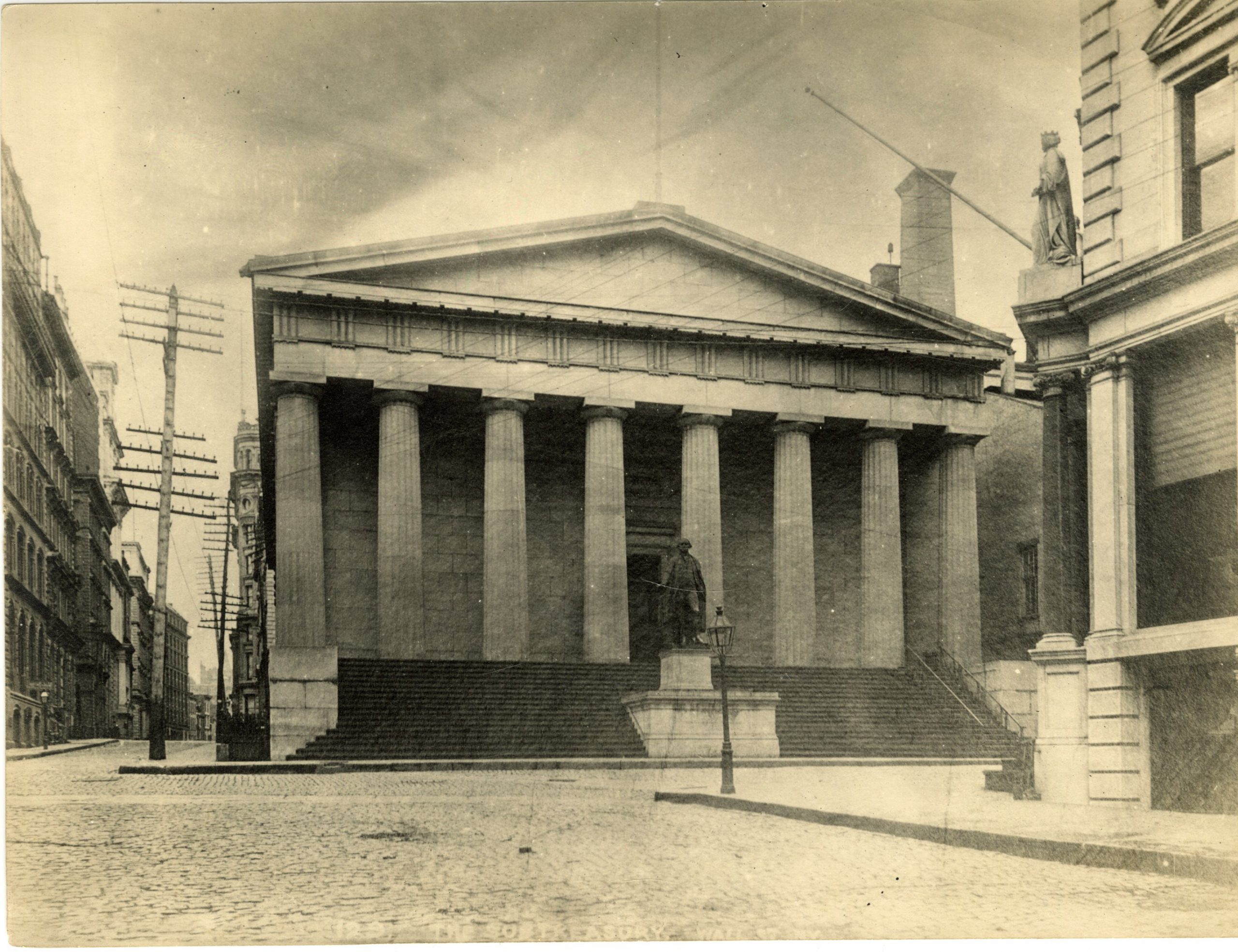
John S. Johnston, attrib. Federal Hall (Sub-Treasury), 26 Wall Street, c. 1890s.
The former U.S. Custom House, designed by Town & Davis and completed in 1842, modeled on the Parthenon with a Doric colonnade and broad flight of steps. It served as the U.S. Sub-Treasury from 1862 until 1920. The building occupies the site of the original Federal Hall, where George Washington took the oath of office as the first president on April 30, 1789. That earlier structure, remodeled by Pierre Charles L’Enfant, was demolished in 1812. The current building became a National Historic Site in 1939 and opened as a museum on Washington’s birthday, 1940.
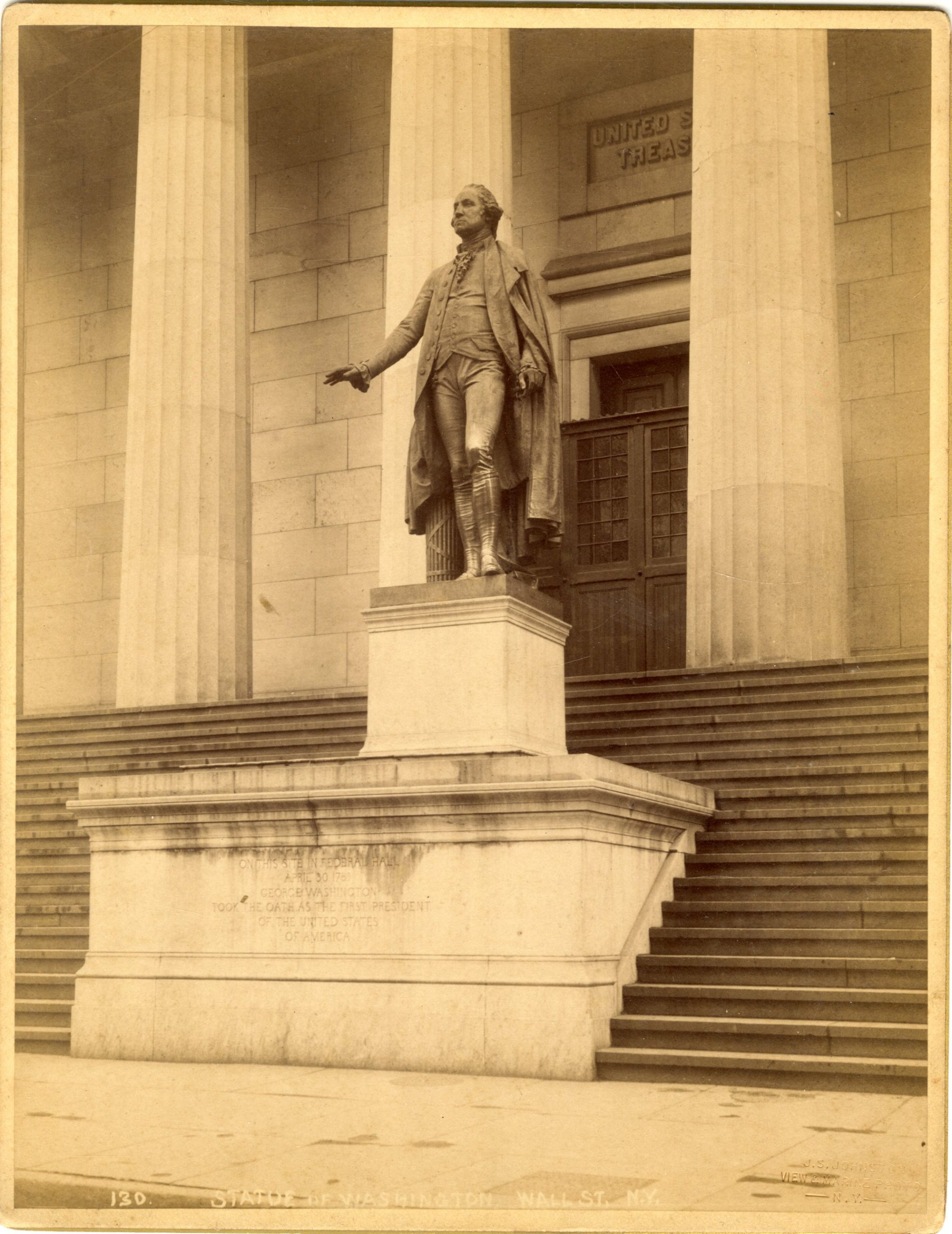
John S. Johnston. Statue of Washington, Wall Street, N.Y., undated.
John Quincy Adams Ward’s bronze statue of Washington, unveiled in 1883 on the centennial of the inauguration, stands on the steps of the Sub-Treasury at approximately the point where the oath was administered. Washington is shown in contemporary dress, his right hand extended in a gesture that hovers between address and completion. The inscription on the pedestal fixes the historical claim with lapidary precision, anchoring the figure to the site even as the surrounding district accelerates into modern finance.
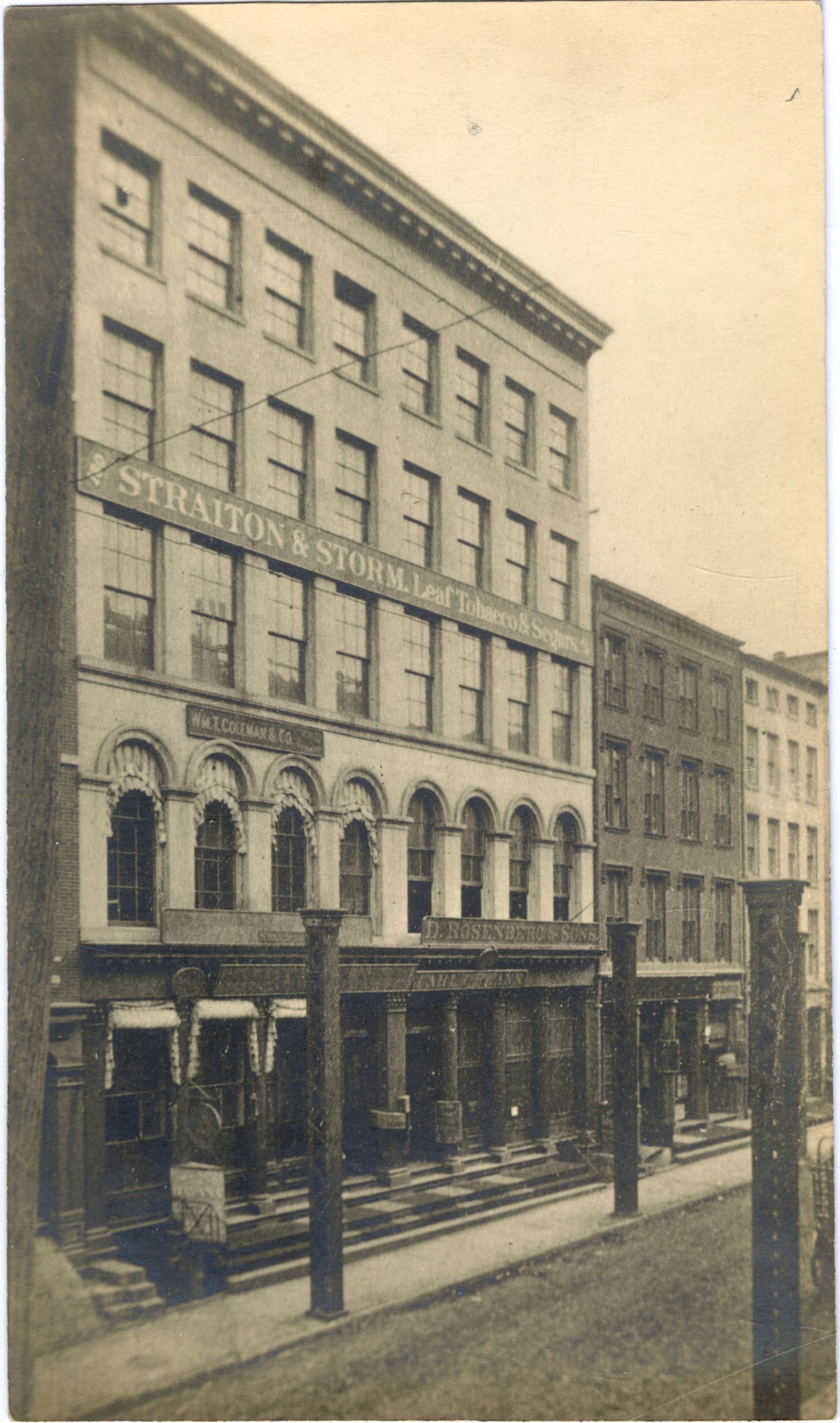
Unidentified photographer. Straiton & Storm Building, Pearl Street, c. 1880s-1890s.
A five-story Italianate commercial building near the waterfront, with “Straiton & Storm, Leaf Tobacco & Segars” painted across the upper façade and “Wm. T. Coleman & Co.” on a sign at left. “D. Rosenberg & Sons” occupies the ground floor at right. Straiton & Storm were one of the largest cigar manufacturers in New York; the verso inscription identifies the building’s use for tobacco storage and inspection by F.C. Linde, Hamilton & Co., a major bonded warehouse firm. The narrow vertical format and the iron awning posts lining the sidewalk give the image an almost claustrophobic compression, a useful reminder that not every building in the Financial District was a temple of finance.
A full description and inventory are available on request.
$8,000