


“the most important single work in science”
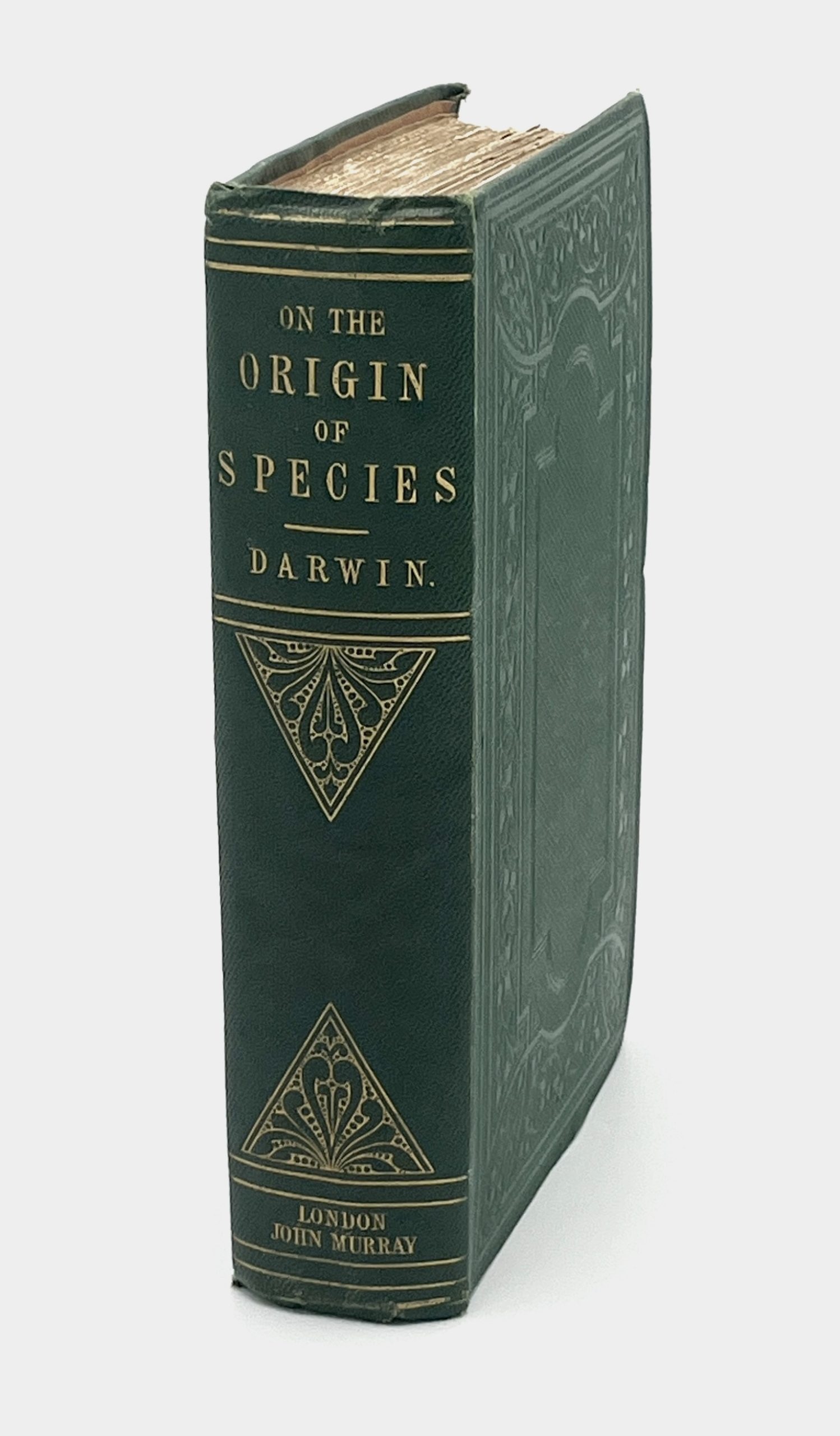
DARWIN, CHARLES. On the Origin of Species by means of natural selection, or the preservation of favoured races in the struggle for life
London: John Murray, 1859
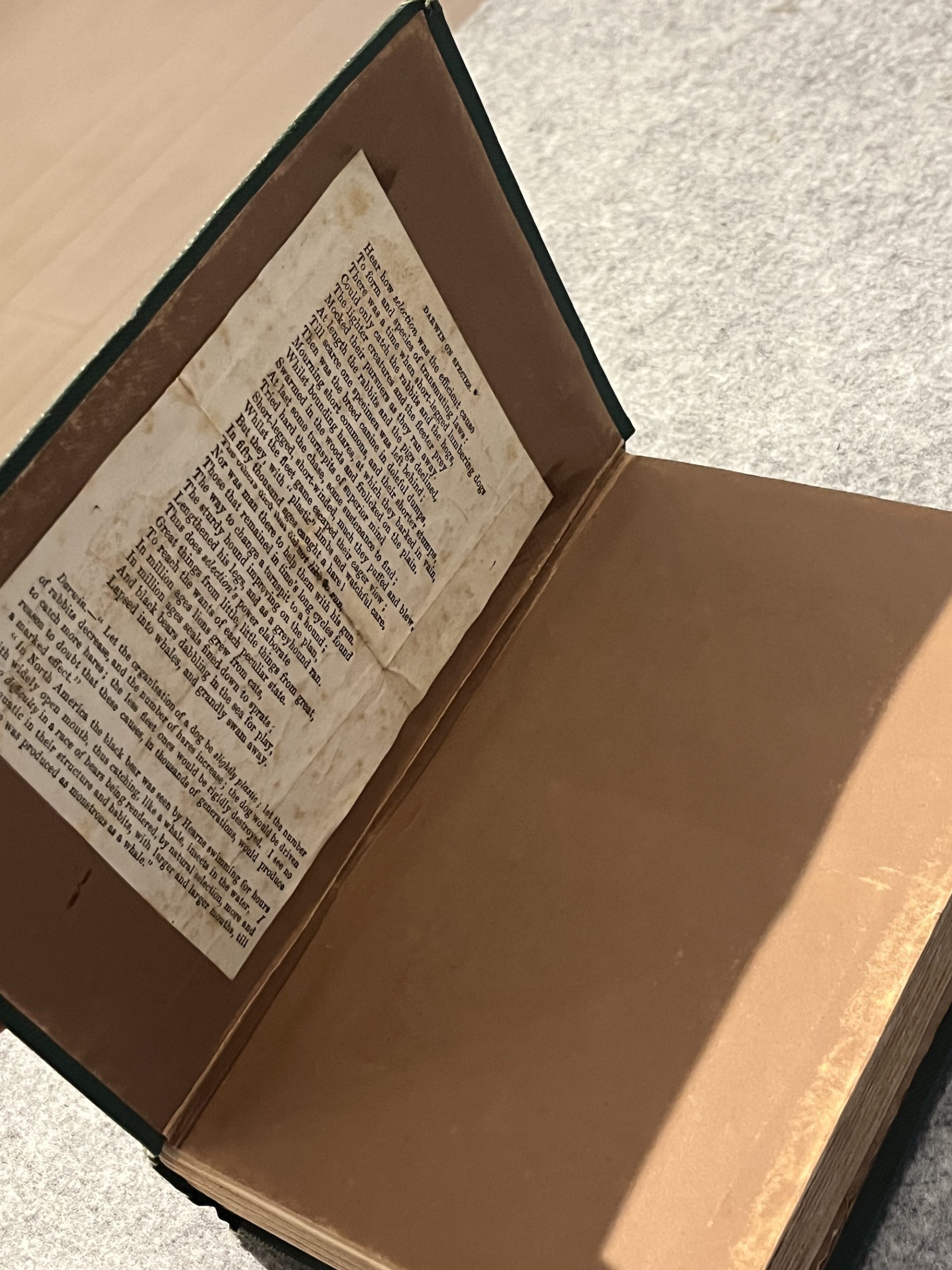
Original green cloth. Very light wear and foxing. Mounted to the front pastedown is a contemporary printed poem headed, “Darwin on Species,” describing the theory of natural selection in rhymed verse. A fine, unrestored copy.
FIRST EDITION of “certainly the greatest biological book ever written” (Freeman) and “the most important single work in science” (Dibner).
Darwin’s theory of the origin of species by means of natural selection arose out of his studies in the 1830s during and after the voyage of H.M.S. Beagle. Reading Malthus’s Essay on Population in 1838, Darwin saw that the tendency of population to grow in excess of food supply applied not just to man but to animals, and in it lay the germ of natural selection. Darwin did not discuss his theory with friends, but in 1842 he drew a rough sketch of his argument and expanded it in 1844. Then beginning in 1845 he put aside the matter and devoted eight years to the study of living and fossil barnacles. In 1856 Darwin described his theory to geologist Charles Lyell, who urged him to write a book on the subject. In June 1858 Alfred Russel Wallace sent Darwin a letter presenting a summary of the very views Darwin had formed twenty years earlier. The two agreed to a joint publication of their ideas.
Darwin then set about writing On the Origin of Species, which he considered an “abstract” of a much larger work that was never published. The book was published on November 24, 1859. Before its publication, Darwin wrote to John Murray, his publisher, “It may be conceit, but I believe the subject will interest the public.” The first edition of 1250 copies sold out immediately.
Darwin concluded his book, “There is grandeur in this view of life, with its several powers, having been originally breathed into a few forms or into one; and that whilst this plan has gone cycling on according to the fixed law of gravity, from so simple a beginning endless forms most beautiful and most wonderful have been, and are being, evolved.”
“Darwin not only not only drew an entirely new picture of the workings of organic nature; he revolutionized our methods of thinking and our outlook on the order of natural things. The recognition that constant change is the order of the universe had finally been established” (PMM).
This is a lovely copy of one of the most sought-after books in the history of ideas.
Printing and the Mind of Man 344b. Freeman 373.
Please inquire