


Houses of Worship
Various artists. Collection of 5 photographs of New York City religious establishments
New York, 1880-1901
5 albumen and gelatin silver prints, various sizes (6 ¼ x 8 in. – 13 x 10). Very good condition over all.
This collection of five photographs shows three significant houses of worship in late 19th century New York.
New York’s churches and synagogues were among the most conspicuous landmarks in the nineteenth-century city, their spires and towers serving as orientation points in a skyline that had not yet been overtaken by commercial buildings. These five photographs document three of them: Trinity Church on Wall Street, Grace Church on Broadway and 10th Street, and the Broadway Tabernacle at Sixth Avenue and 34th Street. Grace Church and Trinity still stand. Temple Emanu-El and the Broadway Tabernacle are gone, casualties of the same northward migration of congregation and commerce that reshaped the rest of the city.
This collection includes:
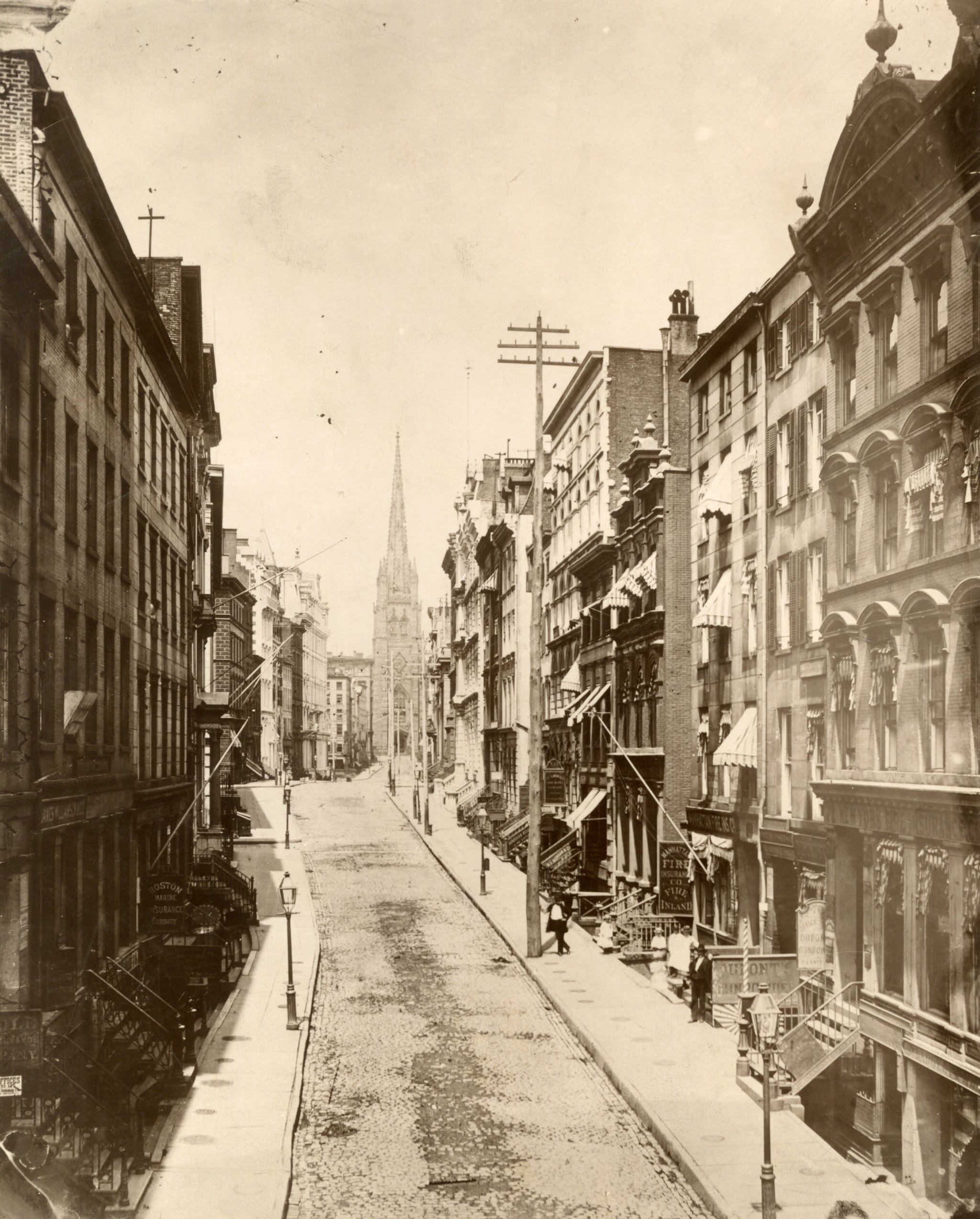
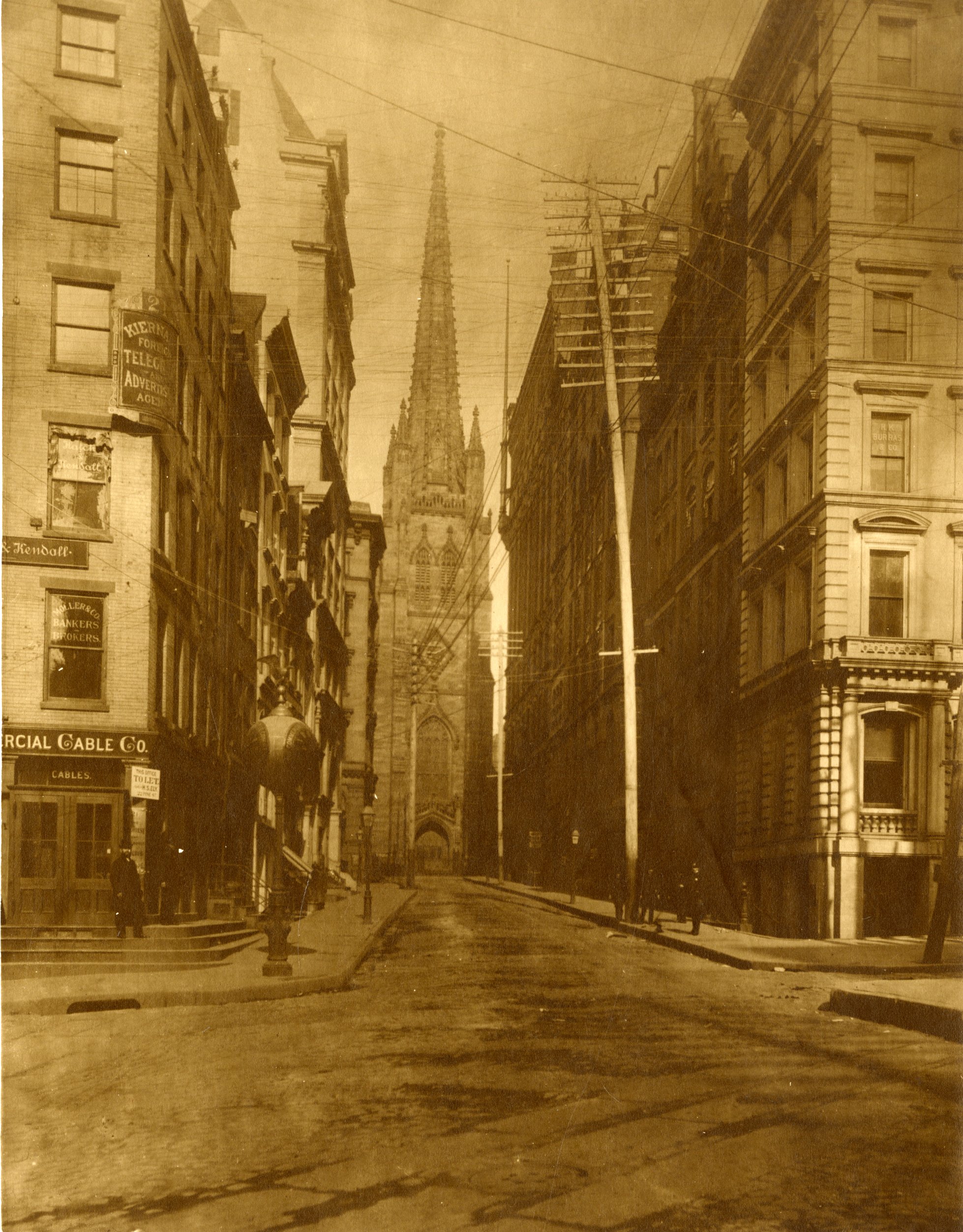
Unidentified photographer. Wall Street looking west toward Trinity Church, c. 1890s.
Trinity Church (Richard Upjohn, completed 1846) anchors the westward termination of Wall Street, its brownstone spire rising above a corridor of commercial façades. Signage for the “Commercial Cable Co.” and “Kendall” / “Bankers” is legible at left. The near-emptiness of the street suggests an early hour, before the financial district’s daily congestion gathers.
Unidentified photographer. Broadway looking south toward Grace Church, c. 1880s-1890s.
Grace Church’s marble spire (James Renwick Jr., completed 1846) closes the southward view along Broadway, framed by rows of brownstones and mixed-use commercial buildings with stoops and striped awnings. The church stands at the irregular meeting of Broadway and 10th Street, where Broadway’s older diagonal course cuts across the street grid, so that its spire terminates the vista with unusual force.
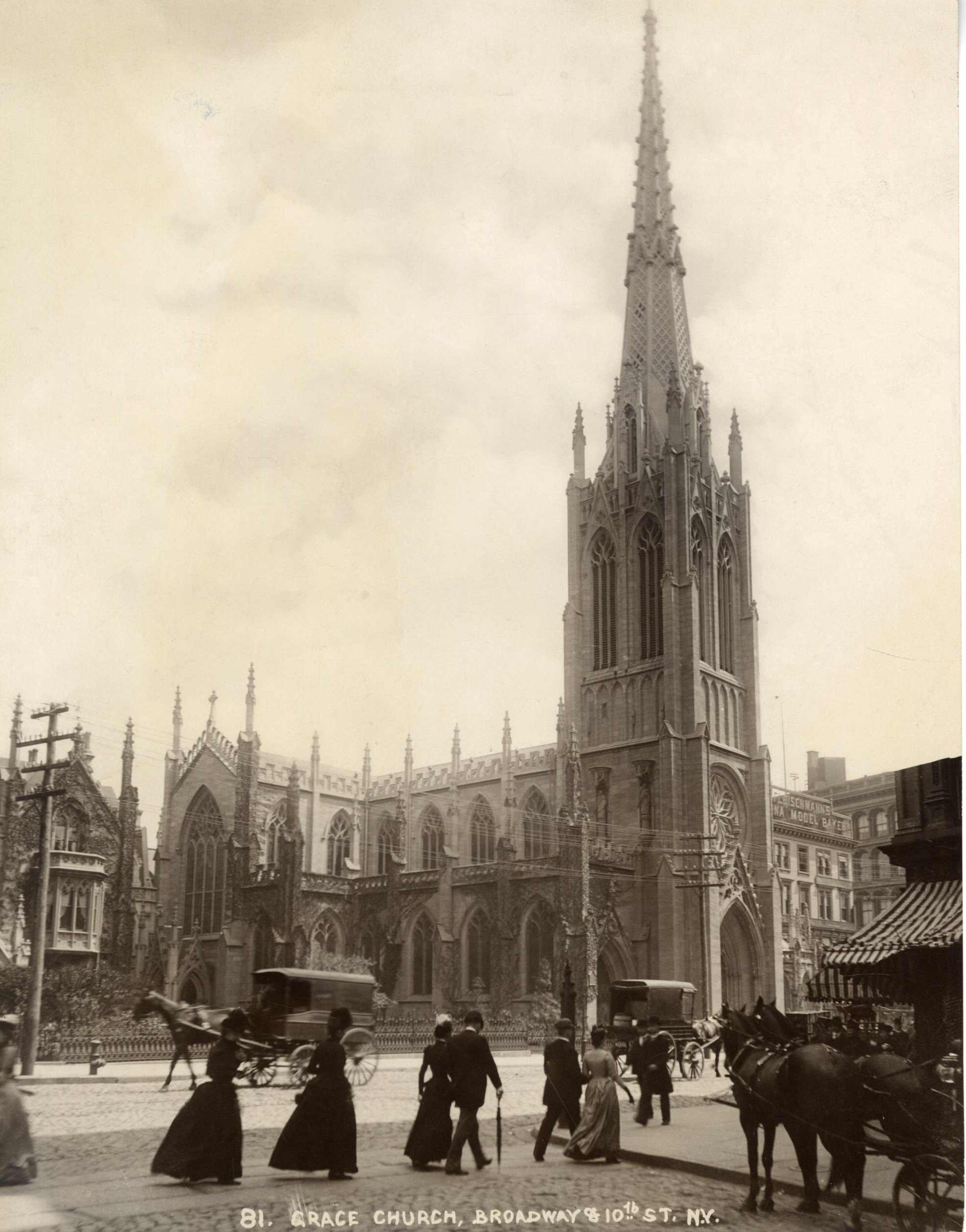
John S. Johnston, attrib. Grace Church, Broadway and 10th Street, N.Y., c. 1895.
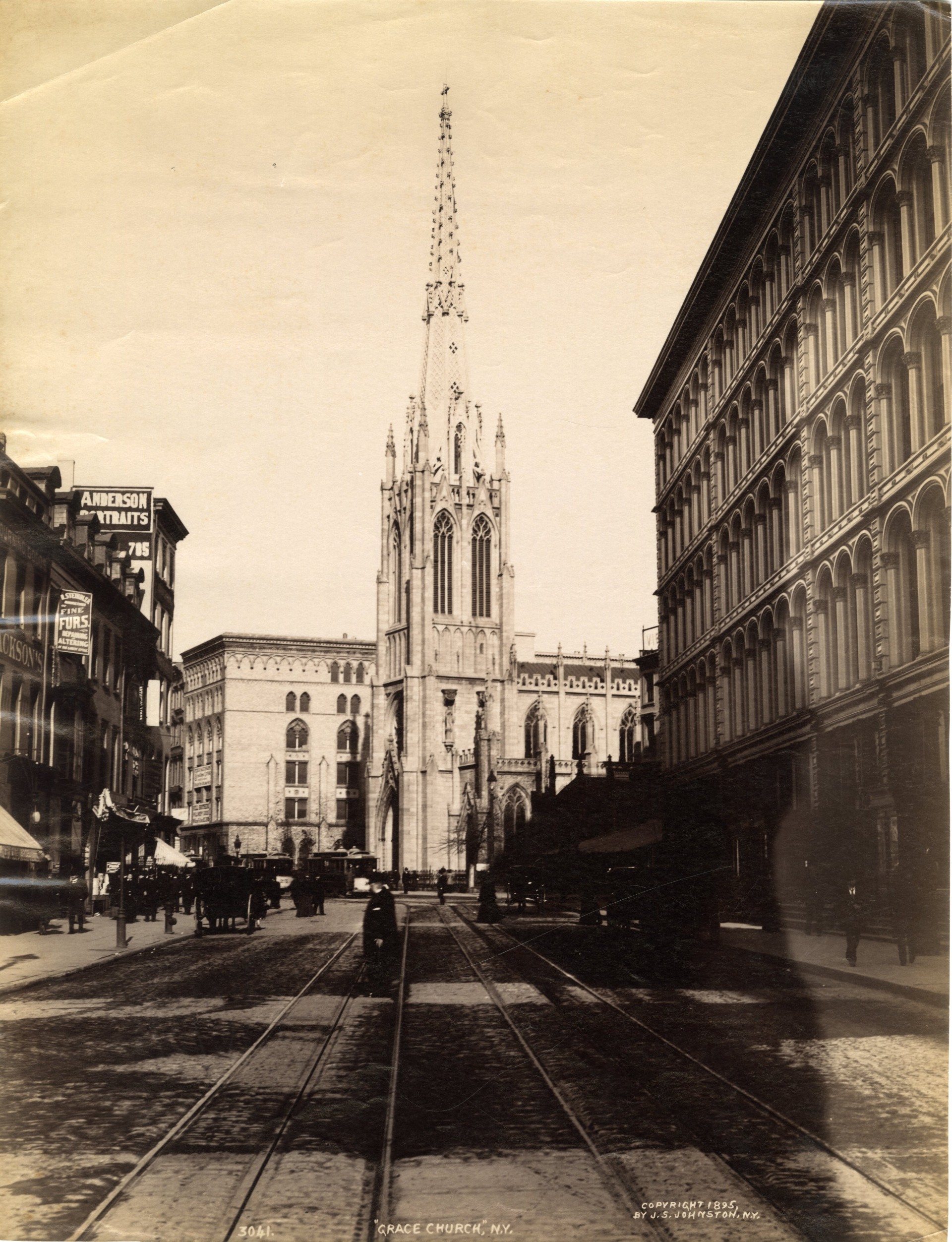
John S. Johnston. Grace Church, N.Y., 1895.
Photographed from further south, looking north along the street railway tracks, Grace Church occupies the point at which Broadway bends westward, its nave and spire fully exposed. Signs for “Anderson Portraits” (no. 785) and “Fine Furs” are legible at left, while a large cast-iron commercial block typical of the Broadway retail district fills the right side of the frame.
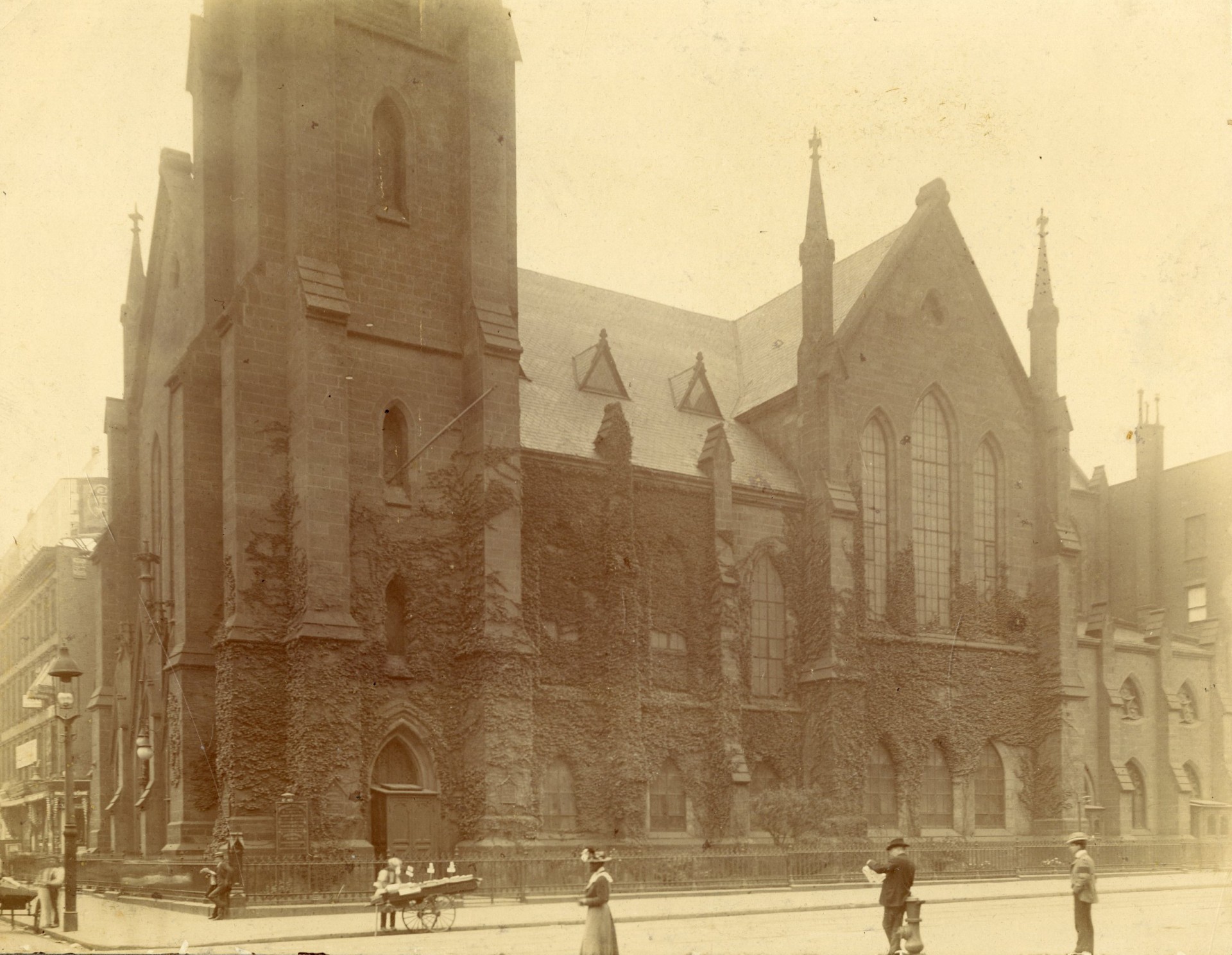
Thomas H. Wilson. Broadway Tabernacle, Sixth Avenue and 34th Street, 1901.
This is the side view of the highly influential Broadway Tabernacle, a dense fabric of ivy covering its walls and climbing across its Gothic windows and buttresses. The Tabernacle, designed by Leopold Eidlitz (who also designed Temple Emanu-El) and completed in 1859, was the second home of a congregational church founded in 1836 by the evangelist Charles Grandison Finney as a center of abolitionist activity. Frederick Douglass, William Lloyd Garrison, and Sojourner Truth all spoke from its pulpit. In 1905, four years after this photograph was taken, the congregation moved to Broadway and 56th Street and the 34th Street building was demolished.
A full description and inventory are available on request.
$5,000