


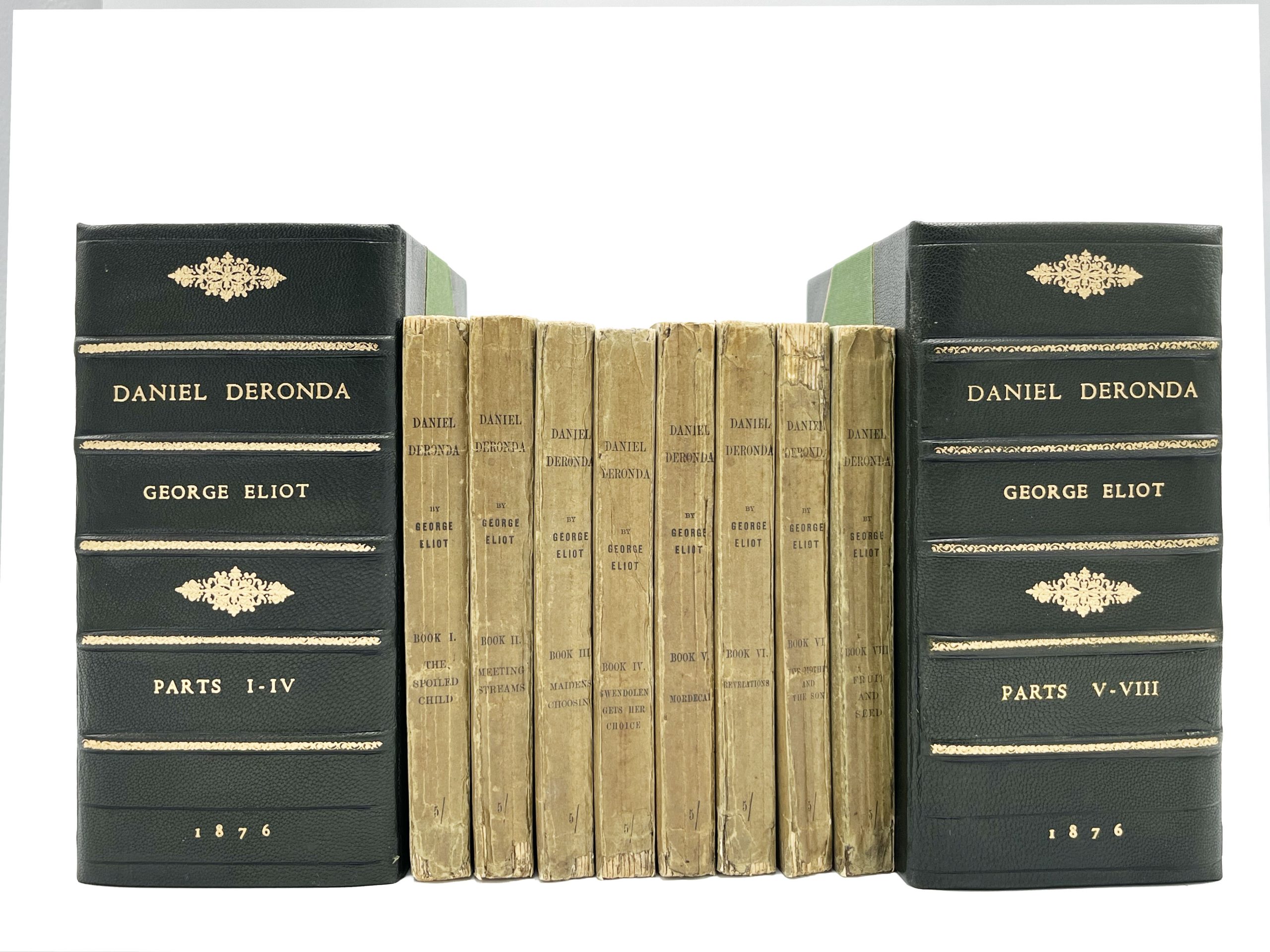
“probably the most influential novel of the nineteenth century” - a key work in the history of Zionism
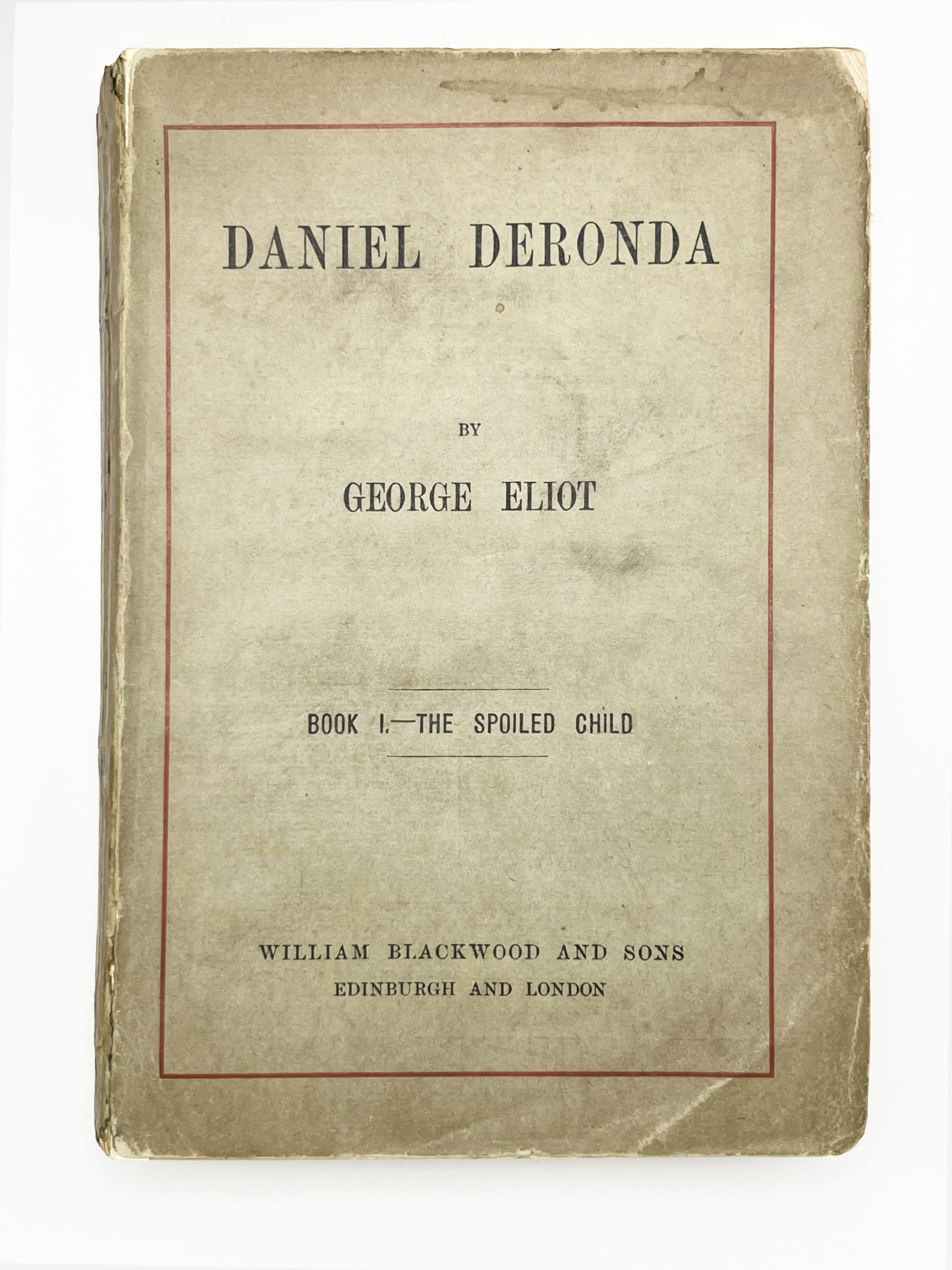
ELIOT, GEORGE. Daniel Deronda
Edinburgh and London: William Blackwood, 1876
Eight volumes. Original wrappers. Slips announcing next parts tipped in at rear of parts 1-7. Erratum slips in parts 3 and 6. Ownership signature on front covers of five parts. First page of adverts in first part torn with loss, and tear to final page of part 8 without loss of text. Some chipping, occasional soiling and staining. A very good set. Half morocco cases.
FIRST EDITION. George Eliot’s final novel, Daniel Deronda played a decisive role in
promoting the idea of a Jewish state fully two decades before the publication of Herzl’s Der Judenstaat. “In terms of its practical effects it was probably the most influential novel of the nineteenth century” (Paul Johnson in A History of The Jews).
In the novel, the Jewish scholar Mordecai (based on Eliot’s friend Emmanuel Deutsch)
echoes Eliot’s own Zionism: “The world will gain as Israel gains. For there will be a
community in the van of the East which carries the culture and sympathies of every great
nation in its bosom; there will be a land set for a halting place of enmities, a neutral ground for the East.”
At the end of the novel, the Messiah-like figure of Deronda prepares to restore “a political
existence to my people, making them a nation again, giving them a national centre, such as the English have, though they too are scattered over the face of the globe.”
Daniel Deronda introduced many British leaders to the idea of a Jewish state. Balfour himself met Eliot the year after the book’s publication. The novel was widely translated including editions in German, Dutch, French, Italian, Hebrew, Yiddish, and Russian. Furthermore, this book is one of only a handful of sympathetic portraits of Jews in Victorian English literature, which often presented anti-Semitic caricatures such as Fagin in Oliver Twist.
“To hundreds of thousands of assimilated Jews, the story presented, for the first time, the
possibility of a return to Zion” (Johnson). Henrietta Szold, Eliezer Ben-Yehuda, and Emma Lazarus all cited the novel as influential in their decisions to become Zionists. Chaim Weizmann claimed that he kept the novel “within easy reach” in his bedroom.
This novel has probably had greater impact on world events than any other single work of fiction of its era, apart perhaps from Uncle Tom’s Cabin.
Please Inquire