


The Golem of Prague
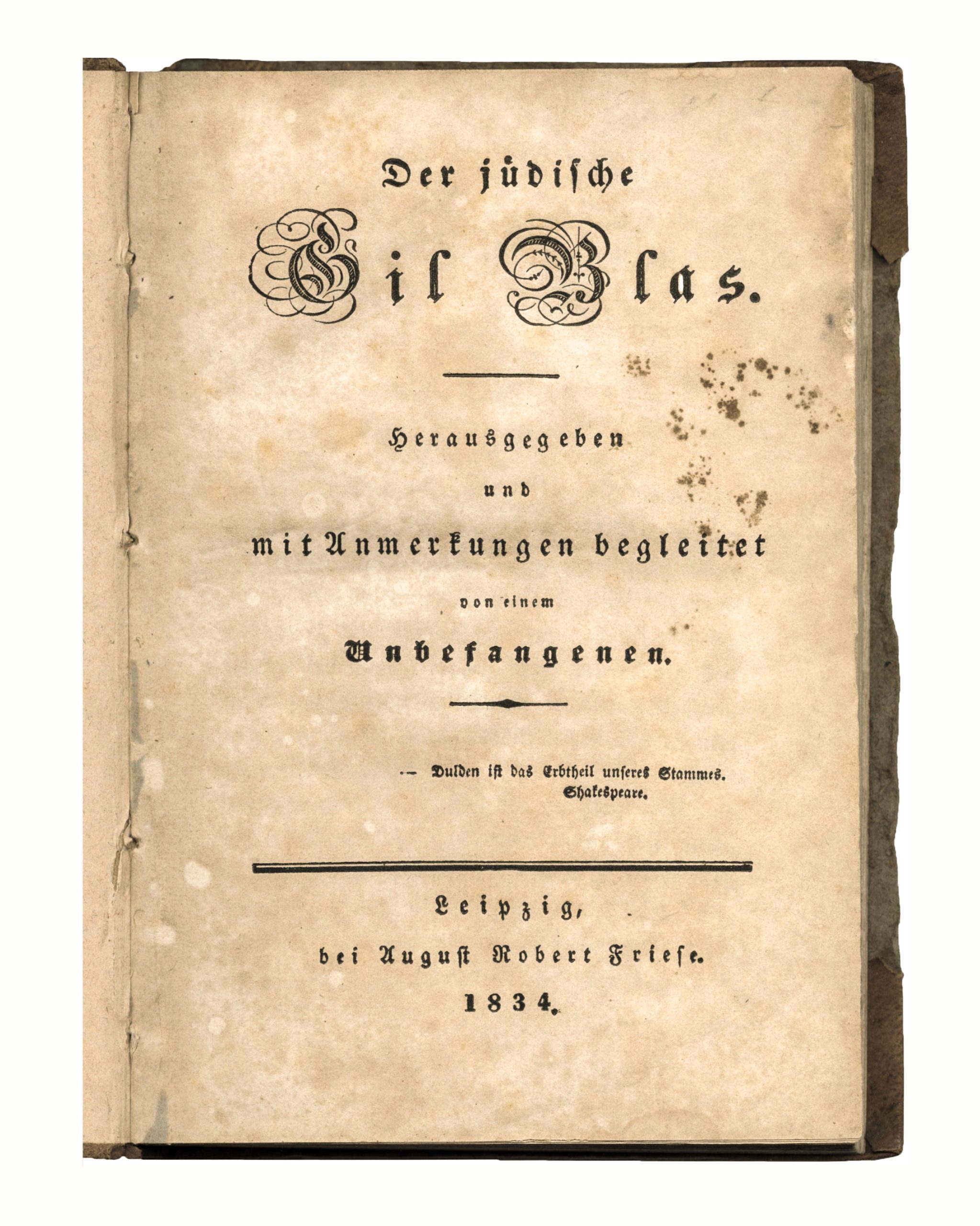
(GOLEM OF PRAGUE.) [Kohn, Joseph Seligmann]. Der jüdische Gil Blas
Leipzig: Friese, 1834
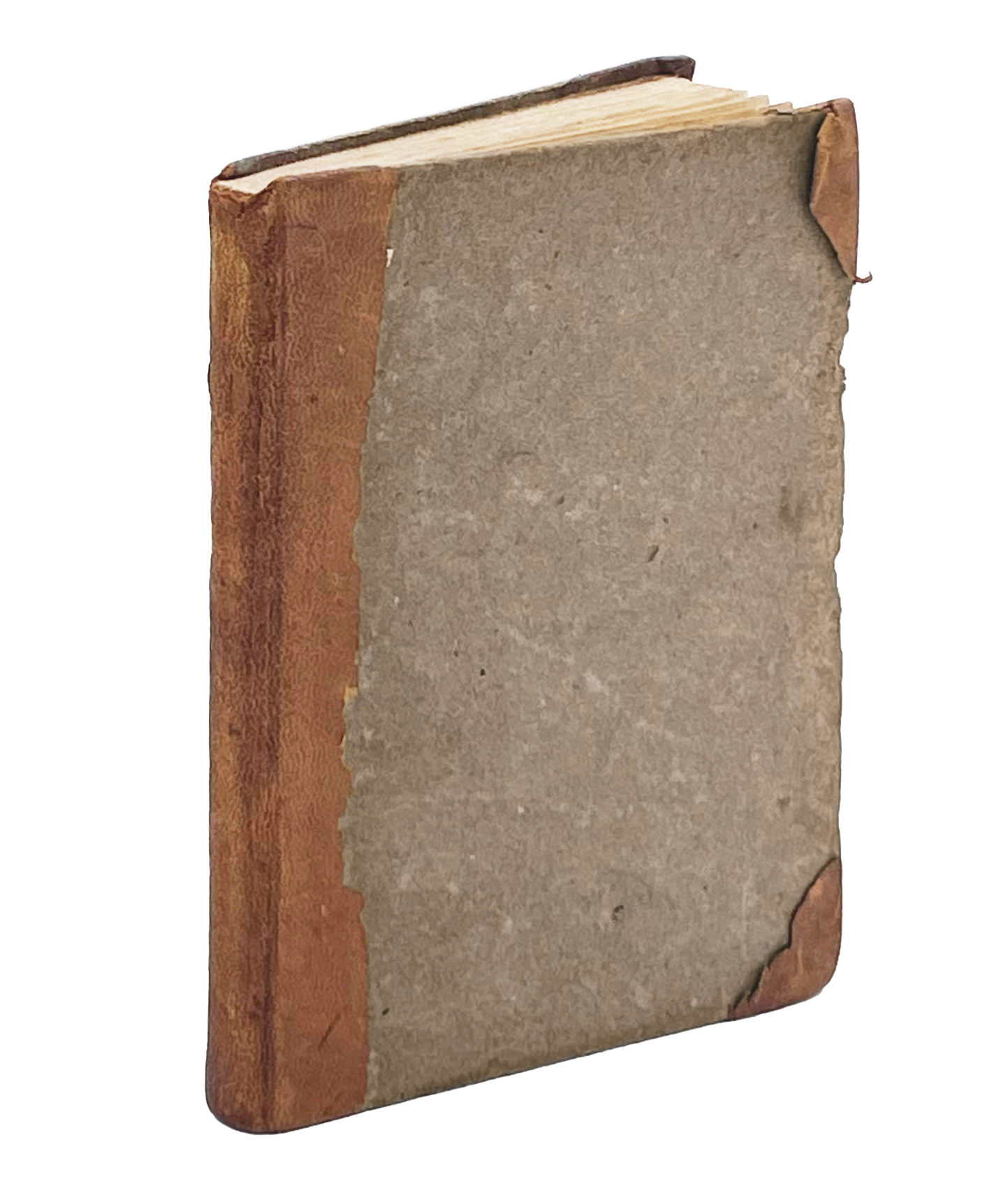
Contemporary half sheep, gray paper boards. Light wear to binding, with some chipping to corners, without free endpapers. Some browning and staining.
First edition. This is the first printing of the legend of the Golem of Prague.
“The legend of the Golem, the mute clay servant brought to life by Rabbi Judah Loew of Prague and who ran amok one Sabbath, is one of the most enduring and imaginative tales in modern Jewish folklore. Although its roots ultimately lie in late antique rabbinic literature, the story dilates somewhat dramatically in the nineteenth century,” originating in the telling by Kohn in 1834 in his The Jewish Gil Blas (Dekel and Gurley, “How the Golem Came to Prague”).
In 16th-century Prague, Rabbi Judah Loew, also known as the Maharal, makes a humanlike figure from clay to defend the Jewish community from persecution and blood libel. Animated by sacred words, the Golem serves faithfully at first but over time grows uncontrollable and threatening. Fearing harm, the rabbi removes the sacred words, returning the Golem to lifeless clay. Tradition holds that its remains were hidden in the attic of the Old-New Synagogue, where they still lie dormant.
Der jüdische Gil Blas is a picaresque realistic novel of Jewish life in nineteenth-century Prague, modeled on Lesage’s popular novel Histoire de Gil Blas. Dekel and Gurley observe that the Jewish Gil Blas “has a serious claim to being the first modern Jewish novel.” The Golem legend appears in a long footnote (beginning on p. 19) in the section on the Altneuschul, the central landmark of Prague’s Jewish quarter. It states in translation:
“The above-mentioned Golam [sic] was an automaton of clay, which the rabbi himself had made, and into whose mouth a different talisman (called sem) was slipped each evening. One Friday the kabbalist had gone to the Altneuschul for evening prayers as usual, and the fallen twilight announced that the Sabbath had already set in. Among the Jews, as is well known, the evening is counted as part of the following day. The Golam, who still had the Friday sem in his mouth, believed that his master’s forgetfulness had relieved him of all subservience and began to make a terrible uproar. The whole building shook, and the monster would inevitably have brought about the downfall of the city, if the kabbalist had not immediately come up with an expedient measure. The chanting of the first psalm which marks the entrance of the Sabbath, had begun in the synagogue, when the Golam, simply trusting in the authority of that psalm, believed the time of his liberation from his arduous service to his master had drawn near, and his frenzied game began. Then the rabbi, who quickly guessed the cause of the unruly behavior of his other wise obedient servant, called out authoritatively to the men who were praying, and whom the Golam had greatly frightened: “Stop!” By ordering this pause, he unnaturally held off the approaching Sabbath, which could only be declared to have arrived after the psalm had been finished. He quickly went back to his home, fetched the Sabbath sem, exchanged it for the Friday one, and the Golam immediately recognizing the superior strength of his master, came to his senses, and the city was saved. To commemorate that event, the first psalm is even now recited twice in the Altneuschul on Friday evenings, namely, by inserting a quarter-hour pause, which is intended to commemorate the interval that the rabbi needed to correct his forgetfulness.”
Following the publication of Kohn’s tale in the Jewish Gil Blas, it was retold in other books by Jewish authors collecting Jewish stories in the Grimms’ tradition. These works, starting with the Jewish Gil Blas, established the story as a fixture of Jewish folklore, forever tying it to Rabbi Loew and placing it permanently in Prague in the Jewish imagination.
This landmark of Jewish folklore is rare in original binding and in collector’s condition.
$6,000