


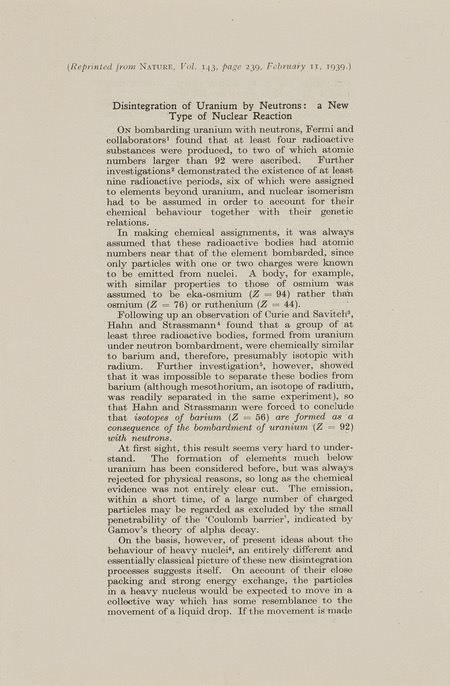
nuclear fission: “a new type of nuclear reaction”
MEITNER, LISE and OTTO ROBERT FRISCH. “Disintegration of Uranium by Neutrons: A New Type of Nuclear Reaction.” Offprint from: Nature. Vol 143
London: Macmillan, 1939
3pp on a bifolium. Near fine.
First edition, the scarce offprint issue, of this epochal paper on nuclear fission, the decisive paper leading to the race for the atomic bomb. In 1938, at the suggestion of Lise Meitner, Otto Hahn and Fritz Strassmann bombarded uranium with neutrons in the expectation of producing “transuranium” elements. Instead they discovered barium isotopes among the resulting decay products. Unable to interpret this, the two men communicated their result by letter to Hahn’s former co-worker Meitner. She had earlier fled to Stockholm to escape Nazi persecution.
Meitner and her nephew Otto Frisch theorized that the uranium nucleus breaks up into two smaller nuclei through the mutual repulsion of the many protons in the uranium nucleus, making it behave like a droplet of water in which the surface tension has been reduced. By taking the difference between the mass of the original nucleus and the slightly smaller total mass of the two fragment nuclei, and using Einstein’s mass-energy equivalence (E = mc²), Meitner calculated the large amount of energy (equal to 200 million electron volts) that would be released during the splitting process. The scientific community immediately adopted the name that Meitner and Frisch proposed for this astounding phenomenon—nuclear fission.
News of the discovery of fission spread rapidly. Meitner and Frisch communicated their results to Niels Bohr, who was about to sail to the United States. Bohr confirmed the validity of the findings while sailing to New York City, arriving on January 16, 1939. Ten days later Bohr, accompanied by Enrico Fermi, communicated the latest developments to some European émigré scientists who had preceded him to the United States and to members of the American scientific community at the opening session of a conference on theoretical physics in Washington, D.C.
“It was quickly recognized that fission of uranium’s 235 isotope would release further neutrons, possibly starting a chain reaction. On the eve of another war, the nuclear age had begun” (Sutton, “Hahn, Meitner and the discovery of nuclear fission”). “Many scientists joined the efforts to produce an atomic bomb, but Meitner wanted no part of that work, and was later greatly saddened by the fact that her discovery had led to such destructive weapons” (American Physical Society).
Rather than risk his own career by highlighting the work of his exiled Jewish colleague, Otto Hahn deliberately obscured Meitner’s central role in the discovery of nuclear fission. “In the fall of 1938, Meitner and other physicists were highly skeptical of Hahn and Strassmann’s finding that the slow neutron irradiation of uranium produced radium … It was she who urgently requested that Hahn and Strassmann test their radium more thoroughly, which led directly to the barium finding. She also was the one who immediately assured Hahn that a disintegration of the uranium nucleus was possible, after which he added to the proofs of the barium publication the suggestion that uranium might have split in two. Had Meitner been in Berlin at the time, the discovery of fission would, without question, have been understood as the superb achievement of an interdisciplinary team. Instead, Meitner was in exile, and she and physics were largely written out of the history of the discovery. The barium finding was published under the names of Hahn and Strassmann only—not because Meitner failed to provide an explanation but because it would have been politically impossible for Hahn and Strassmann to include her, a Jew in exile, as a coauthor.
“The records also show that Hahn quickly sought political cover and distanced himself from Meitner, claiming that the discovery was due to chemistry alone and that physics had delayed and impeded it, a view that was eventually codified by the Nobel Prize decisions. What kept Meitner from being completely obscured was that her theoretical interpretation with Otto Frisch was recognized as a brilliant extension of existing nuclear theory to the fission process. But the separate publications created an artificial divide—between chemistry and physics, experiment and theory, discovery and interpretation. It is important to recognize that this divide and Meitner’s exclusion from the fission discovery do not reflect how the science was done but are instead artifacts of her forced emigration and the political conditions in Nazi Germany at the time” (Sime, “Lise Meitner and the Discovery of Nuclear Fission”).
Printing and the Mind of Man 422b.
$19,500