


a great rarity: Midrash Rabbah
Midrash Rabbah, on the Five Books of the Torah
Constantinople: [Joseph Gabbai and Abraham Yerushalmi], 1512
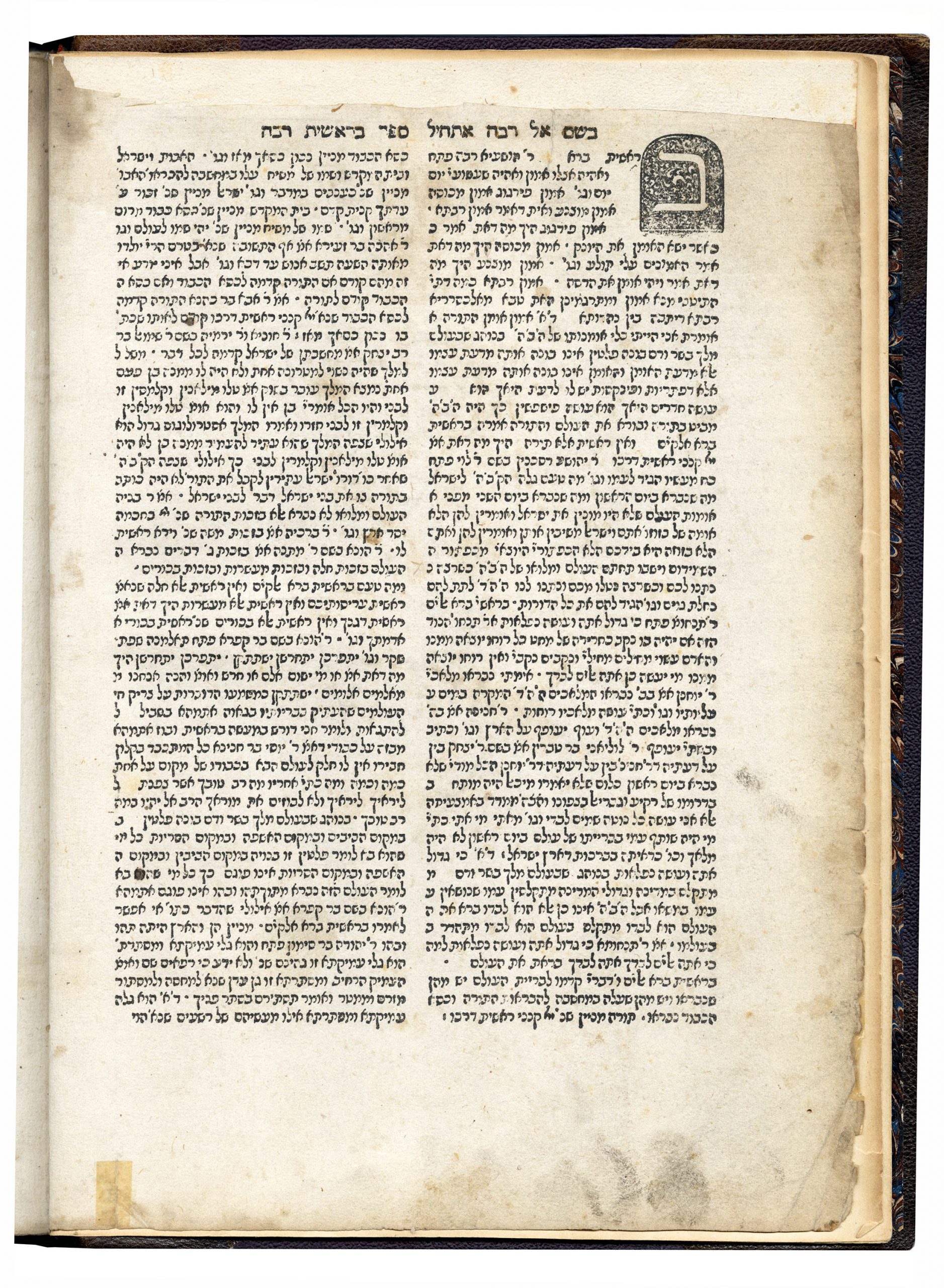
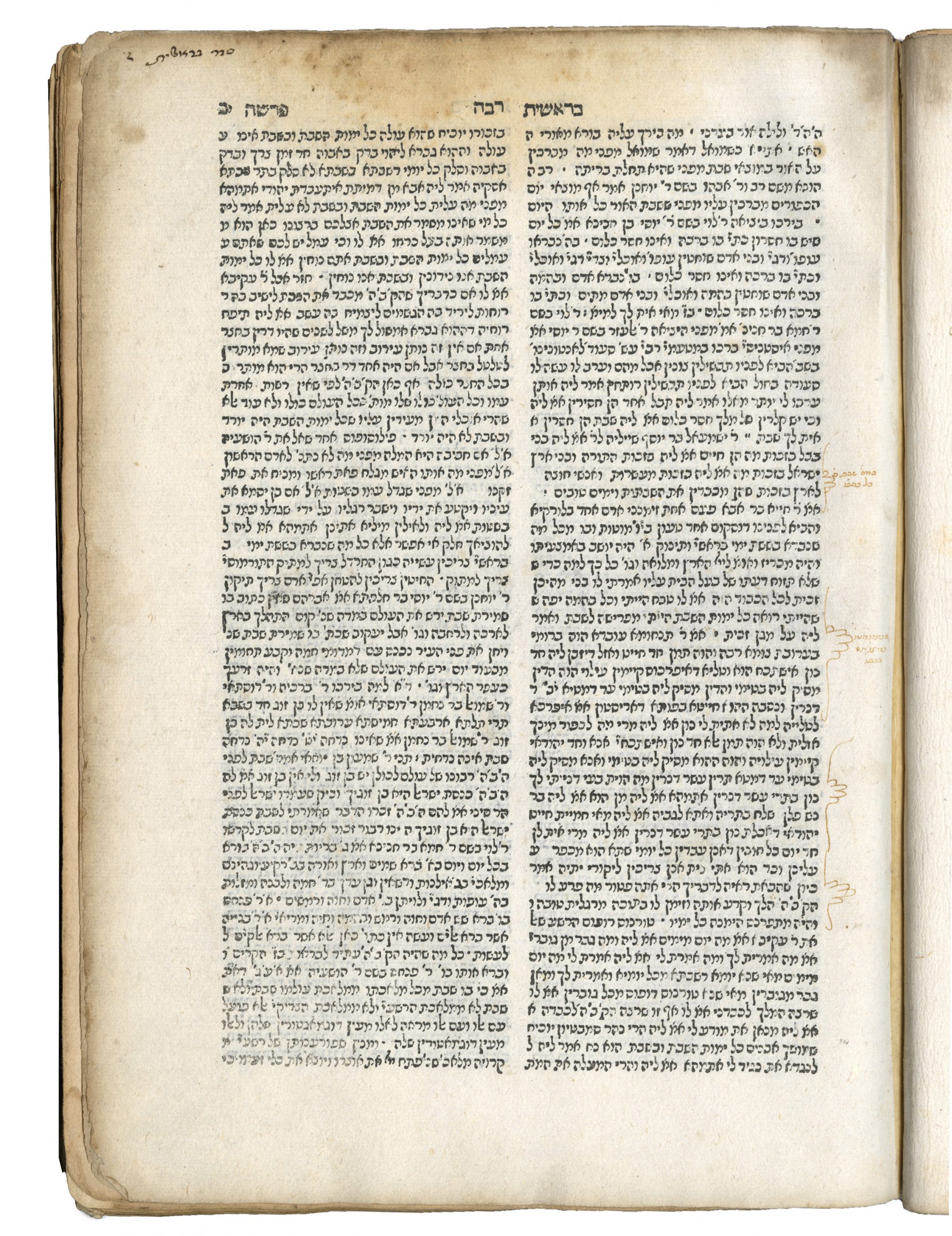
Folio. Five parts in one volume: [68]; [44]; [34]; [68]; [16] leaves. Final four leaves supplied from another copy. Hebrew, printed in two columns, in Rashi type, printed without title page as issued (first page blank). Colophon: “The work was completed … R. Yosef Gabbai and R. Avraham Yerushalmi … whose spirit moved them … to aggrandize and spread Torah among the Jewish people … This distinguished and precious book, the Rabbot, was completed today, 5th Nisan [1512], here in Constantinople.”
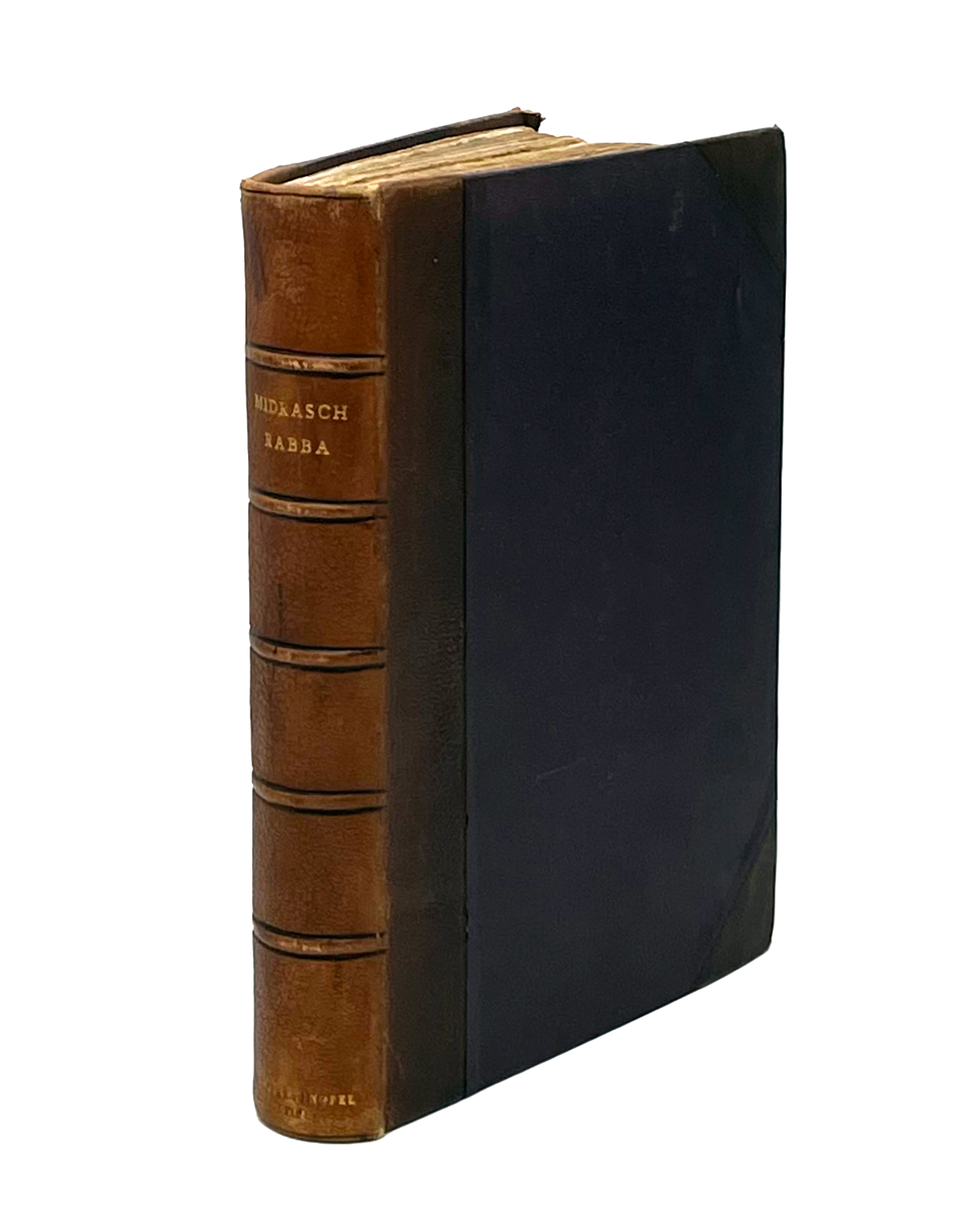
An excellent, complete, wide-margined copy of this important rarity. Staining and wear, minor worming, marginal tears, some closed, others with minor paper loss, repairs, and restoration, touching the text of several leaves. Names of Torah portions in manuscript, foliated with Hebrew numerals. 19th-century brown morocco, cloth boards, marbled endpapers.
a foundational work in the intellectual and religious history of Judaism
FIRST EDITION of the Midrash Rabbah on the Torah, the most influential homiletic (aggadic) commentary on the Pentateuch. Homiletics relates to writing and delivering sermons and other practical religious instruction. A foundational repository of biblical exegesis and rabbinic thought, this collection of writings has shaped the interpretation of the Torah from Rashi down to the present.
Midrash Rabbah is the great anthology of aggadic midrashim, meaning narrative and homiletic (relating to sermons and practical religious instruction) interpretations of Scripture, as distinct from the halakhic (legal) midrashim. “Midrash most commonly refers to the famous compilation of Midrash Rabbah, a compilation of the rabbis’ comments on each of the five volumes of the Torah” (Telushkin, Jewish Literacy). The five midrashim on the Torah were first printed in Constantinople in 1512. Compiled and redacted over many centuries, it constitutes one of the central repositories of rabbinic exegesis, profoundly shaping the study of the Bible and the Jewish people’s engagement with it.
Midrash Rabbah is a central document in the early rabbinic exegetical tradition of Judaism, as is reflected in the works of the great medieval Jewish thinkers including Rashi and Maimonides. The most important of the texts first printed in this volume is Bereshit Rabbah, described by the New Cambridge History of the Bible as “the most important early exegetical midrash.” Rashi treated Bereshit Rabbah as one of the standard repositories of the inherited interpretations of the Sages. In his commentary on Genesis 3:8, for example, he observed that there are many aggadic interpretations and that “our Rabbis have already arranged them in their proper places in Bereshit Rabbah and in the other Midrashim.” Maimonides likewise drew upon Bereshit Rabbah in the Guide of the Perplexed as evidence for the philosophical ideas he attributed to the ancient rabbis. Similrly Nachmanides (Ramban) often treated traditions preserved in Bereshit Rabbah as reflecting received ancient tradition.
Much more than the exclusive province of the sages, these texts became the shared cultural inheritance of the Jewish people. Transmitted through sermons, festival readings, and scholarly study, they expanded on the biblical narrative to shape the understanding of countless generations of Jews. Preserving centuries of oral tradition, they offered vital ethical lessons and theological guidance. They formed a common store of stories, images, and themes through which Jewish communities across the diaspora came to understand the Bible, their history, and Jewish identity itself.
Midrash Rabbah contains some of the most famous ideas and quotations in Jewish thought:
– Torah as the blueprint of creation: “The Holy One, blessed be He, looked in the Torah and created the world.” Genesis Rabbah 1:1
– Humanity as reflection of divine creation: “The beauty of Adam was like the beauty of the sun.” Genesis Rabbah 12:6
– Abraham and moral courage: “All the world was on one side, and he was on the other side.” Genesis Rabbah 42:8
– Power of teshuva: “Repentance preceded the creation of the world.” Genesis Rabbah 1:4
– Divine omnipresence and empathy: ““Why out of a thornbush? To teach you that there is no place devoid of the Divine Presence… and just as Israel is in suffering, so the Holy One, blessed be He, is with them in their suffering.” Exodus Rabah 2:5
– Art, craftsmanship, and creation: “Bezalel knew how to combine the letters by which heaven and earth were created.” Exodus Rabbah 48:4
VERY RARE. No other complete copies have appeared for public sale in more than fifty years. Only two complete copies have been located in American institutions (Hebrew Union College and Jewish Theological Seminary).
Provenance
1. Early inscriptions in Ashkenazic script on blank first page: “G-d granted me this as well, and I trust in His kindness [—] [to study] it, I, my offspring and my offspring’s offspring forever. So says Cusi son of R. Asher”; “G-d, blessed be His name, granted me to purchase this as well from R. Leib Kulpa, and so do I trust in G-d’s kindness to study it, I, my offspring and my offspring’s offspring forever. So says the least of the students, Cusi son of R. Asher”. The signature appears to be that of R. Meshulam Cusi son of R. Asher, a Torah scholar of Italy and a member of the Beit Din of R. Meir Katzenellenbogen – Maharam Padua, who signed along with him on halachic rulings (see: Responsa Matanot BaAdam 77, 84; his signatures there, from 1545 and 1549: “The least of the students, Cusi son of R. Asher of Montagnana”, or “So says the occupied one, least of the students, Meshulam Cusi son of R. Asher of Montagnana”; see further in preface to Responsa Matanot BaAdam, p. 24, note 67).
2. Another inscription on this leaf, in Italian script: “This is the Book of Rabbot. I, Shlomo Consalli.”
3. Inscription on last leaf (trimmed): “I place my name upon my book that I not be among [—], and this is my name which I place, Shalom son of R. [—].”
4. Schocken Library, Jerusalem, with its small circular stamp and with pencil notes by Salman Schocken on the endpaper.
References
Vinograd, Otsar ha-sefer ha-’ivri [The Thesaurus of the Hebrew Book], Constantinople 35.
Yaari, Ha-defus ha-’ivri be-Kushta [Hebrew Printing in Constantinople] no. 19.
Please inquire