



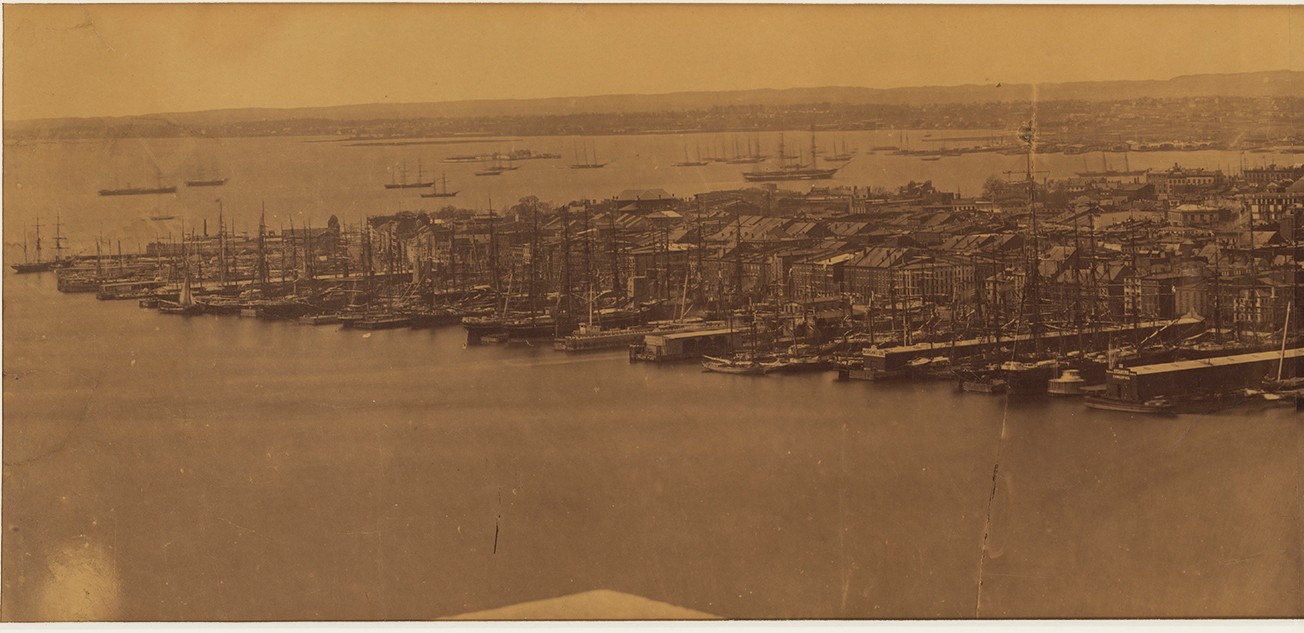
“New Yorkers had never seen their city like this before” – Mary Shapiro, Picture History of the Brooklyn Bridge
BEAL, JOSHUA H. Monumental 5-part Panorama of Lower Manhattan from the Brooklyn Bridge Tower
New York, 1876
Five joined albumen prints (total size 9 x 87 7/8 in.), flush mounted. Professional conservation. A splendid, monumental photograph in excellent condition.
“a seminal event in the representation of both the Brooklyn Bridge and New York City” – Richard Haw, The Brooklyn Bridge
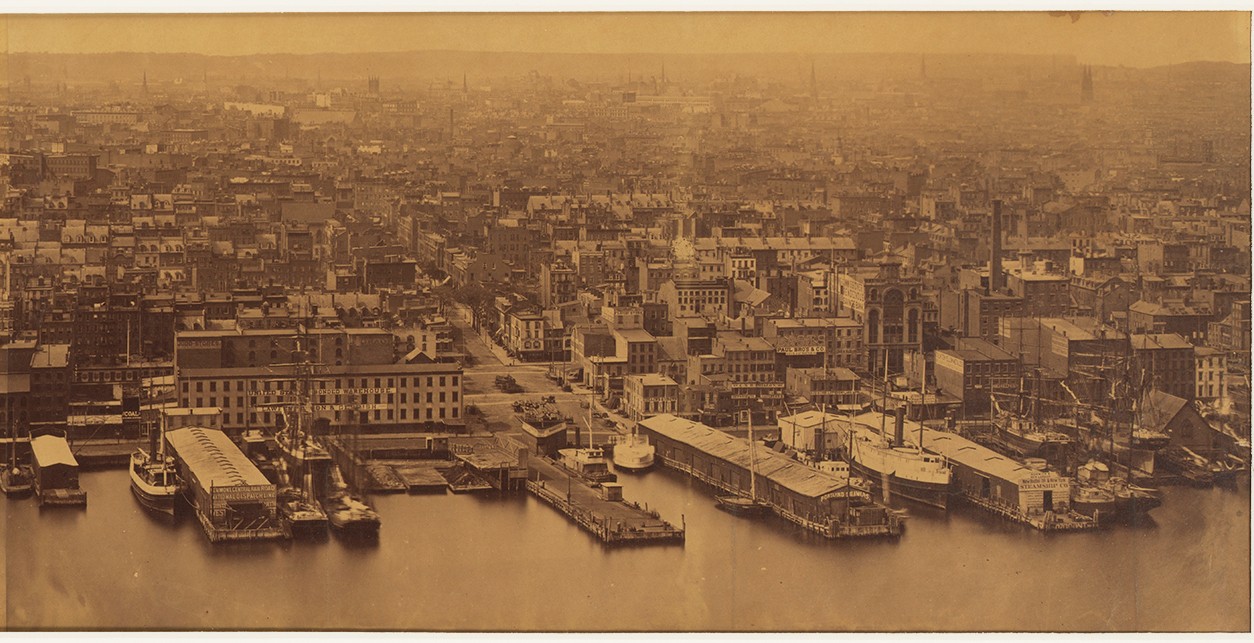
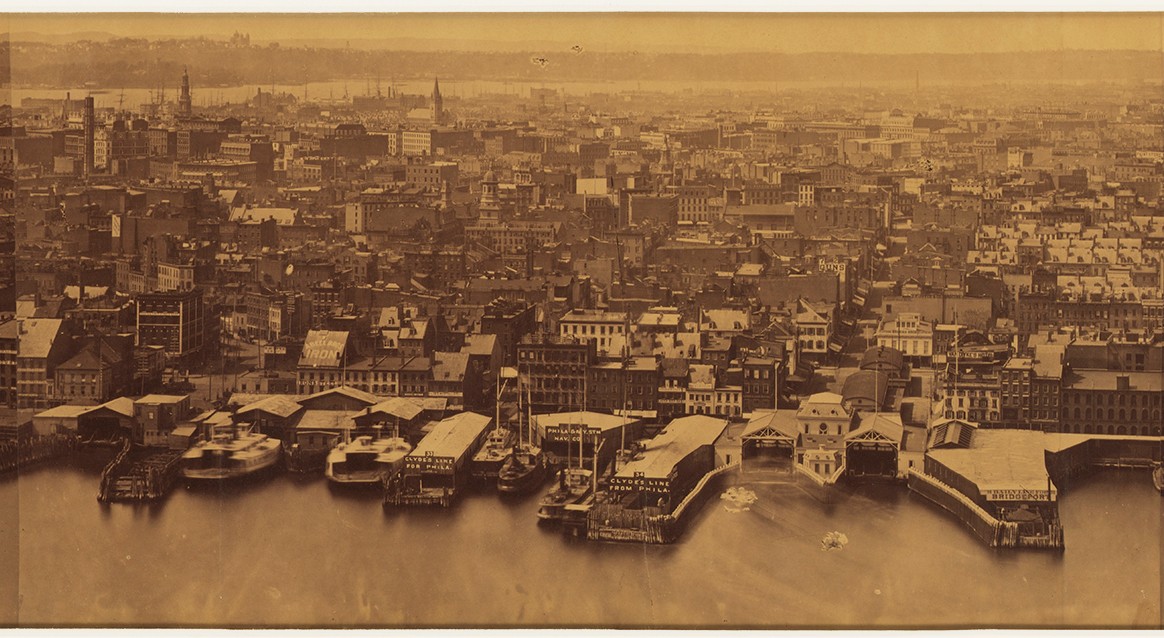
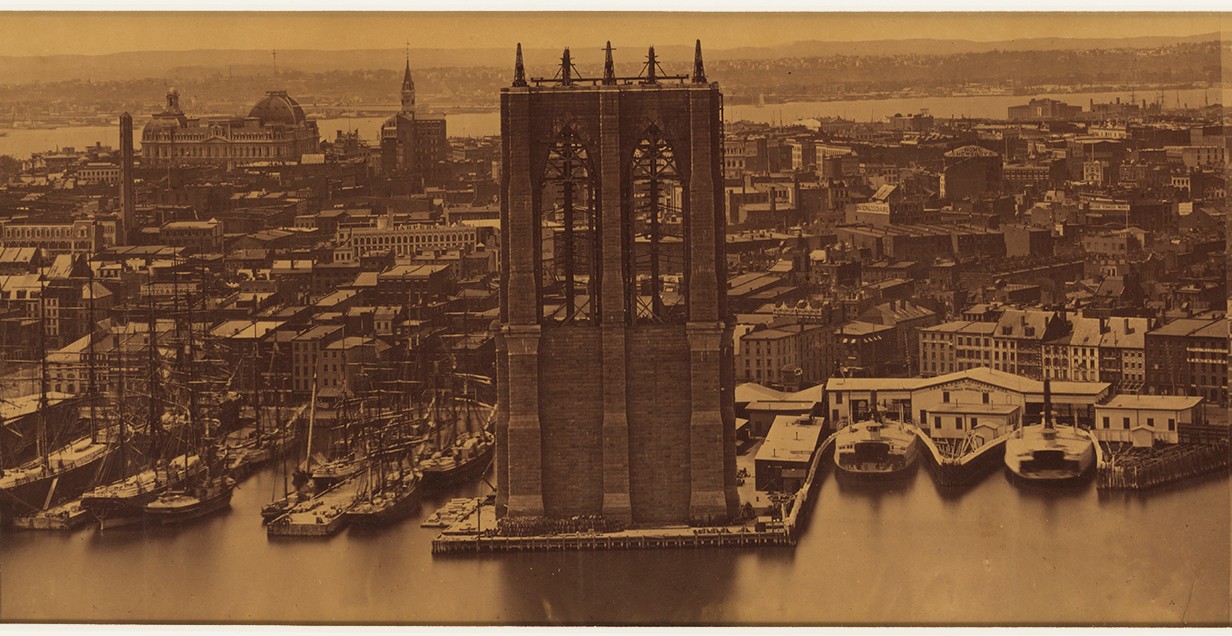
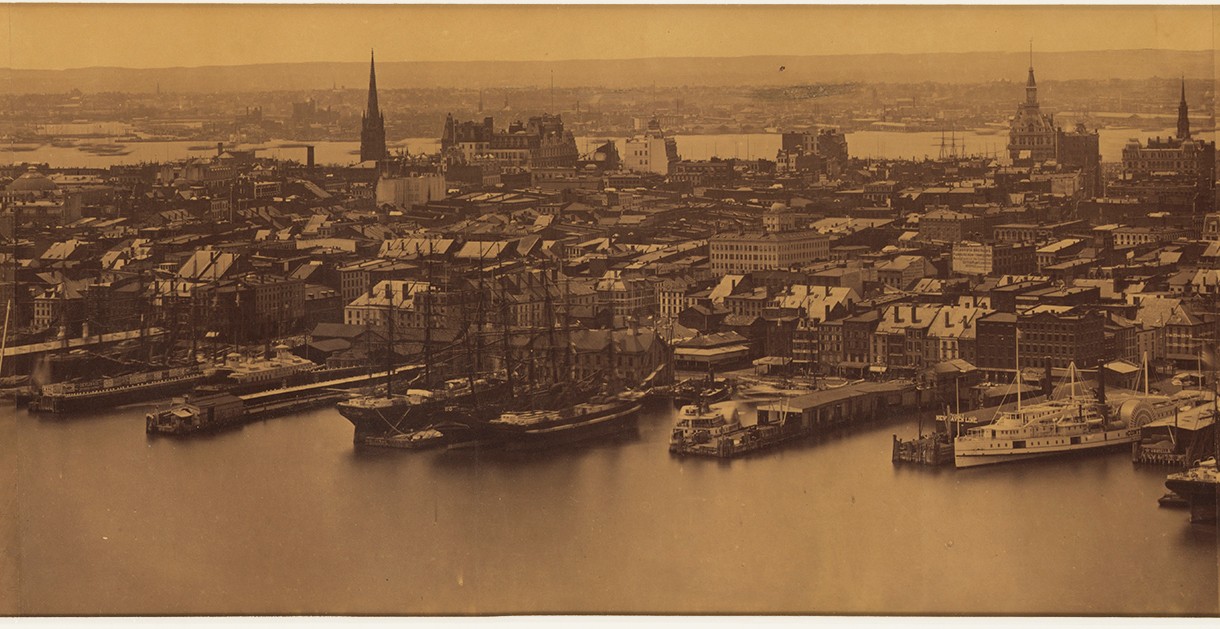
THE GREATEST NEW YORK CITY PANORAMIC PHOTOGRAPH. New York photographer Joshua H. Beal made this magnificent panoramic view of New York City in January 1876. The project required the photographer to carry his heavy camera equipment and glass plates up the thirty flights of stairs to the top of the east tower of the Brooklyn Bridge, then under construction. Back in his studio at 16 Beekman Street, Beal exposed five negatives to create this composite, 7-foot-long view. The images provided a never-before-seen sweeping panorama of lower Manhattan’s landmarks and commercial activity along the East River.
The photograph shows a never-before-seen sweeping vista of lower Manhattan’s landmarks. From the panorama’s left edge, the harbor opens toward the Battery, its waters crowded with ships and ferries, their masts forming a second skyline above the East River. South Ferry and Castle Clinton (the nation’s first immigration station, then still in operation) anchor the island’s tip, while the piers along South Street speak to the city’s bustling commercial activity in the years just after the Civil War. Behind them rises the columned Merchants’ Exchange at 55 Wall Street in its original four-story form.
Moving inland, the vast United States Hotel, then among the city’s largest hotels, occupies the block along Fulton Street between Pearl and Water, while Trinity Church’s spire pierces the dense grid of rooftops. Nearby stand the early skyscrapers of the Equitable Life and Mutual Life buildings (completed in 1870 and 1872, respectively), followed by the Western Union Telegraph and Evening Post buildings (both completed in 1875), their façades announcing the city’s new corporate modernity. Although Trinity’s spire remained the tallest point in the city, the Western Union building achieved the status of tallest building. To their north, St. Paul’s Chapel and the immense Post Office (which would only be completed in 1880, but had been occupied since 1875) extend the horizon toward Printing House Square, where the Tribune Building rises sharply beside the west tower of the Brooklyn Bridge, then under construction.
The Brooklyn Bridge’s New York tower dominates the center of Beal’s composition, dividing the view much as it would soon unite the city. To the right, the Roosevelt Street ferry slips line the river’s edge, while numerous painted signs, including “Harper’s,” “Abel Bros. Iron,” “Van Dyke’s Hotel,” “Judd Storage,” and “Clyde’s Line from Phila.,” bedeck the myriad buildings and piers. Further north, the busy Market Street traverses the city, extending to what was then known as Market Slip (piers 37 and 38). S. Valentine & Son Flour Store (started by Stephen Valentine, one of the founders of the New York Produce Exchange), can be spotted at the corner of Market Street and Cherry Street, with the Seamens Exchange building a little further on.
This is a monument of 19th-century American photography. “Perhaps the earliest fully successful overlapping multi-plate panorama, and also one of the most extravagant of New York City’s panoramas, was a seven-foot-long, five-plate assemblage made by Joshua R. Beal in 1856 [sic, 1876]. …Beal’s [view] started from the edge of the city—and New York had the advantage of a clearly delineated edge, where Manhattan island met the waters. …[Compared to Carleton Watkins’s panoramas of San Francisco,] Beal raised the stakes in the New York view by expanding its size and by using the far more sophisticated but also more cumbersome 16 x 20 ‘mammoth-plate’ view camera using glass plates and wet collodion. Beal could do this in part because he was exploiting the peak of the unfinished Brooklyn Bridge to give him ‘lift’ and keep the picture from ending up a long stripe of water with a city in the distance. A New York photographer who lived in Brooklyn and commuted to a Manhattan studio on Beekman Street, Beal was fully appreciative of the changes about to be wrought on New York by the bridge” (Hales, Silver Cities).
The Beal panorama of New York will be a centerpiece for any collection of American photography. Complete examples rarely appear for sale. An example sold at auction for $96,000 in 2012. The Library of Congress acquired its copy in the 2010s for $170,000. The New York Public Library’s copy has been prominently exhibited in its ongoing Treasures exhibition.
$150,000