


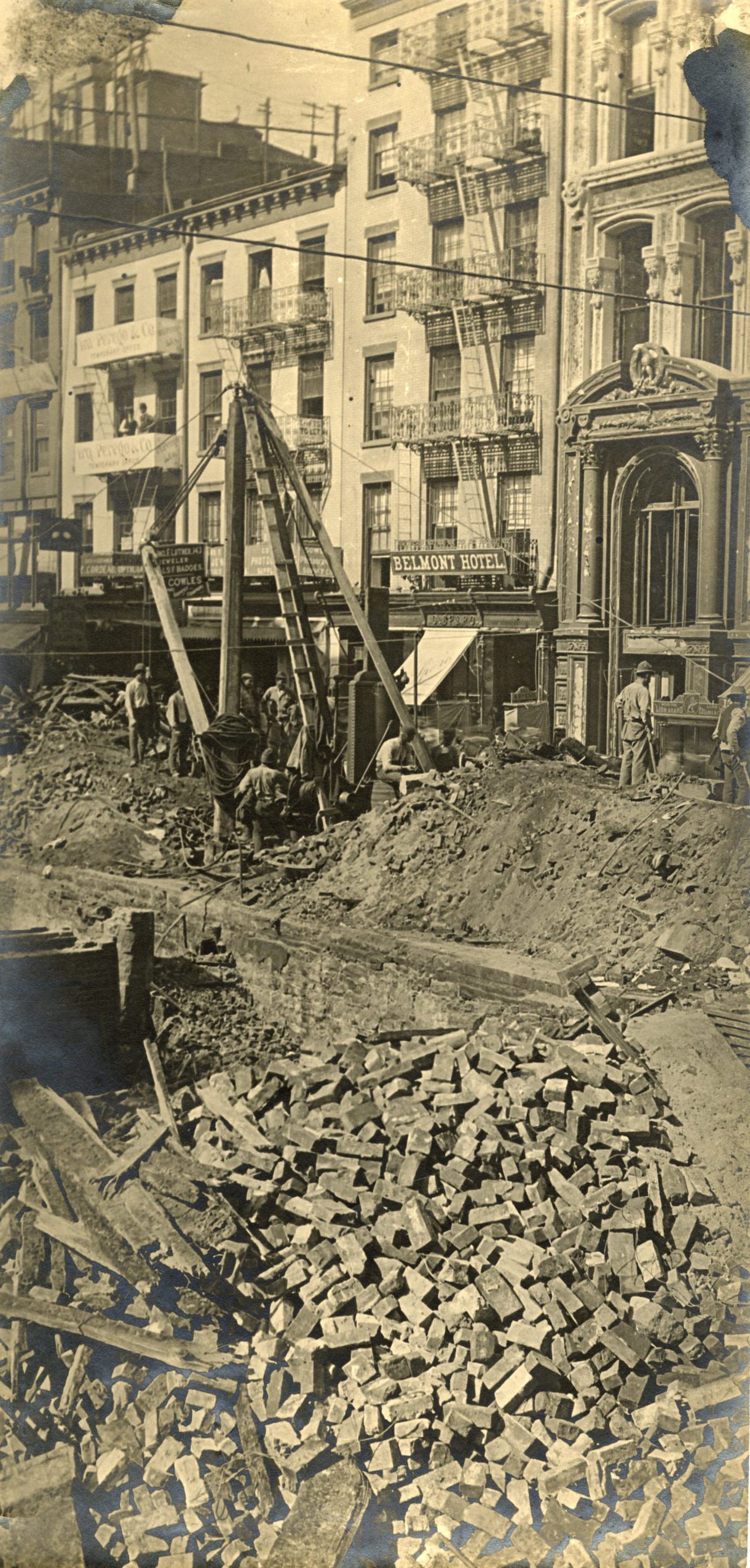
Urban renewal in New York
Unidentified photographer. Street excavation with Belmont Hotel
New York, 1900-1910
Gelatin silver print, 13 ½ x 6 ½ in.
This remarkable photograph records a stretch of old New York in the midst of destructive renewal. Rising across the background is a row of narrow buildings, upper stories crowded with iron balconies and fire escapes, and ground floors occupied by small businesses.
The sign reading “Belmont Hotel” identifies the building at center-right as a small downtown or lower-midtown hostelry of the ordinary sort that served clerks, transients, and other working people. It was emphatically not the far more famous Belmont Hotel erected at Park Avenue and 42nd Street between 1904 and 1908, the great August Belmont skyscraper-hotel that later dominated that corner. The very existence of that better-known hotel as a separate and later structure makes clear that the establishment seen here belongs to another, humbler urban register altogether.
The view is dominated, however, by the immense trench opened directly before these buildings. Heaps of broken brick and earth fill the foreground; a timber derrick rises from the churned-up roadway; laborers stand among cables, spoil, and exposed masonry walls. The excavation strongly resembles the open-cut or “cut-and-cover” works associated with the construction of New York’s first subway. Ground was broken for that system on March 24, 1900, and the original line opened in October 1904. Contemporary engineers repeatedly stressed that such work advanced through streets already congested by traffic and already packed beneath the pavement with sewers, water and gas mains, electric conduits, and other buried services. The scene here, with its broad trench carved through a fully built-up streetscape and its web of overhead wires crossing the image, belongs persuasively to that first great phase of subterranean reconstruction.
The photograph therefore stages a moment of sharp urban disjunction. The nineteenth-century street, with its mixed-use architecture and small-scale commerce, remains visibly in place, while the ground itself has already been seized by a new technological order.
$4,000