


New York’s first elevated railway
JOHNSTON, JOHN S. (attr.). The Ninth Avenue El
New York, 1893
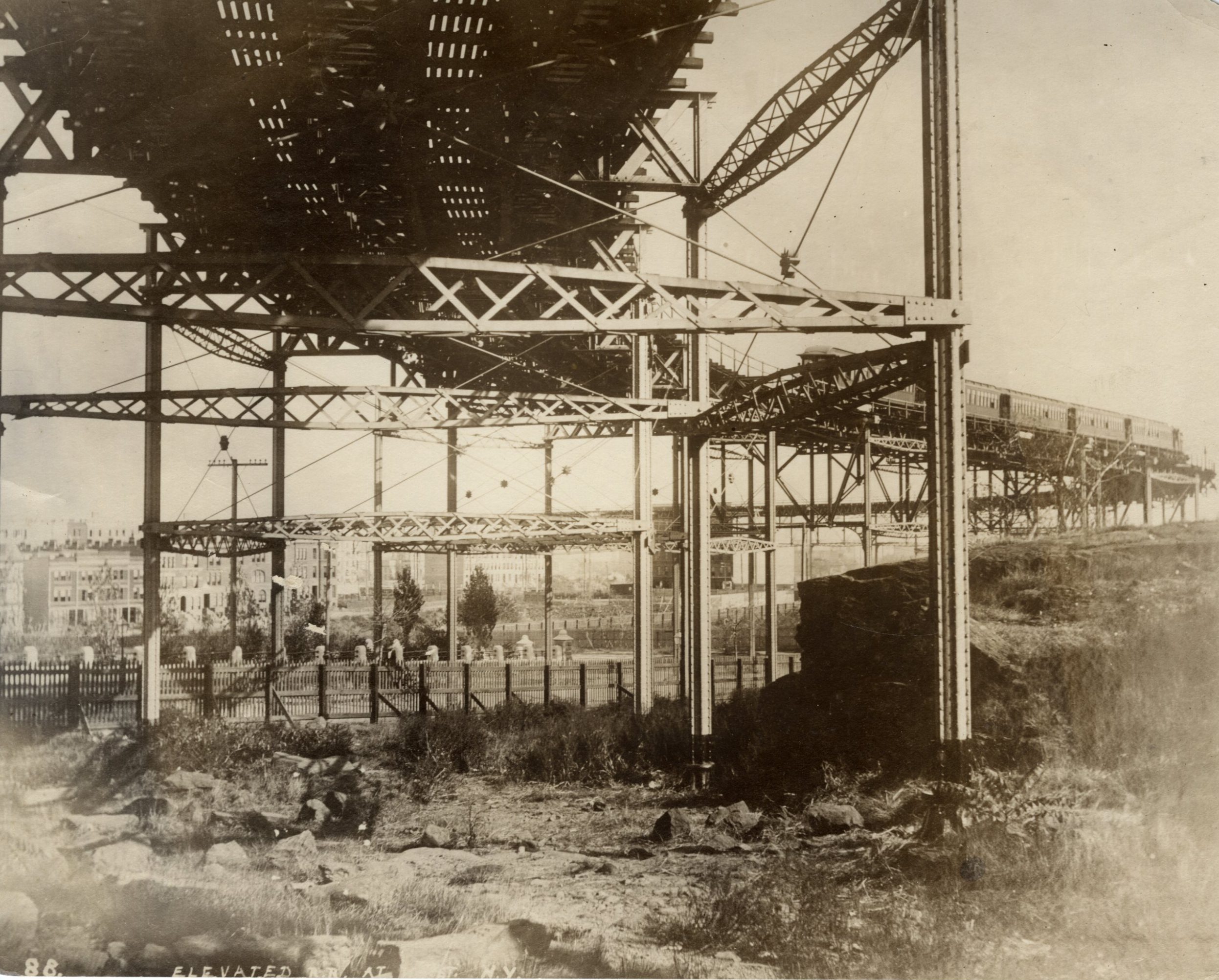
Albumen print, 7 x 8 ¾ in. Captioned in the negative “88. Elevated R. R. at [?] St. N. Y.” and inscribed in pencil on verso “110th St + 8th Ave – ‘L’ – 1893”. Very good condition. Archivally framed.
The Ninth Avenue Elevated was New York’s first elevated railway, opened in 1868 as a cable-hauled line and extended northward in stages, reaching 116th Street by 1891. This photograph shows the Ninth Avenue El at the intersection of 110th Street and Eighth Avenue (now Frederick Douglass Boulevard), where the line made a pair of 90-degree turns to get from Ninth Avenue across to Eighth.
Because the Upper West Side sits on a plateau that drops off sharply toward the Harlem valley, the tracks at this bend stood roughly 100 feet above the pavement, the highest point in the entire system. In later decades the spot became notorious for suicides and acquired the name “Suicide Curve.” A train is visible at right, rounding the turn at the reduced speed the geometry demanded.
The photograph is equally valuable as a record of what had not yet been built: the cornerstone of the Cathedral of St. John the Divine had been laid only the previous year, Columbia College would not relocate to Morningside Heights until 1897, and the surrounding blocks remained largely undeveloped scrubland, marked here only by a picket fence and the raw ironwork of the structure itself.
The El itself did not last to see the neighborhood’s maturity: service on the Ninth Avenue line ceased in 1940, and demolition of the curve began that November.
$2,900