


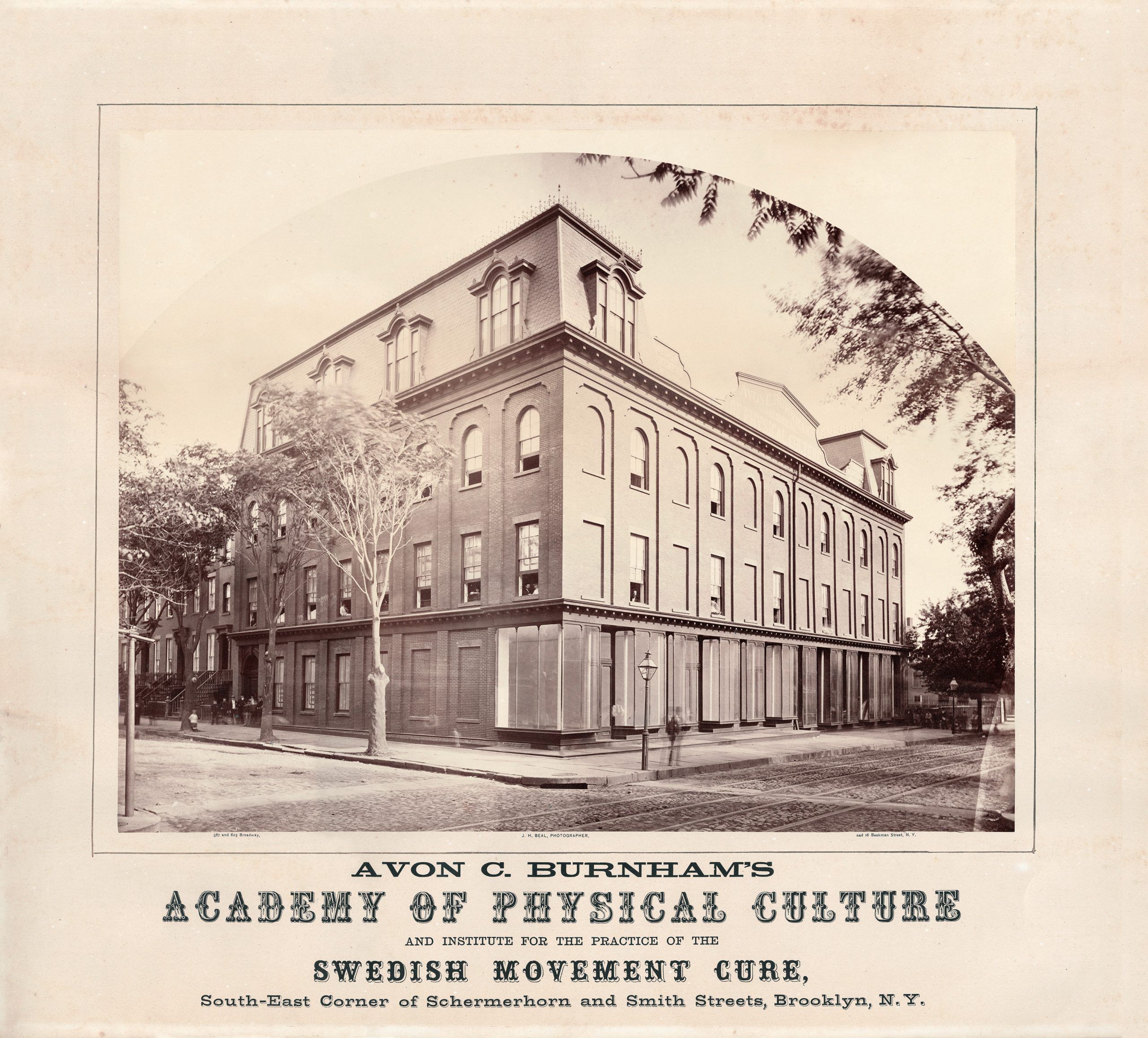
Brooklyn’s first public gymnasium and health club
Joshua H. Beal. Avon C. Burnham’s Academy of Physical Culture and Institute for the Practice of the Swedish Movement Cure, southeast corner of Schermerhorn and Smith Streets, Brooklyn, N.Y.
New York, 1870
14 1/2 x 18 3/4 in. Albumen silver print, mounted on card, printed title on mount. Fine condition.
This is a spectacular mammoth plate view of Brooklyn’s first public gymnasium and health club. Avon C. Burnham had been teaching gymnastics in Brooklyn since 1864, when he opened his first gymnasium at Fulton Street and Boerum Place; its popularity quickly outgrew the space, and in 1870 he moved the club to this substantial brick building at the southeast corner of Schermerhorn and Smith Streets, in what is now Boerum Hill. Burnham promoted his Academy in the Brooklyn Directory Advertiser as “the largest and most complete institution of its kind in the world”: the upper floors contained the gymnasium, offices, dressing rooms, and a spectator gallery, while the lower level housed Turkish and Russian baths, bowling alleys, and Dr. George H. Taylor’s department for the Swedish Movement Cure, a therapeutic system of medical gymnastics and manual treatment derived from the methods of Pehr Henrik Ling.
Burnham’s academy belonged to a broader nineteenth-century movement that treated bodily training as an answer to the perceived debility of modern urban life. By the 1860s and 1870s, sedentary office work had become a subject of reformist anxiety, and several systems competed for authority, most prominently the German Turnverein tradition of heavy apparatus work and the Swedish system associated with Ling, which took a more therapeutic approach, using ordered calisthenic movements and manual manipulation to cultivate health, posture, and bodily discipline. The organized controversy later known as the “Battle of the Systems” came to the fore in the 1880s and 1890s; Burnham’s work belongs to the earlier ferment from which those debates emerged, and his “Pangymnastikon” aimed above all at comprehensiveness.
Born in New Brunswick, Canada, around 1836 or 1837, Burnham spent most of his life in Brooklyn and appears to have understood physical education as part of a broader culture of self-improvement. His classes included women and girls as well as men and boys, a significant feature at a moment when female exercise was still hedged by medical and social caution. His pupils also took part in gymnastic, calisthenic, tableaux, and pantomimic entertainments, joining bodily training to the practices of public display and cultivated performance. He remained associated with physical education in Brooklyn for decades and died there in 1917.
Burnham’s Academy is pictured here by photographer Joshua H. Beal in what is almost certainly a promotional image given the prominent text underneath.
$9,500