


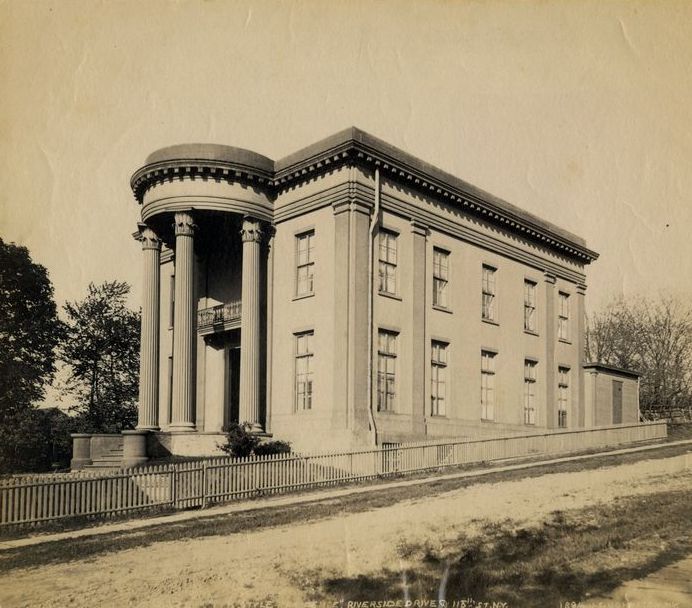
Classic New York mansion at present-day 420 Riverside Drive
JOHNSTON, JOHN S. Carrigan-Rudd Mansion
New York, 1894
Albumen print, 7 x 8 ¾ in. Captioned in the negative, partially illegible: “[?]283A ‘Old style residence,’ Riverside Drive & 115th St., N.Y.” The final digit appears to have been altered from 4 to 5; the house is well documented at the northeast corner of Riverside Drive and 114th Street.
The “old style residence” presented here was originally the home built for Andrew Carrigan, an Irish-born provisions merchant who emigrated in the 1820s, made his fortune, and in 1850 helped found the Emigrant Industrial Savings Bank. Sources disagree on when it was erected (dates range from the late 1830s to 1854), but the Greek Revival style is consistent with the country villas that lined the old Bloomingdale Road before Riverside Drive opened in 1880. Most striking in this photograph is the semicircular portico on four Corinthian columns, facing the Drive.
The Carrigan family sold the house and estate, which originally occupied some twenty-two building lots, to the Rudd family in the 1870s, in whose hands it remained for nearly forty years as the Upper West Side filled in around it. In 1910, Althea Ward Rudd sold the property to a developer. Demolition came the following year, and 420 Riverside Drive, an apartment building, went up in its place. The New York Times noted the sale on its front page that February under the heading “Another Landmark Passing.”
Very little is known about John S. Johnston (c. 1839-1899), and what is known tends toward the enigmatic. He was reportedly born in Ireland, lived alone at 464 West 166th Street, and operated a studio at 1,263 Broadway. Johnston specialized in what the New York Times called “scenic photography,” producing both a large body of carefully numbered views of New York City and an extensive record of maritime subjects, including most of the United States warships that served in the Spanish-American War and all of the international yacht races of the 1890s. His photographs appeared in periodicals like Outing Magazine and Forest and Stream. He was also a technical innovator: in 1886, Scientific American reported his patent for a plate reservoir camera that could feed and deposit sensitized plates automatically, designed for rapid, handheld use. In the fall of 1899, Johnston caught a severe cold while photographing the Columbia-Shamrock America’s Cup races and traveled to Niagara Falls to recover. He died there of apparent heart trouble on December 17th. According to the Times, “Mr. Johnston would not give his home address or the names of any friends in New York, even when he was told that his death was near.” His glass negatives are held by the New-York Historical Society; the Museum of the City of New York and the Library of Congress also hold extensive collections of his work.
$2,500