


Broadway
Various artists. Collection of 10 photographs of Broadway
New York, 1884-1915
10 albumen and gelatin silver prints, various sizes (6½ × 8¼ in. – 17 × 10 in.). Very good condition over all.
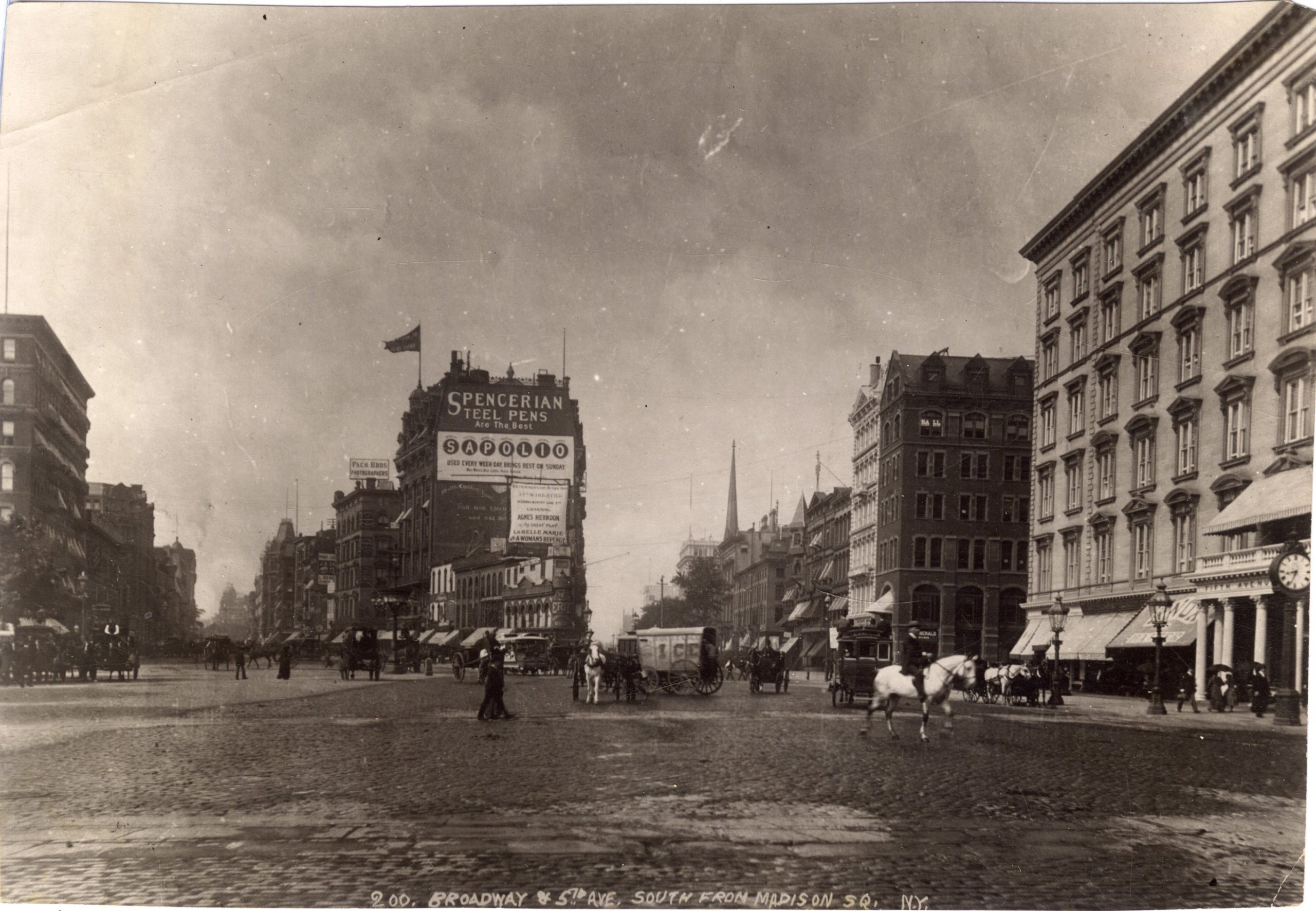
This collection of ten photographs shows Broadway and its environs from Bowling Green to Madison Square.
By the 1890s, Broadway functioned as both the primary commercial artery of Manhattan and a testing ground for new building forms. Along its length, older masonry structures from the 1860s and 1870s remained in use even as steel-framed office buildings rose beside them, producing a street defined by uneven heights, mixed materials, and rapid turnover. These photographs trace Broadway from Bowling Green north past Madison Square, documenting a corridor where finance, retail, and transportation converged within a span of roughly two miles.
This collection includes:
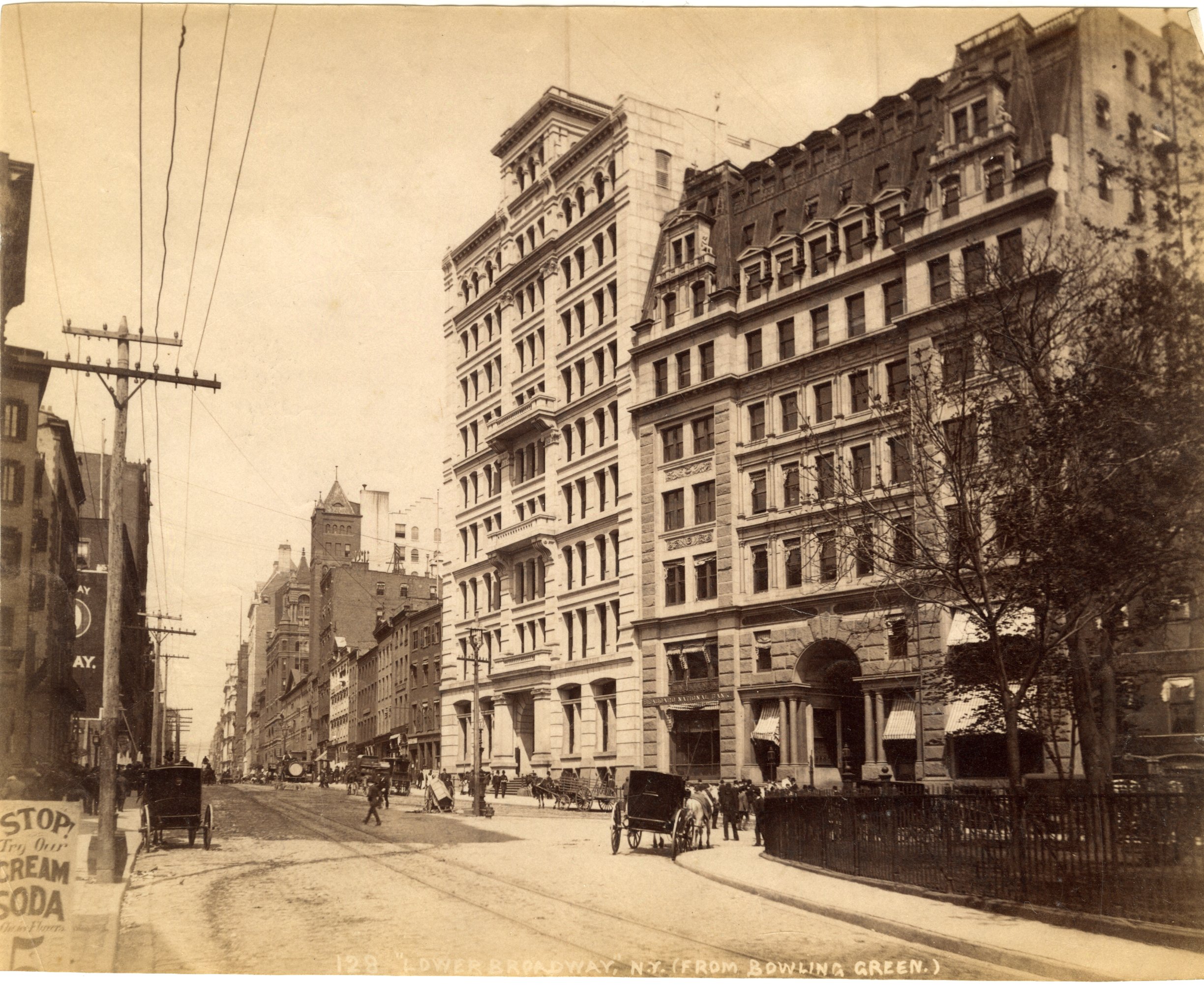
John S. Johnston. Lower Broadway, N.Y. (from Bowling Green), c. 1894-85.
View north from Bowling Green, the city’s oldest park, with its iron fence is visible at far right). Early tall office buildings, including the Washington Building (completed in 1885), line the avenue.
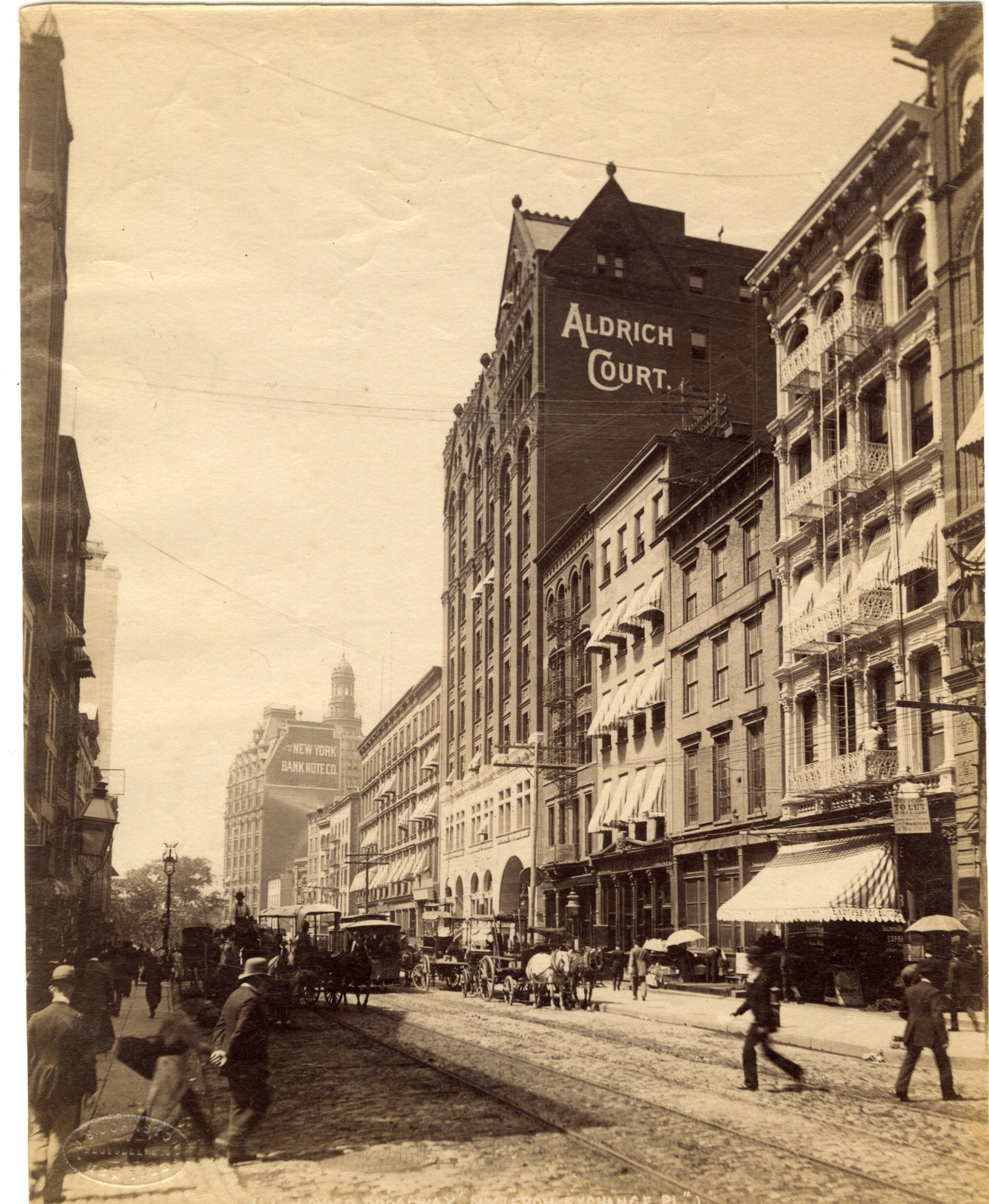
John S. Johnston. Lower Broadway, N.Y. (from Exchange Place), c. 1894-95.
This is several blocks north of the Bowling Green view. Aldrich Court, erected between 1886 and 1887, is designated by a large painted sign, while a “New York Bank Note Co.” sign is visible in the distance. The mix of building heights is emblematic of Broadway in transition, with mansarded structures from the 1870s standing next to newer commercial buildings pushing toward ten stories.
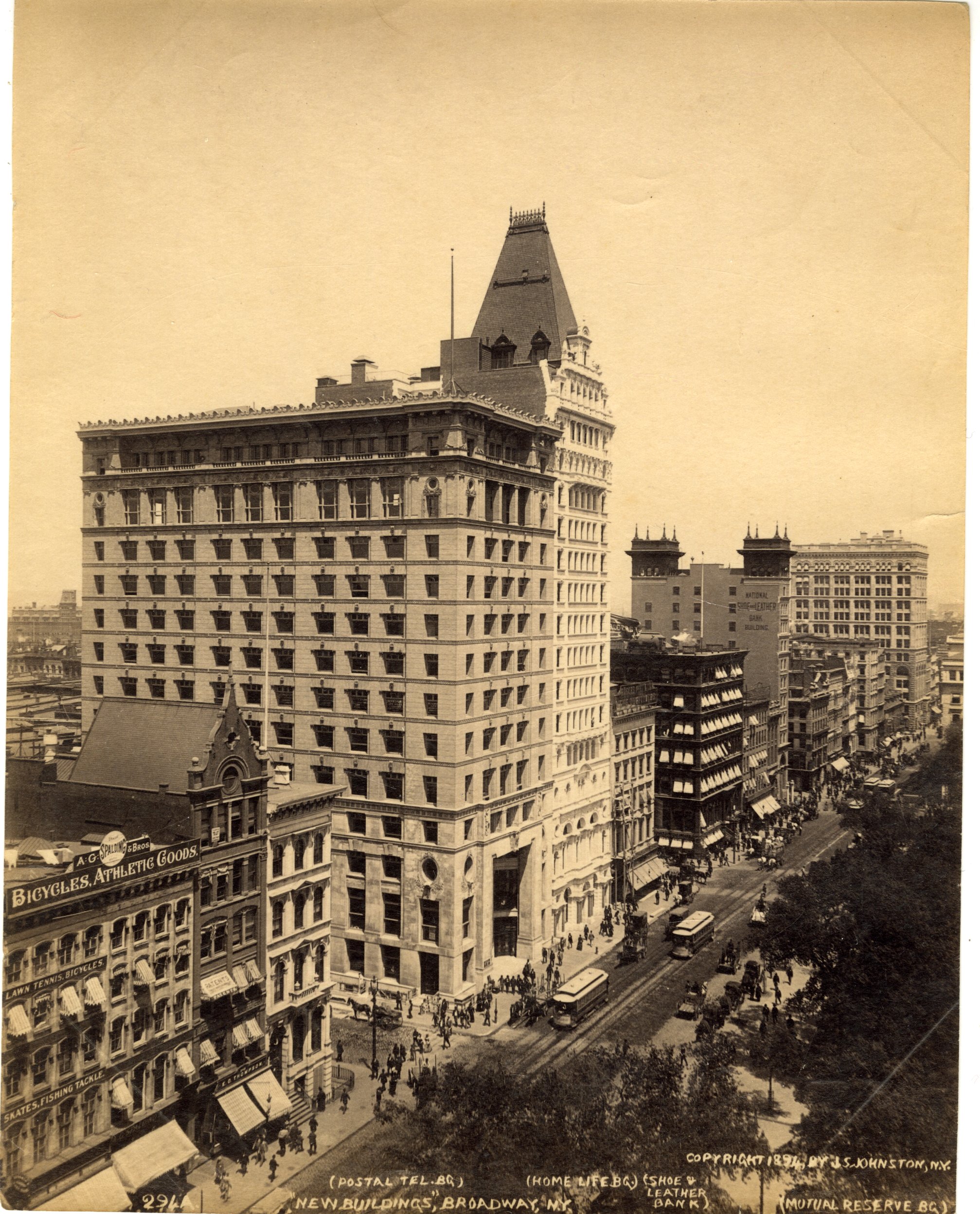
John S. Johnston. New Buildings, Broadway, N.Y., 1894.
Johnston’s caption here points directly to the newness of the buildings included here. The Postal Telegraph Building dominates the left foreground; the Home Life Insurance Building, the Shoe and Leather Bank, and the Mutual Reserve Building are identified along the right side of Broadway. Signs for “A.G. Spalding & Bros. Bicycles, Athletic Goods” are legible at far left, while a small Gothic church threatens to be swallowed by the towers rising around it.
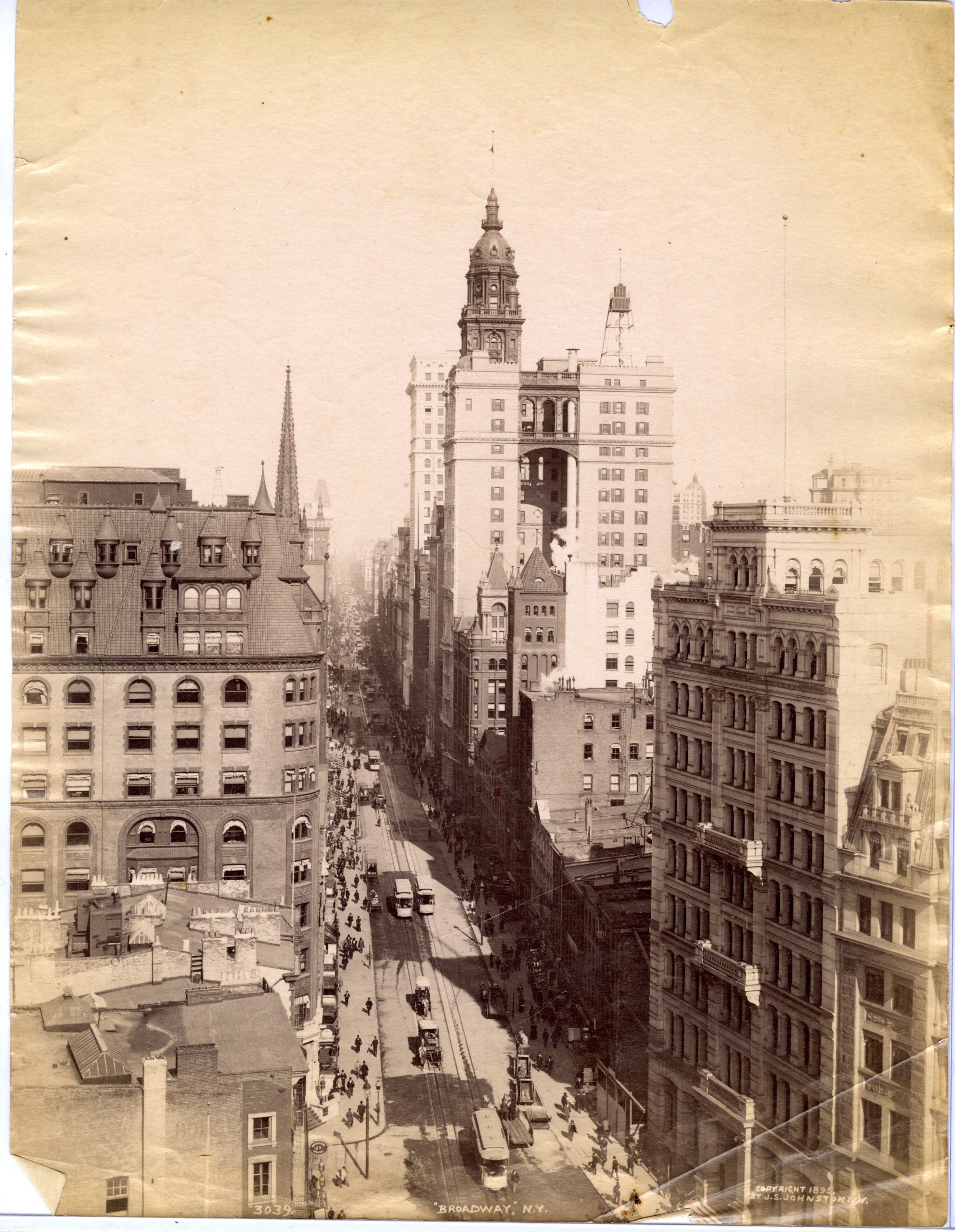
John S. Johnston. Broadway, N.Y., 1895. Albumen print, 13 x 10 in.
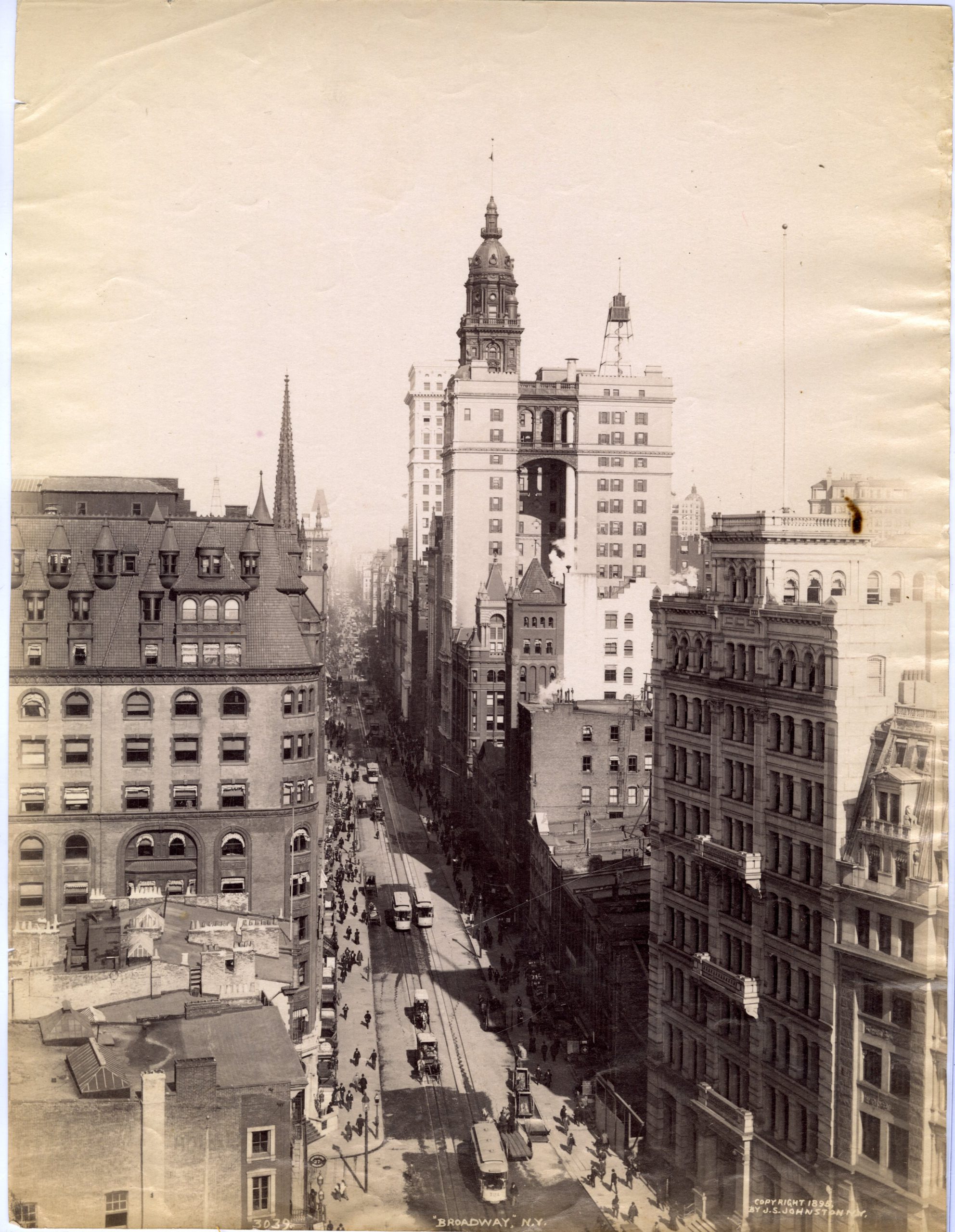
John S. Johnston. Broadway, N.Y., 1895. Albumen print, 13 x 10 in.
Two prints from the same negative, Johnston’s largest-format view of lower Broadway, taken from high up and looking north. The World Building, completed in 1890, rises at center with its dome and tower, while the Washington Building of 1885 and the newer Home Life, Postal Telegraph, Shoe and Leather Bank, and Mutual Reserve buildings, all completed between 1892 and 1894, mark the rapid vertical rebuilding of the avenue.
Unidentified photographer. Wall Street looking west toward Trinity Church, c. 1890s-1900s.
The Gillender Building, an early skyscraper completed in 1897, rises at center, with the Gothic spire of Trinity Church visible behind it. The columned portico of the Sub-Treasury (Federal Hall) appears at right.
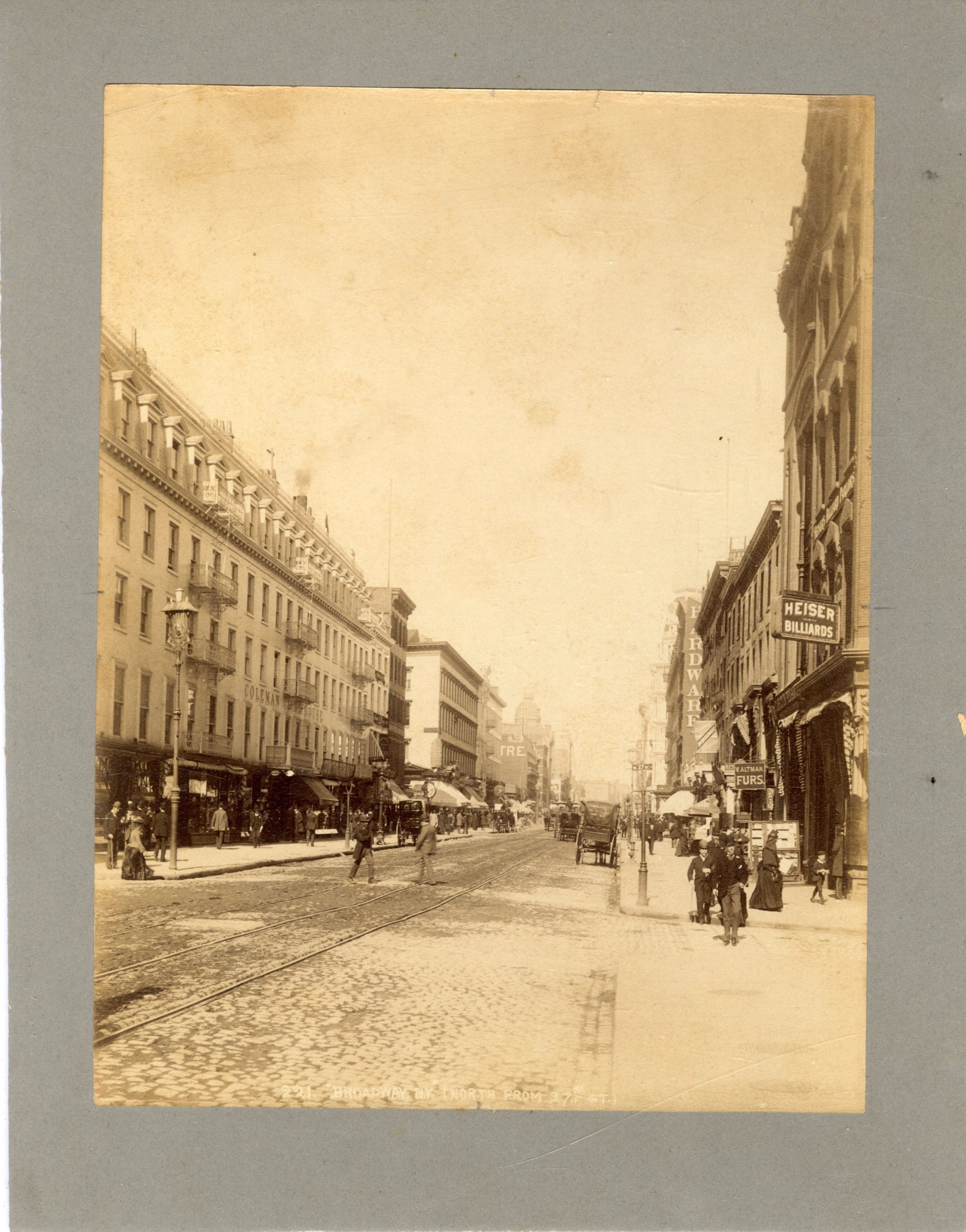
John S. Johnston. Broadway, N.Y. (North from 27th St.), c. 1894-95.
Upper Broadway at 27th Street, with signage for Heiser Billiards, hardware merchants, and fur dealers. This stretch functioned as a retail corridor tied to nearby hotels and theaters.
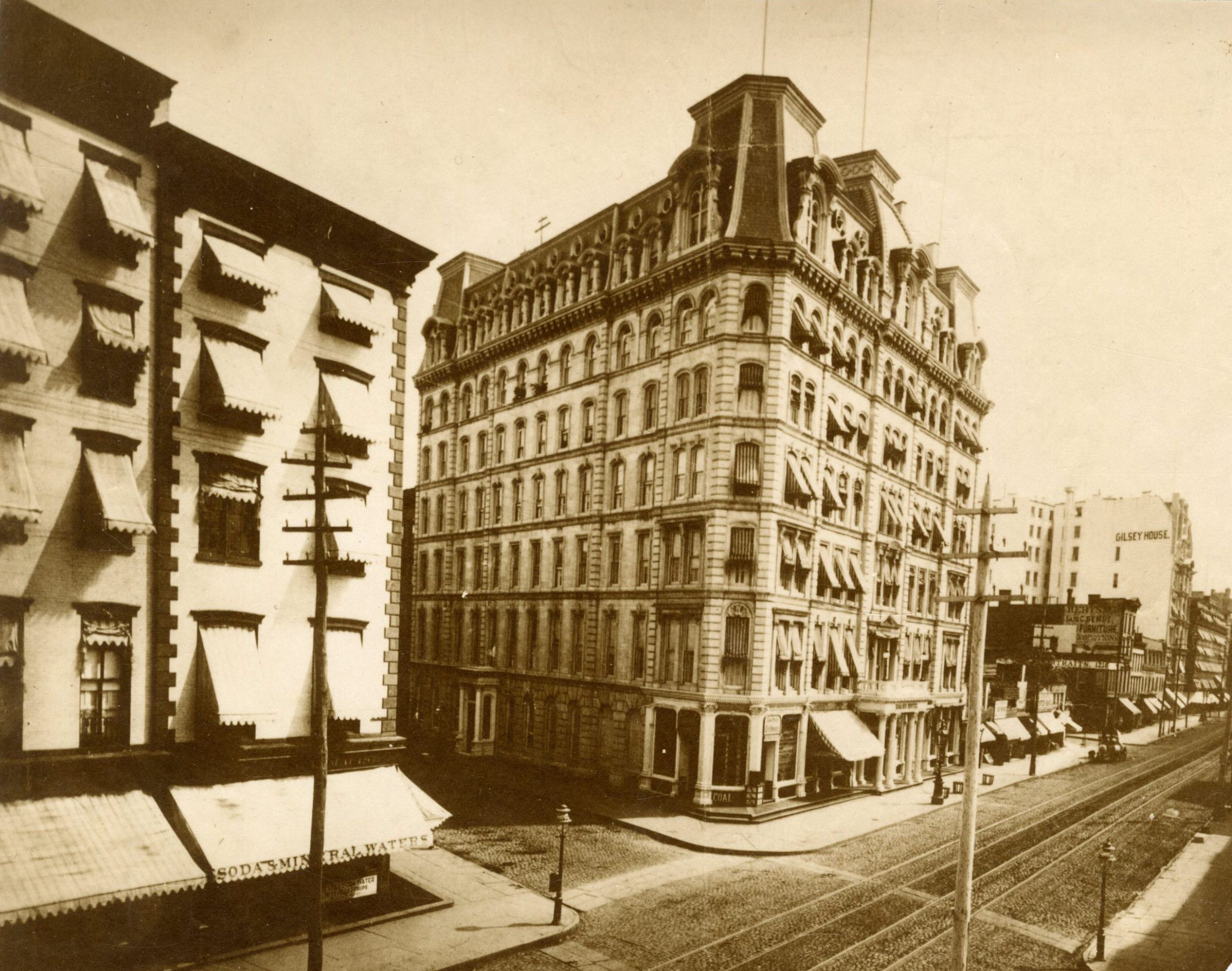
Unidentified photographer. Broadway and 31st Street, c. 1884.
The Grand Hotel at the southeast corner of Broadway and 31st Street, a six-story Second Empire structure completed in 1868 by architect Henry Engelbert. The photograph predates the taller commercial buildings that later defined this section of Broadway. The Grand Hotel survived into the twentieth century under various names before ultimately being demolished.
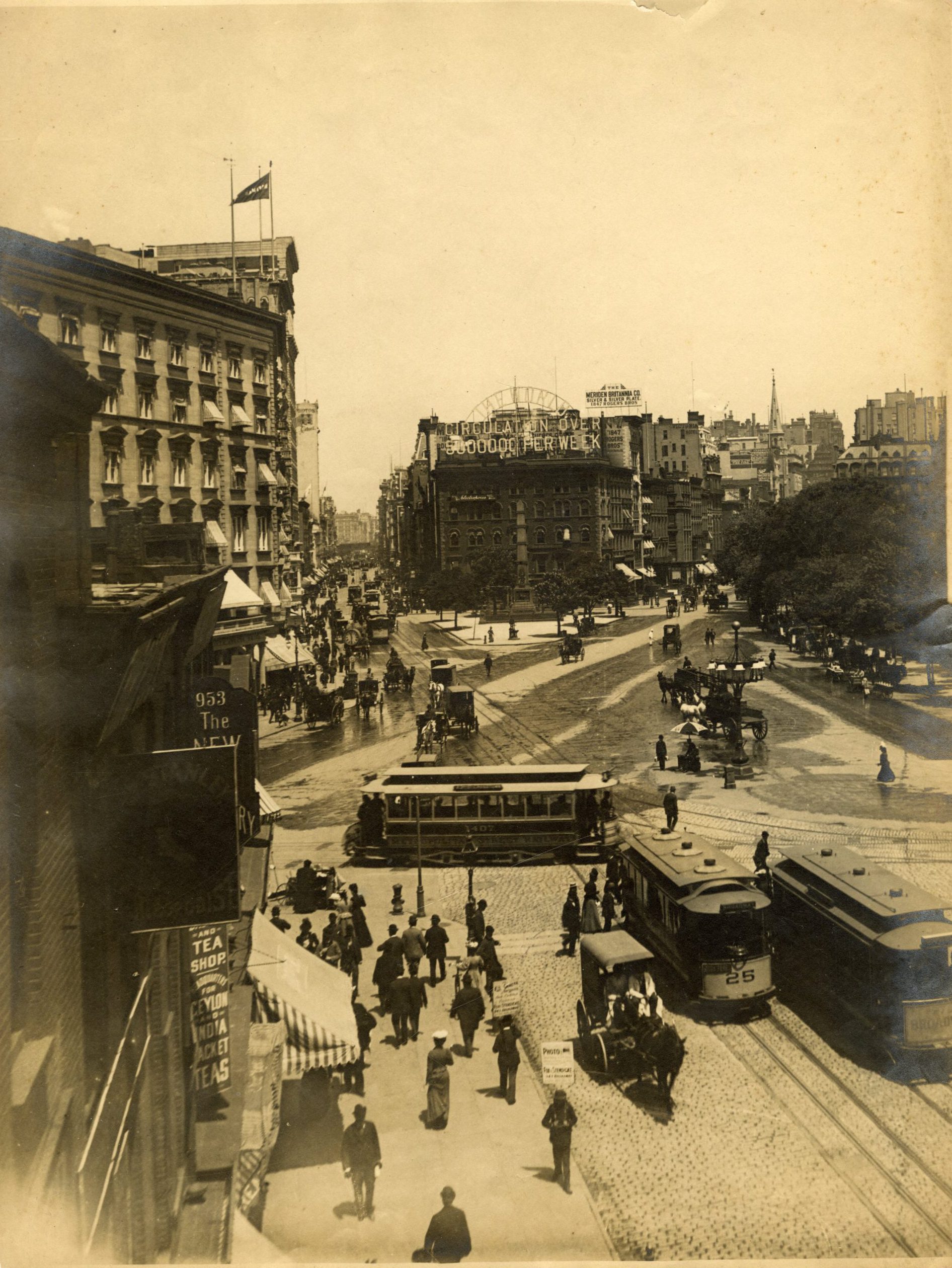
Unidentified photographer. Worth Square, looking north up Broadway and Fifth Avenue, c. 1900s.
Worth Square occupies the small wedge at Broadway, Fifth Avenue, and 25th Street, where the two avenues meet before separating again farther north beside Madison Square Park. At center stands the Worth Monument, the granite obelisk marking the burial place of Major General William Jenkins Worth; beyond it rises the spire of Marble Collegiate Church at Fifth Avenue and 29th Street. At left, a storefront sign for “Ceylon India Packet Teas” appears to mark no. 953 Broadway.
The photograph also catches New York in a moment of transit overlap: electric streetcars run through the square while horse-drawn wagons, carriages, and delivery vehicles still crowd the roadway, so that older street traffic and newer electrified urban movement share the same scene
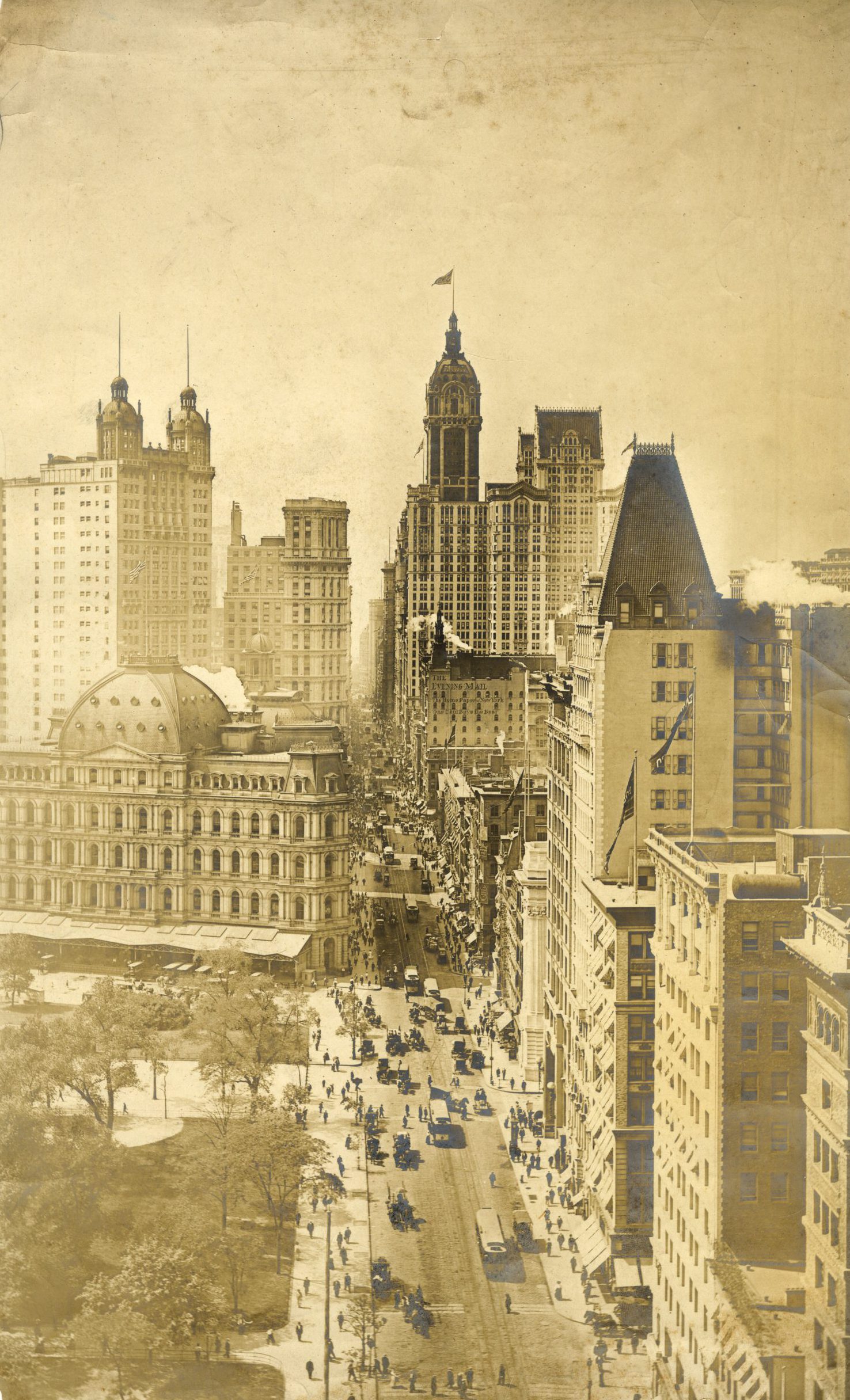
Unidentified photographer. Broadway looking south from above City Hall Park, c. 1905-1915.
Later view showing increased building height and density. Commercial signage, including “The Evening Mail,” occupies upper façades while automobiles now appear alongside older forms of street traffic.
A full description and inventory are available on request.
$15,000