


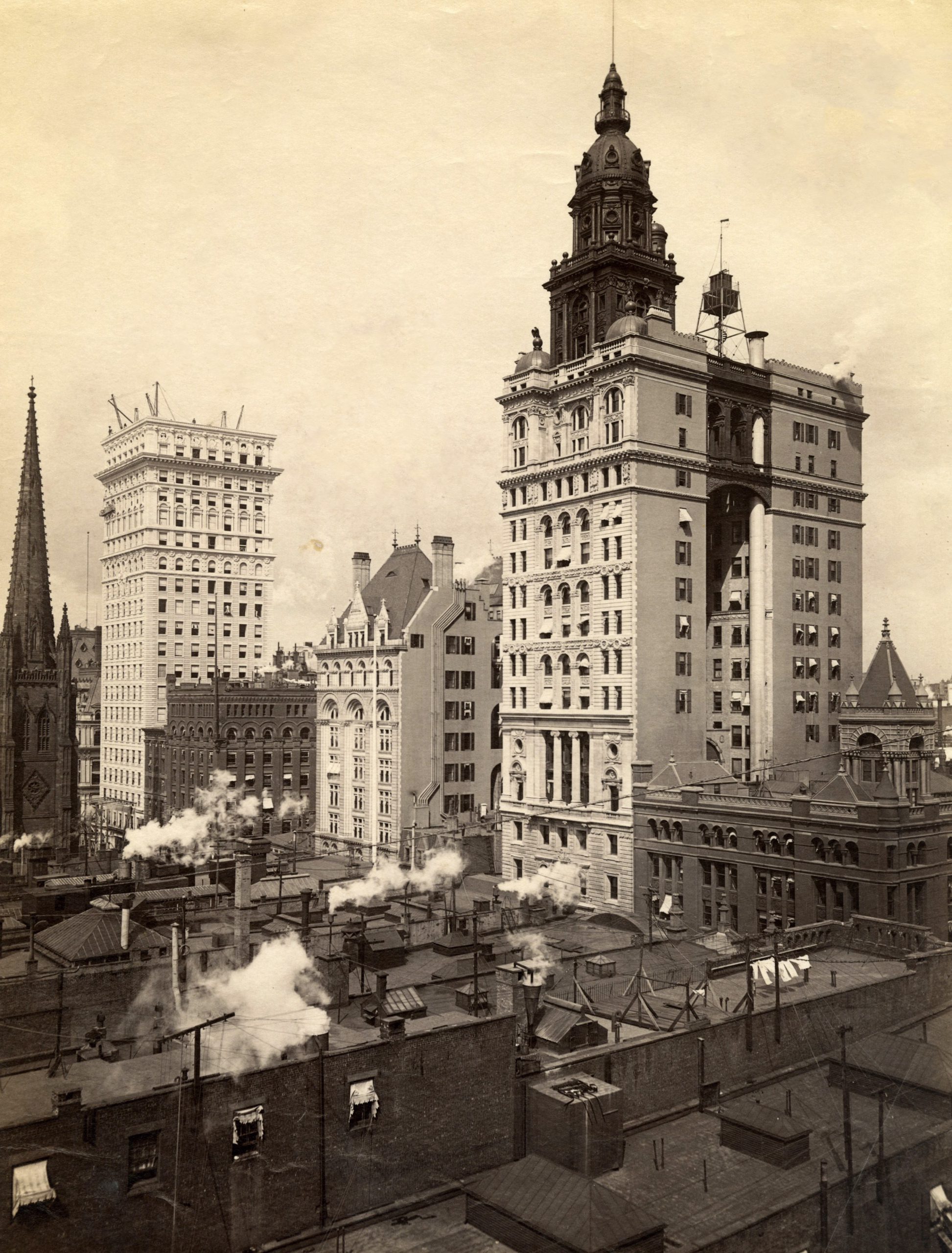
The tallest building in New York
JOHNSTON, JOHN S. Manhattan Life Building, N.Y.
New York, 1895
Albumen print, 13 x 10 in. Captioned in the negative “3036. Manhattan Life Building, N.Y. Copyright 1895, By J.S. Johnston, N.Y.” with additional labels identifying “Trinity Church,” “Surety Bg.,” “United Bank Bg.,” “Union Trust Co. Bg.,” and “Consolidated Exchange Bg.” Archivally framed. A lovely print with excellent tones and contrast.
The dominant structure in this view is the Manhattan Life Insurance Building at 64–66 Broadway, designed by Francis H. Kimball and George Kramer Thompson and completed in 1894. Rising 348 feet to the top of its lantern, it was the tallest building in New York when this photograph was taken, having surpassed the World Building the previous year; it retained that distinction until the Park Row Building overtook it in 1899. The building was also a notable engineering achievement, its foundations among the first in the city to employ pneumatic caissons, sunk through deep mud and quicksand to bedrock under the direction of engineer Charles Sooysmith.
At far left stands the spire of Trinity Church. Behind it rises the American Surety Building at Broadway and Pine Street, designed by Bruce Price and here still under construction or nearing completion. Johnston’s photograph thus records a pivotal moment in Lower Manhattan’s transformation, juxtaposing Trinity’s Gothic landmark and the low, smoke-filled rooftops of the older commercial city with the new generation of steel-frame office towers then reshaping the financial district.
Of the major structures visible here, Trinity Church and the American Surety Building survive, the latter enlarged in 1920-22. The Manhattan Life Building was demolished in 1963 or 1964 to make way for the annex to 1 Wall Street.
Very little is known about John S. Johnston (c. 1839-1899), and what is known tends toward the enigmatic. He was reportedly born in Ireland, lived alone at 464 West 166th Street, and operated a studio at 1,263 Broadway. Johnston specialized in what the New York Times called “scenic photography,” producing both a large body of carefully numbered views of New York City and an extensive record of maritime subjects, including most of the United States warships that served in the Spanish-American War and all of the international yacht races of the 1890s. His photographs appeared in periodicals like Outing Magazine and Forest and Stream. He was also a technical innovator: in 1886, Scientific American reported his patent for a plate reservoir camera that could feed and deposit sensitized plates automatically, designed for rapid, handheld use. In the fall of 1899, Johnston caught a severe cold while photographing the Columbia-Shamrock America’s Cup races and traveled to Niagara Falls to recover. He died there of apparent heart trouble on December 17th. According to the Times, “Mr. Johnston would not give his home address or the names of any friends in New York, even when he was told that his death was near.” His glass negatives are held by the New-York Historical Society; the Museum of the City of New York and the Library of Congress also hold extensive collections of his work.
$5,000