


Hunter College
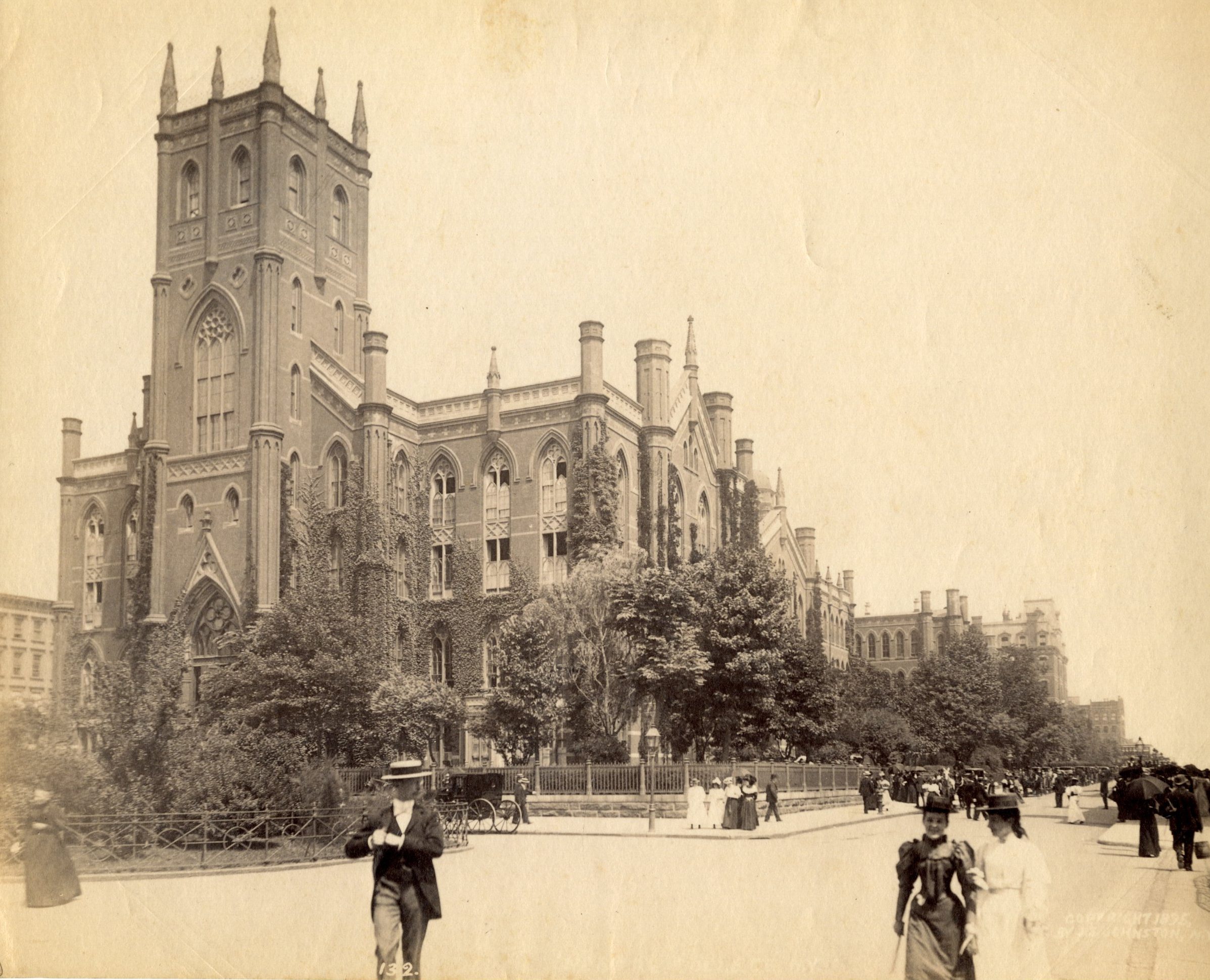
JOHNSTON, JOHN S. Normal College, 68th Street and Park Avenue.
New York, 1895
Albumen print, 7 x 9 ½ in. Captioned in the negative “132. ‘Normal College’ Copyright 1895, by J. S. Johnston, N.Y.”
This photograph shows the original building of the Normal College of the City of New York, seen from Park Avenue at East 68th Street. Designed by David I. Stagg and formally opened in September 1873, the large Gothic Revival structure occupied the block between Park and Lexington Avenues and 68th and 69th Streets. Its tower, pinnacles, pointed-arch windows, and ivy-clad walls gave the college a distinctly collegiate character, while its commanding siting on Park Avenue announced the civic ambitions of the institution within the rapidly developing Upper East Side streetscape.
Founded in 1870 by Thomas Hunter as the Female Normal and High School, the institution trained women as teachers and admitted qualified students without regard to race, religion, or ethnicity. In 1888 it was chartered as the Normal College of the City of New York, and in 1914 it was renamed Hunter College in honor of its founder. As Hunter College later described its own history, it was the first public, tuition-free college for women in the United States, and the monumental scale of the building recorded here reflects that unusually ambitious civic commitment to women’s education.
The 1873 building was practically destroyed by fire on February 14, 1936. It was replaced on the same site by the present Hunter College North Building, designed by Shreve, Lamb & Harmon in consultation with Harrison & Fouilhoux and dedicated in October 1940.
Very little is known about John S. Johnston (c. 1839-1899), and what is known tends toward the enigmatic. He was reportedly born in Ireland, lived alone at 464 West 166th Street, and operated a studio at 1,263 Broadway. Johnston specialized in what the New York Times called “scenic photography,” producing both a large body of carefully numbered views of New York City and an extensive record of maritime subjects, including most of the United States warships that served in the Spanish-American War and all of the international yacht races of the 1890s. His photographs appeared in periodicals like Outing Magazine and Forest and Stream. He was also a technical innovator: in 1886, Scientific American reported his patent for a plate reservoir camera that could feed and deposit sensitized plates automatically, designed for rapid, handheld use. In the fall of 1899, Johnston caught a severe cold while photographing the Columbia-Shamrock America’s Cup races and traveled to Niagara Falls to recover. He died there of apparent heart trouble on December 17th. According to the Times, “Mr. Johnston would not give his home address or the names of any friends in New York, even when he was told that his death was near.” His glass negatives are held by the New-York Historical Society; the Museum of the City of New York and the Library of Congress also hold extensive collections of his work.
$2,500