


“If the law supposes that, the law is an ass—a idiot” – Oliver Twist, Chapter 51
DICKENS, CHARLES. The Adventures of Oliver Twist
London: Bentley, 1838
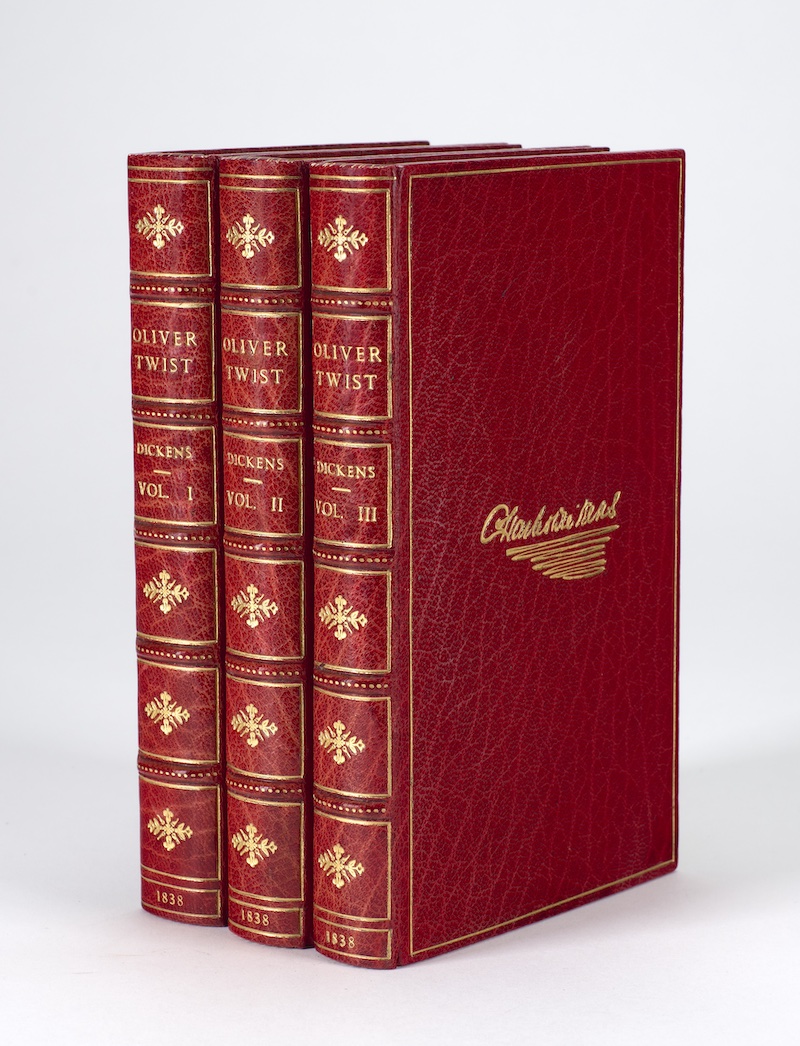
Three volumes. Fine scarlet morocco by Bayntun, a.e.g., facsimile of Dickens’s signature on upper boards. With the half-title in vol. I, without the half title in vol. II, none called for in vol. III. . Light foxing to titles. A fine set.
FIRST EDITION IN BOOK FORM, FIRST ISSUE. Oliver Twist was Dickens’s first book to be published in the three-decker format. There was no parts edition until 1846. Instead, the novel was published serially in the magazine Bentley’s Miscellany. Before the magazine publication was completed, Bentley decided to issue the book edition, likely an attempt to sell the book to those who could not wait to see the conclusion in the magazine.
As a result, George Cruikshank, who contributed 24 illustrations for the work, had to complete the final plates in haste. Dickens did not review them until publication was at hand, and he found that he objected to the “Fireside” plate in vol. III. Cruikshank obliged by replacing the engraving with the so-called “Church” plate, which was not completed in time for the first copies issued on November 9. This is one of those first issue copies with the “Fireside” plate. The second (November 16) and later issues and the magazine publication contain the replacement illustration. Dickens also disliked the use of the pseudonym “Boz” on the title-page, though it had been used in his Sketches and Pickwick Papers. This set has the preferred “Boz” title-pages; the later issue has cancel title-pages bearing Dickens’s name.
“Oliver Twist was originally conceived as a satire on the new poor law of 1834 which herded the destitute and the helpless into harshly run union workhouses, and which was perceived by Dickens as a monstrously unjust and inhumane piece of legislation (he was still fiercely attacking it in Our Mutual Friend in 1865). Once the scene shifted to London, however, Oliver Twist developed into a unique and compelling blend of a ‘realistic’ tale about thieves and prostitutes and a melodrama with strong metaphysical overtones. The pathos of little Oliver (the first of many such child figures in Dickens), the farcical comedy of the Bumbles, the sinister fascination of Fagin, the horror of Nancy’s murder, and the powerful evocation of London’s dark and labyrinthine criminal underworld, all helped to drive Dickens’s popularity to new heights” (ODNB).
$3,500