


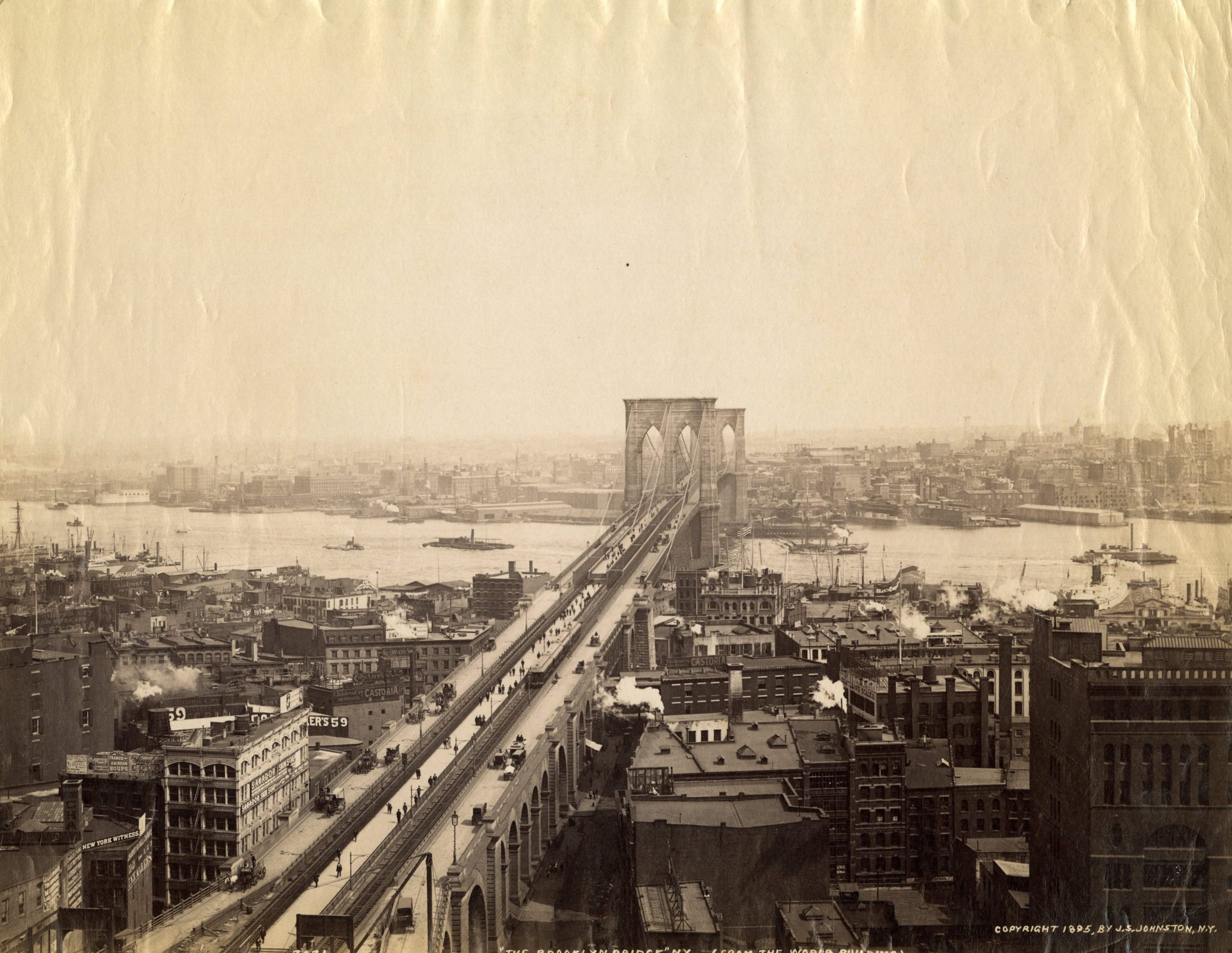
The Brooklyn Bridge seen from New York’s tallest building
JOHNSTON, JOHN S. The Brooklyn Bridge, from the World Building
New York, 1895
Albumen print, 10 x 13 ¼ in. Captioned in the negative “3034. ‘The Brooklyn Bridge’, N.Y. (from the World Building) Copyright 1895, By J.S. Johnston, N.Y.”
Taken from high in the World Building on Park Row, this view looks east across the Manhattan approach and along the full span of the Brooklyn Bridge toward the still-independent city of Brooklyn, whose consolidation with New York would come only in 1898.
The Brooklyn Bridge, designed by John Augustus Roebling and completed under the direction of his son Washington after the elder Roebling’s death, had opened on May 24, 1883, and in 1895 remained the only fixed crossing of the East River. Bridge-railway cars are visible on the center tracks, which at this date still carried the cable-powered service introduced in September 1883; horse-drawn vehicles use the outer roadways, while pedestrians move along the elevated promenade above. The river beyond is busy with steamships, sailing craft, and ferries.
The World Building itself, designed by George B. Post and completed in 1890, rose 309 feet to the top of its copper dome and was the tallest building in New York until 1894. Joseph Pulitzer, publisher of the New York World, maintained his private office in the dome, from which he could survey Newspaper Row and the bridge beyond. Standing immediately beside the Manhattan bridge approach, the building was demolished in 1955 to make way for its widening.
The photograph therefore joins two of the period’s great metropolitan emblems, the suspension bridge and the skyscraper, while also recording the infrastructural bond that was helping bind Manhattan and Brooklyn into a single modern city.
Very little is known about John S. Johnston (c. 1839-1899), and what is known tends toward the enigmatic. He was reportedly born in Ireland, lived alone at 464 West 166th Street, and operated a studio at 1,263 Broadway. Johnston specialized in what the New York Times called “scenic photography,” producing both a large body of carefully numbered views of New York City and an extensive record of maritime subjects, including most of the United States warships that served in the Spanish-American War and all of the international yacht races of the 1890s. His photographs appeared in periodicals like Outing Magazine and Forest and Stream. He was also a technical innovator: in 1886, Scientific American reported his patent for a plate reservoir camera that could feed and deposit sensitized plates automatically, designed for rapid, handheld use. In the fall of 1899, Johnston caught a severe cold while photographing the Columbia-Shamrock America’s Cup races and traveled to Niagara Falls to recover. He died there of apparent heart trouble on December 17th. According to the Times, “Mr. Johnston would not give his home address or the names of any friends in New York, even when he was told that his death was near.” His glass negatives are held by the New-York Historical Society; the Museum of the City of New York and the Library of Congress also hold extensive collections of his work.
$5,000