


“one of the most influential modern works of the history and philosophy of science”
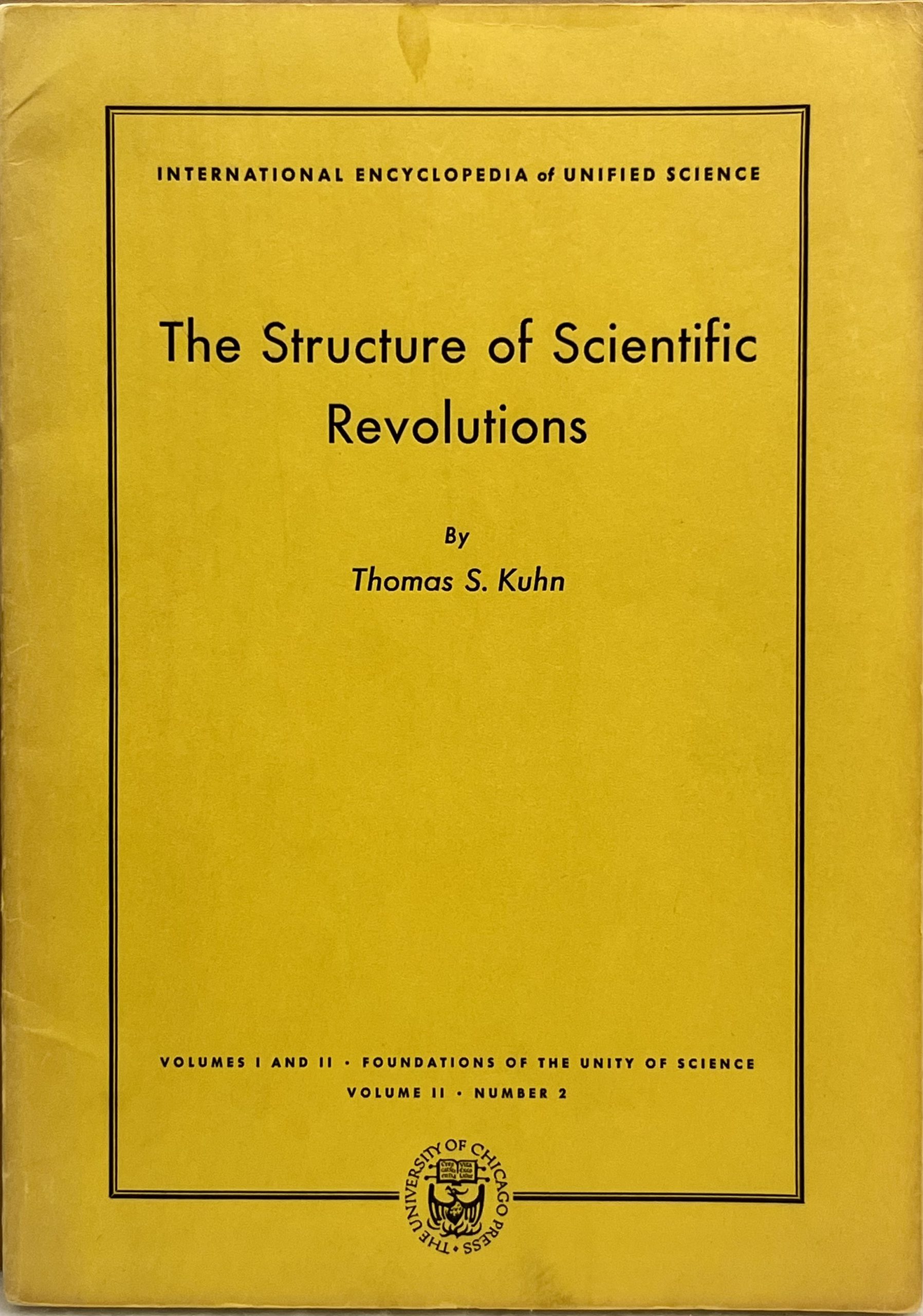
KUHN, THOMAS S. The Structure of Scientific Revolutions
Chicago and London: University of Chicago Press, (1962)
Original yellow paper wrappers (i.e. first issue). Light wear and soiling, tiny spot to upper wrapper. A very good copy.
FIRST EDITION of this landmark in the history of ideas, one of the most influential twentieth-century works in the history and philosophy of science. “One of the most influential books of the 20th century. … It singlehandedly changed the way we think about mankind’s most organized attempt to understand the world” (The Guardian).
“Thomas Kuhn was one of the most influential philosophers of science of the twentieth century, perhaps the most influential. His 1962 book The Structure of Scientific Revolutions is one of the most cited academic books of all time. Kuhn’s contribution to the philosophy of science marked not only a break with several key positivist doctrines, but also inaugurated a new style of philosophy of science that brought it closer to the history of science. His account of the development of science held that science enjoys periods of stable growth punctuated by revisionary revolutions” (Stanford Encyclopedia of Philosophy).
This work is the origin of the term “paradigm shift,” which has come to enter everyday language. Structure of Scientific Revolutions is “one of the most influential modern works of the history and philosophy of science. … Kuhn stresses that the history of science is not a smooth progressive accumulation of data and successful theory, but the outcome of ruptures, false starts, and imaginative constraints that themselves reflect many different variables. In his account, science during a normal period works within a framework of assumptions called a paradigm, but in exceptional and revolutionary periods an old paradigm breaks down and after a period of competition is replaced by a new one” (Oxford Philosophy).
Structure “punctured the widely held notion that scientific change was a strictly rational process … Kuhn’s treatise influenced not only scientists but also economists, historians, sociologists and philosophers, touching off considerable debate” (New York Times).
“Great books are rare. This is one” (Ian Hacking, leading philosopher of science).
Modern Library, 100 Non-fiction Books of the 20th Century.
$6,000