


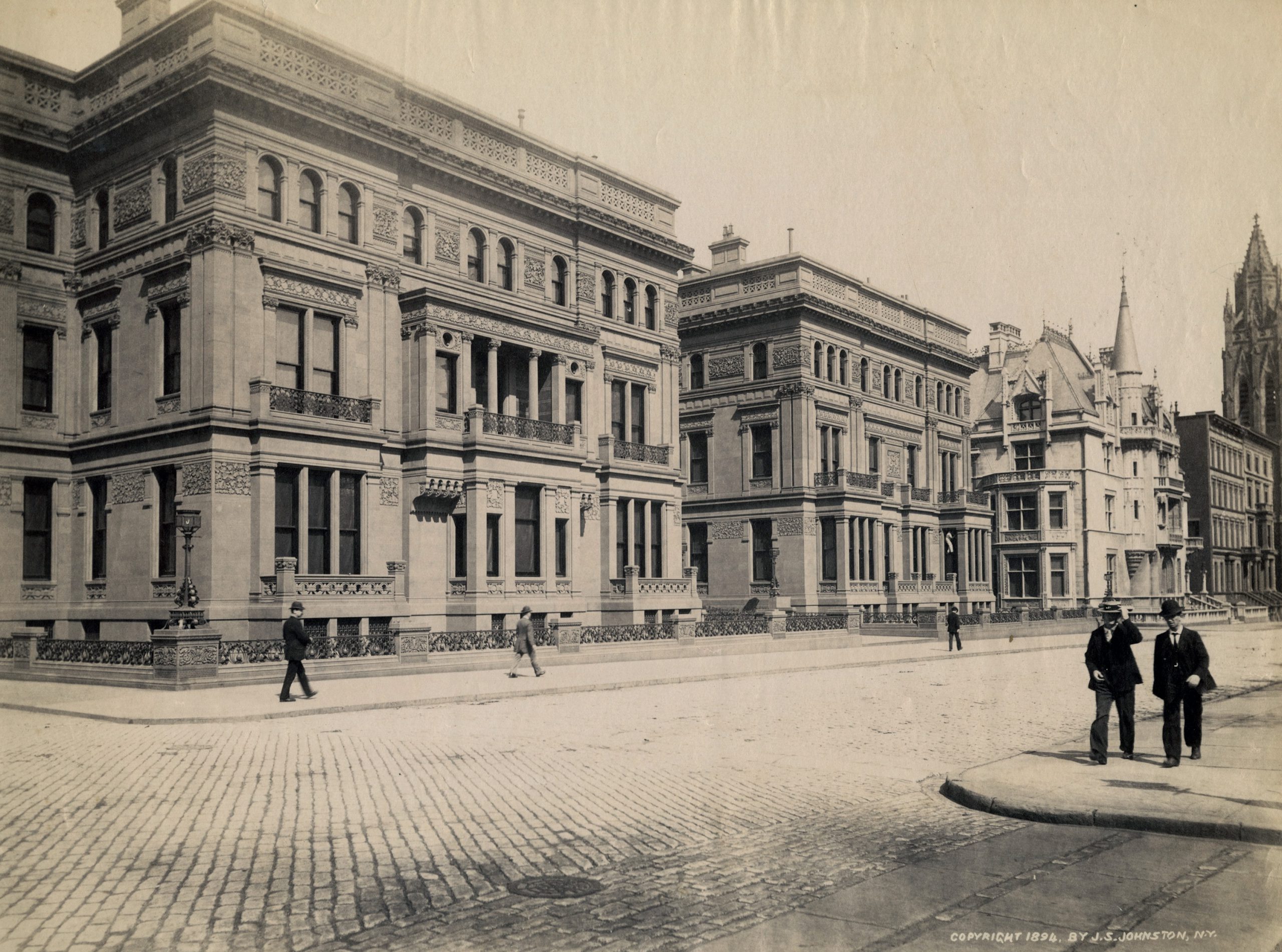
Vanderbilt Row
JOHNSTON, JOHN S. Vanderbilt Residences
New York, 1894
Albumen print, 10 x 13 in. Captioned in the negative “3008 ‘Vanderbilt Residences’ N.Y. Copyright 1894, BY J.S. Johnston, N.Y.” Archivally framed. A lovely print with excellent tones.
Famed residences from New York’s Gilded Age. By the early 1890s, the cluster of Vanderbilt family houses around 51st and 52nd Streets had given this stretch of Fifth Avenue the nickname “Vanderbilt Row.” This photograph looks north along the west side of Fifth Avenue from about 51st Street.
Dominating the left and center is the William Henry Vanderbilt House, usually called the “Triple Palace,” completed in 1882 and occupying the entire Fifth Avenue frontage of the block between 51st and 52nd Streets. Although J. B. Snook and Charles B. Atwood were associated with its design, the building’s authorship remained contested, since Herter Brothers later claimed a determining role in the project. The complex contained three residences: William Henry Vanderbilt’s own fifty-eight-room house at 640 Fifth Avenue in the southern section, and two units in the northern section for his daughters Emily (Mrs. William Douglas Sloane) and Margaret (Mrs. Elliott Fitch Shepard).
At right, with its steep slate roof and turret, is the William K. Vanderbilt House, known as the Petit Château, completed in 1882 to designs by Richard Morris Hunt for Vanderbilt’s son William Kissam and his wife Alva, at the northwest corner of 52nd Street and Fifth Avenue. Alva Vanderbilt’s costume ball of March 1883, held in the new house, is widely considered the event that secured the family’s place in New York society. At the far right rises the tower of St. Thomas Church at 53rd Street.
The photograph is historically significant as a record of Fifth Avenue at the height of its late nineteenth-century residential prestige, before commercial redevelopment transformed the district. None of the buildings shown survives. The Petit Château was sold in 1926 and demolished shortly thereafter; the northern section of the Triple Palace followed in 1927, and the southern section was razed between 1947 and 1949.
Very little is known about John S. Johnston (c. 1839-1899), and what is known tends toward the enigmatic. He was reportedly born in Ireland, lived alone at 464 West 166th Street, and operated a studio at 1,263 Broadway. Johnston specialized in what the New York Times called “scenic photography,” producing both a large body of carefully numbered views of New York City and an extensive record of maritime subjects, including most of the United States warships that served in the Spanish-American War and all of the international yacht races of the 1890s. His photographs appeared in periodicals like Outing Magazine and Forest and Stream. He was also a technical innovator: in 1886, Scientific American reported his patent for a plate reservoir camera that could feed and deposit sensitized plates automatically, designed for rapid, handheld use. In the fall of 1899, Johnston caught a severe cold while photographing the Columbia-Shamrock America’s Cup races and traveled to Niagara Falls to recover. He died there of apparent heart trouble on December 17th. According to the Times, “Mr. Johnston would not give his home address or the names of any friends in New York, even when he was told that his death was near.” His glass negatives are held by the New-York Historical Society; the Museum of the City of New York and the Library of Congress also hold extensive collections of his work.
$5,000